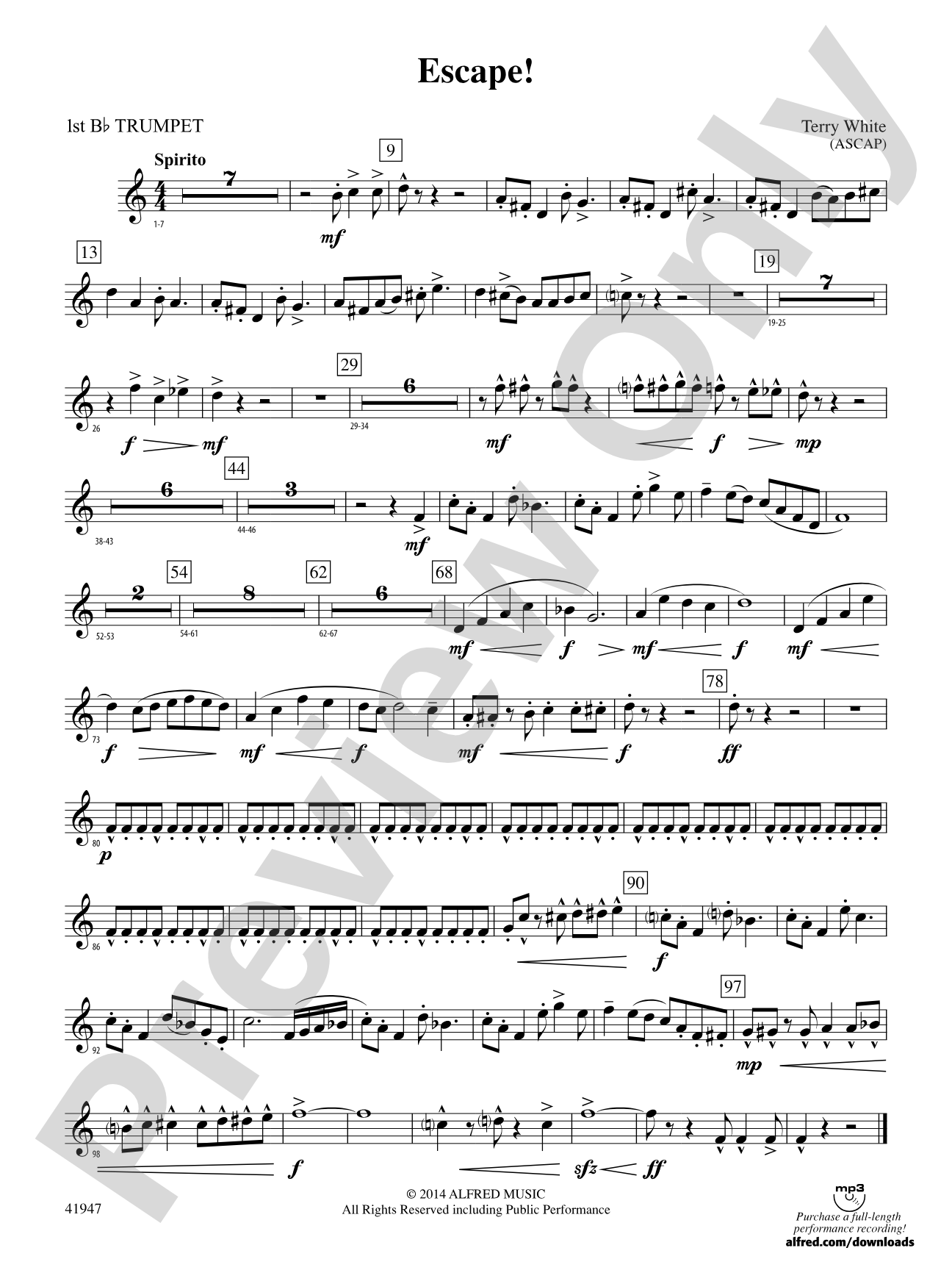
Escape!: 1st B-flat Trumpet Sheet Music Preview

Escape!: 1st B-flat Trumpet

By Terry White

Grade: 2 (Medium Easy)

Item: 00-PC-0016429_T1

Digital Download
$3.00
Description
Try to picture extracting yourself from a maze with someone closely in pursuit, darting here, there and everywhere as quickly as you could to find a way out of. "Fleet afoot" would be an appropriate way to describe how the music in this piece should be approached---played lightly and with a sense of direction leading to the next phrase or rhythmic pattern. This tuneful and rhythmic offering provides some delightful twists and turns along the way! (3:00) This title is available in MakeMusic Cloud.

Don't just read it, hear it, play along with it, and watch your students grow with it. In MakeMusic Cloud, Escape!: 1st B-flat Trumpet comes alive with professional accompaniment, adjustable tempo, and built-in practice tools that turn solo practice into real progress.

Sample Audio
0:00
0:00
Sample Video
Additional Details
Series: Young Symphonic
Publisher: Alfred Music
Page Count: 218
SKU: 00-PC-0016429_T1

More about this title

About the Composer: Terry White

Terry White

Terry White brings three decades of Maine classroom experience to his compositional voice, grounded in a dual background of composition training at Berklee College of Music and music education study at the University of New Hampshire. His works have earned recognition through commissions and performances by the Portland Symphony Orchestra and ensembles across secondary and higher education levels, while his leadership of a Portland-area big band demonstrates his deep engagement with both education and the contemporary performance world.

Why we love this

White captures the kinetic energy of pursuit and escape without resorting to bombast, instead layering rhythmic patterns and tonal direction that teach ensemble cohesion while keeping players engaged. The piece's "fleet afoot" character translates into genuine musical momentum for young players, making it equally effective as a concert closer or a festival selection where clarity of intent matters.

What to expect

The music hums with purposeful activity, darting and shifting like someone navigating a puzzle under pressure. There's a lightness to the orchestration that keeps the energy playful rather than frantic, with rhythmic hooks that lodge in players' minds and carry the sense of forward momentum from phrase to phrase.

Who it's for

Grade 2 concert bands seeking repertoire that combines musical substance with accessible technical demands. Ensembles new to managing layered rhythmic independence and ensemble balance will find genuine pedagogical value here, while the tuneful writing ensures that players stay invested in the musical narrative rather than fixating on mechanics.

How to get the most out of it

  • Conduct with a light, forward-moving gesture; resist the temptation to over-accent the rhythmic patterns, which are already clear in the orchestration and should breathe rather than stomp.
  • Balance the melodic lines across sections so that phrase direction remains obvious even as the music darts between instrumental groups; this prevents the piece from feeling scattered.
  • Shape the dynamic transitions through the twists and turns as genuine musical surprises rather than sudden jumps; the phrasing should feel like a conversation that pivots, not lurches.
  • Maintain articulation consistency within rhythmic figures across all parts to unify the sense of direction and purpose that defines this piece.

How to use it

Program this as a concert opener or closer depending on your needs; its compact three-minute length and immediate accessibility make it ideal for transitions, while its energetic character can anchor a program section. It also serves well in festival or contest settings where concise, clearly executed musicianship carries more weight than spectacle.

Skills your students will build

  • Maintaining rhythmic precision through layered, independent patterns across sections
  • Following phrase direction and stylistic intent ("fleet afoot") rather than mechanical execution
  • Balance and blend when melodic material moves rapidly between instrumental groups
  • Reading and executing clear dynamic and articulation markings that support musical architecture

You May Also Like