
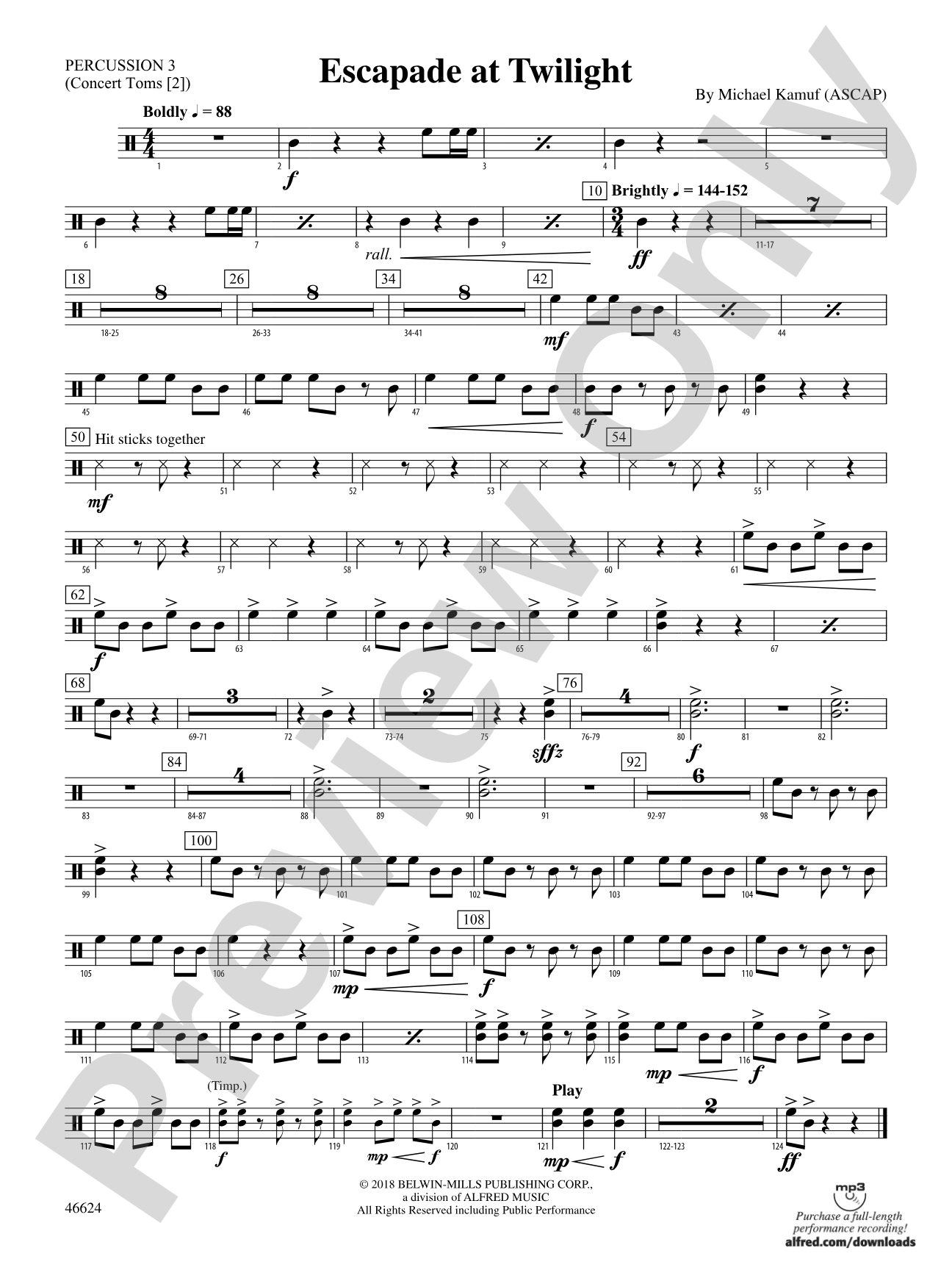

Escapade at Twilight: 3rd Percussion
By Michael Kamuf
Grade: 2 (Easy)
Item: 00-PC-0018058_PC3
$3.00
Pickup currently not available
Description
This exciting and bold original new work for developing bands contains lyrical themes, dissonant harmonies, and a sinister development section combined to create a musical story of a late night adventure that's gone . . . well, a little awry! Perfect as an opening or closing selection, your students will enjoy performing this work . . . but let's be careful out there!


Don't just read it, hear it, play along with it, and watch your students grow with it. In MakeMusic Cloud, Escapade at Twilight: 3rd Percussion comes alive with professional accompaniment, adjustable tempo, and built-in practice tools that turn solo practice into real progress.
Open in the Player
Jump straight in and assign it today.
Start Your Free Trial
Open this title and explore the full library in minutes.
Sample Audio
1
Audio File
--:--
0:00
0:00
Sample Video
Additional Details
Series:
Belwin Young Band
Publisher:
Alfred Music
Page Count:
264
SKU:
00-PC-0018058_PC3
More about this title
About the Composer: Michael Kamuf

Michael Kamuf earned Bachelor of Music degrees in Jazz Performance and Music Education from the Dana School of Music at Youngstown State University and a Master of Arts in Instrumental Conducting from George Mason University. His compositions and arrangements have been performed by ensembles including the Woody Herman and Glenn Miller Orchestras, the USAF Airmen of Note, and the US Navy Commodores, as well as by accomplished soloists such as James Moody, Eddie Daniels, and Sean Jones.
Kamuf spent three decades teaching instrumental music in Montgomery County Public Schools, Maryland, where he directed bands and orchestras at John T. Baker Middle School for twenty-seven years. Under his leadership, the Baker ensembles earned consistent festival recognition and commissioned multiple works for young concert bands. An exclusive writer for the Belwin Division of Alfred Music Publishing, Kamuf maintains an active catalog of over 100 published titles in jazz, orchestra, and concert band literature. He currently leads the Mike Kamuf Little Big Band, a jazz octet based in the Baltimore and Washington, DC region.
Why we love this
Kamuf brings genuine understanding of what developing bands can execute and enjoy. The shift from lyrical passages into unsettling harmonies and a sinister development section gives students real dramatic stakes to explore without overwhelming their technical capabilities; this kind of storytelling hooks young musicians and makes rehearsals feel purposeful rather than exercise-based.
What to expect
The music unfolds like a night adventure taking an unexpected turn. Graceful themes give way to unsettling harmonies and a genuinely sinister passage that's equal parts dramatic and fun. There's enough edge here to make students feel they're performing something with real substance.
Who it's for
Grade 2 concert bands seeking repertoire with genuine musical personality and narrative arc. Directors programming a concert that needs a strong opener or closer will find a piece that engages audiences while remaining accessible for developing players.
How to get the most out of it
- Shape the lyrical themes with long, connected phrasing in the early sections to establish contrast before the darker material emerges. Avoid letting these passages feel static or dull.
- Balance the dissonant harmonies carefully so they sound intentional rather than muddy. Intonation becomes a tool for creating tension, not a liability.
- Use the sinister development section as an opportunity to practice dynamic control and ensemble cohesion under pressure. Steady tempo and unified articulation will make this moment land.
How to use it
This works equally well as an opening number that establishes an adventurous mood or as a closing selection that leaves the audience with a memorable character piece. The Halloween connection offers natural programming opportunities, though the composition stands on its own year-round for festivals or concerts where you want a piece with storytelling appeal.
Skills your students will build
- Phrasing longer lyrical lines with direction and shape
- Balancing intonation in dissonant harmonic contexts
- Maintaining ensemble cohesion during rapid dramatic shifts
- Dynamic control and articulation clarity in contrasting sections