
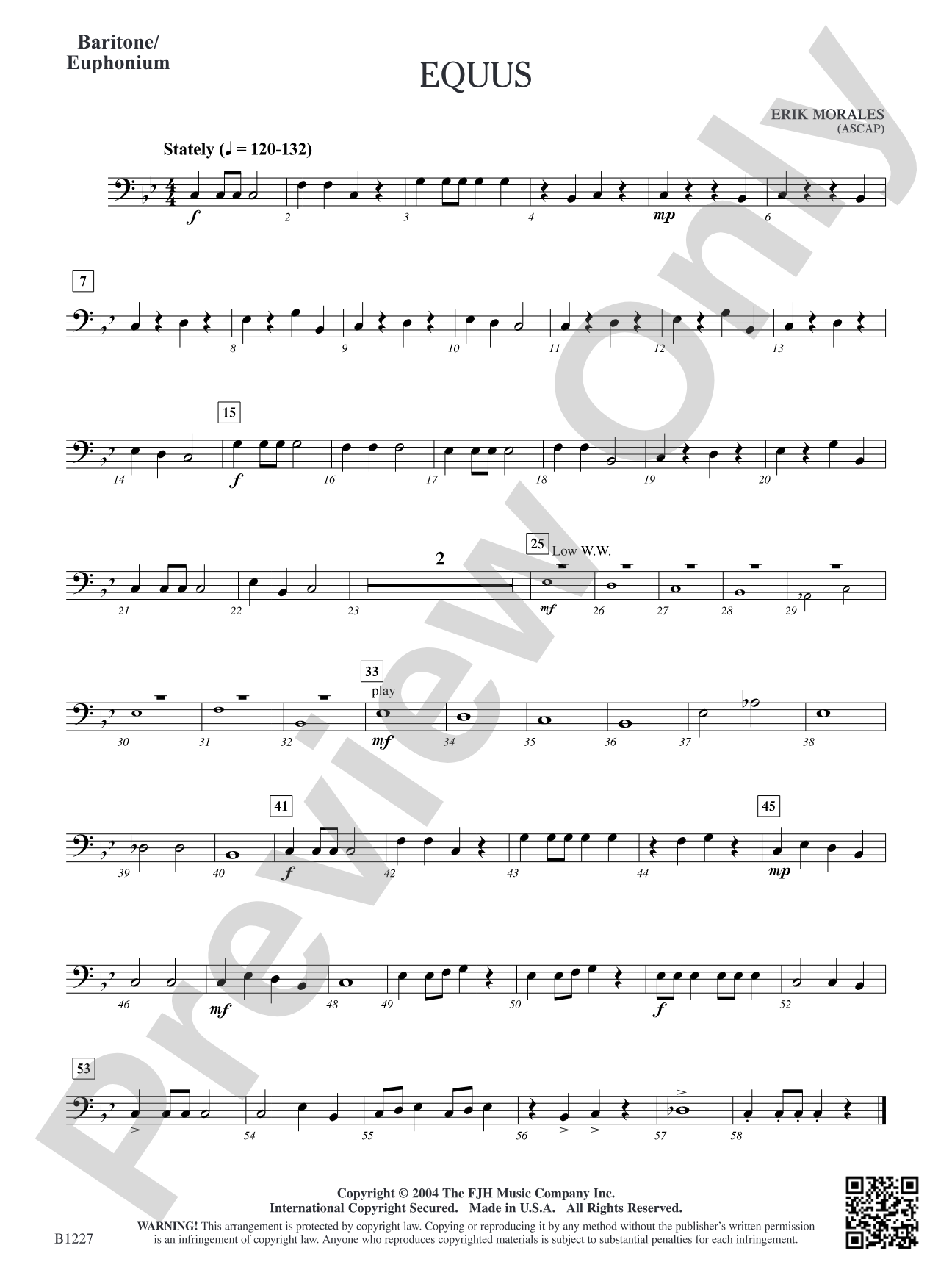

Equus: Baritone/Euphonium
By Erik Morales
Grade: 1
Item: 98-PC-DB1227_BBC1
$7.00
Pickup currently not available
Description
Equus, Latin for "horse," takes us on a thrilling ride on one of these magnificent animals. Wood blocks help create the sound of the horse as the ensemble comes along for the ride. A serene section at the same tempo almost seems to slow the ride down, so listeners can take the time to appreciate the scenery around them. The opening material then returns as the piece comes to a strong conclusion.


Equus: Baritone/Euphonium isn't in MakeMusic Cloud just yet...but it could be. Let us know you'd like to see it, and you'll help shape what comes next. In the meantime, start a free trial and dive into thousands of interactive titles your students can play along with today.
Request This Title
Tell us you want it.
Start Your Free Trial
Explore everything that's ready to play right now.
Sample Audio
1
Audio File
--:--
0:00
0:00
Sample Video
No sample videos found.
Additional Details
Series:
FJH Beginning Band
Publisher:
The FJH Music Company, Inc.
SKU:
98-PC-DB1227_BBC1
More about this title
About the Composer: Erik Morales

Erik Morales brings a distinctive melodic sensibility to educational and professional music across multiple genres. Born in New York City in 1966, he studied composition at Florida International University and earned his bachelor's degree from the University of Louisiana, Lafayette in 1989. His composing career began immediately after high school when a former band director commissioned arrangements for marching band, a role that launched his extensive involvement with educational publishing. Since 2002, his works for wind, jazz, string, and chamber ensembles have circulated worldwide.
With trumpet as his primary instrument, Morales has made significant contributions to the trumpet repertoire. His trumpet ensembles earned first place at the 2006 and 2008 National Trumpet Competitions, and his Concerto for Trumpet in C and Piano premiered at the 2009 International Trumpet Guild conference. A consortium commission resulted in his Concerto for Two Trumpets, premiered at the 2013 ITG conference. He was inducted into the Louisiana Association for Jazz Education's Hall of Fame in 2016. Today, over 150 of his publications span wind, orchestral, jazz, and chamber settings, with an intentional focus on balancing artistic integrity with pedagogical accessibility.
Why we love this
Grade 1 literature rarely captures imagination quite like this. The programmatic concept of a horse ride unfolds naturally without oversimplifying the ensemble writing, and the wood block color palette adds character that students actually hear and care about. It's the kind of piece that holds young musicians' attention through performance and makes audiences lean in.
What to expect
The gallop of hoofbeats frames a brief journey, complete with moments of stillness that invite reflection before the ride accelerates again. The texture is bright and accessible without losing musical substance, making it feel like an adventure rather than an exercise.
Who it's for
Grade 1 bands beginning to explore programmatic and colorful concert repertoire. Players at this level benefit from the clear melodic writing and straightforward rhythmic demands, while directors gain a piece that engages students through storytelling and introduces effective use of percussion color.
How to get the most out of it
- Establish a clear rhythmic pulse before rehearsal begins; wood blocks need a rock-solid foundation from the percussion section to sound effective.
- Balance the ensemble so the wood block pattern reads clearly over the harmonic and melodic material rather than competing with it.
- Let the serene middle section breathe at the same tempo. Resist the urge to slow down; the contrast comes from orchestration and melodic gesture, not a tempo change.
- Shape the return of opening material as the climax. Build intensity gradually through dynamics and articulation to earn the strong conclusion.
How to use it
This works beautifully early in a concert to engage audiences and set an energetic tone, or as part of a thematic concert featuring animal or nature-inspired works. At Grade 1, it's an ideal vehicle for introducing students to contest and festival performance in a piece with genuine musical appeal.
Skills your students will build
- Maintaining steady tempo while responding to percussion colors and orchestration changes
- Balancing individual parts within a Grade 1 ensemble texture
- Articulation control in repeated rhythmic patterns (wood block figures)
- Dynamic shaping across a multi-section form
- Listening to ensemble sound rather than focusing solely on individual part accuracy