
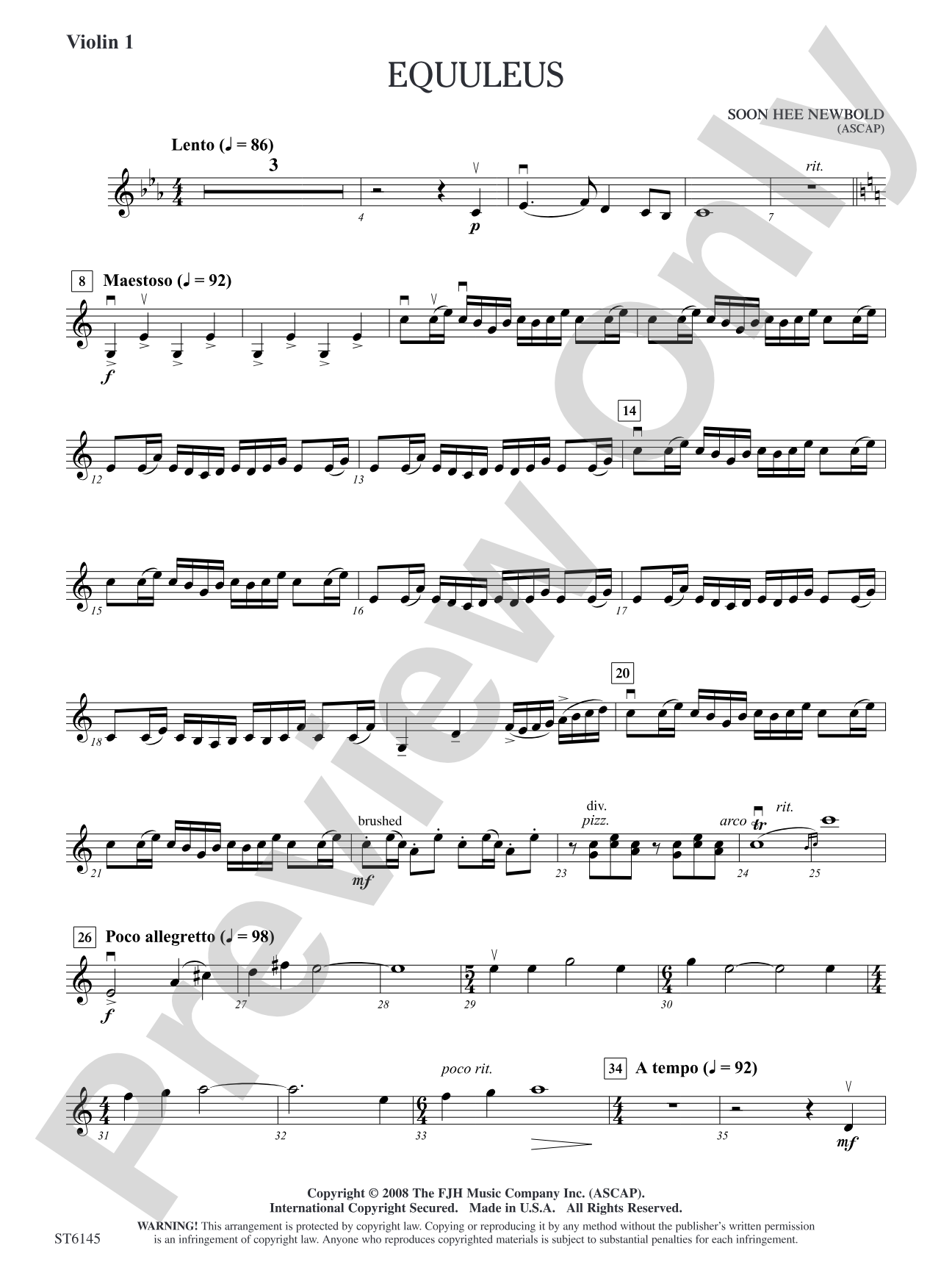

Equuleus: Violin 1
By Soon Hee Newbold
Grade: 3.5
Item: 98-PC-DST6145_VN1
$7.00
Pickup currently not available
Description
Based on the small constellation Equuleus ("The Foal" or "Little Horse"), this rich symphonic work celebrates the life of a student originally from Poland who loved horses and had dreams of joining the air force. From riding horseback through the Polish landscape to flying over the beautiful Tatra Mountains onward to the stars, this moving work will take you on a thrilling and emotional journey.


Equuleus: Violin 1 isn't in MakeMusic Cloud just yet...but it could be. Let us know you'd like to see it, and you'll help shape what comes next. In the meantime, start a free trial and dive into thousands of interactive titles your students can play along with today.
Request This Title
Tell us you want it.
Start Your Free Trial
Explore everything that's ready to play right now.
Sample Audio
1
Audio File
--:--
0:00
0:00
Sample Video
No sample videos found.
Additional Details
Series:
FJH String Orchestra
Publisher:
The FJH Music Company, Inc.
SKU:
98-PC-DST6145_VN1
More about this title
About the Composer: Soon Hee Newbold

Soon Hee Newbold's compositional voice draws from a life spent crossing continents and cultures. A pianist from age five and violinist from seven, she performed as a concert artist in professional ensembles worldwide before establishing herself as a composer whose works span all performance levels, from elementary ensembles to professional orchestras. Her music has graced Carnegie Hall, the Kennedy Center, Lincoln Center, and Disney Hall, among many others.
Newbold's approach to composition weaves cultural and ethnic influences throughout her writing, informed by her extensive travels and collaborations across the United States, Europe, Asia, and Australia. Beyond concert music, she has composed for film and recording projects in Hollywood. As a sought-after guest clinician and keynote speaker, she brings her perspective on culturally conscious composition directly to educators and students at major conferences and festivals worldwide.
Why we love this
Newbold writes with genuine respect for student orchestras, crafting music that challenges without overwhelming. The biographical narrative woven through the score gives your students something concrete to conduct and perform about, transforming a technical exercise into storytelling. At Grade 3.5, the orchestration sits in that sweet spot where intermediate players feel capable while the harmonic language and musical arc never patronize them.
What to expect
Equuleus unfolds like a journey painted in orchestral color. The music captures the freedom and longing of riding across Polish landscape, then soars into the exhilaration of flight over mountain peaks and into open sky. Rich harmonic layers and strategic moments of sparseness create emotional peaks and valleys, leaving both players and listeners moved by the arc from earth-bound dreams to celestial wonder.
Who it's for
String orchestras at the Grade 3.5 level who are ready for programmatic storytelling and want a contest or festival piece with genuine emotional substance. This work suits ensembles whose players have developed secure intonation and can navigate divided sections; it also works well for directors seeking music that honors both a student's memory and their musicians' growing capabilities.
How to get the most out of it
- Shape the arc in large phrases rather than measure-to-measure. This work traces an emotional journey from earth to sky, so conductors should map the big structural movements before rehearsing details.
- Let the programmatic content guide your tempo choices. Each section reflects a different moment in the character's life, so transitions between riding, flying, and stargazing warrant distinct tempos and textures.
- Balance the string sections carefully in passages where the upper and lower voices carry independent melodic ideas simultaneously. Equuleus depends on listeners hearing multiple narrative threads at once.
- Take time in early rehearsals to share the program note with your orchestra. Students who understand they're depicting a real person's dreams will invest more emotionally in their own part-playing.
How to use it
Program this as a centerpiece in a concert exploring music inspired by landscape, nature, or personal stories. Its Grade 3.5 level allows it to anchor a program alongside other intermediate contest pieces without requiring a full advanced orchestra. The work also serves exceptionally well as a festival or competition selection where judges appreciate both technical competence and genuine musical vision.
Skills your students will build
- Conducting and performing programmatic narratives through tempo, dynamics, and phrasing
- Balancing independent melodic lines in divided string sections
- Sustaining musical focus across longer formal structures with multiple movements
- Responding to harmonic language that moves beyond diatonic progressions
- Collaborating as an ensemble to shape climactic moments and emotional arcs