
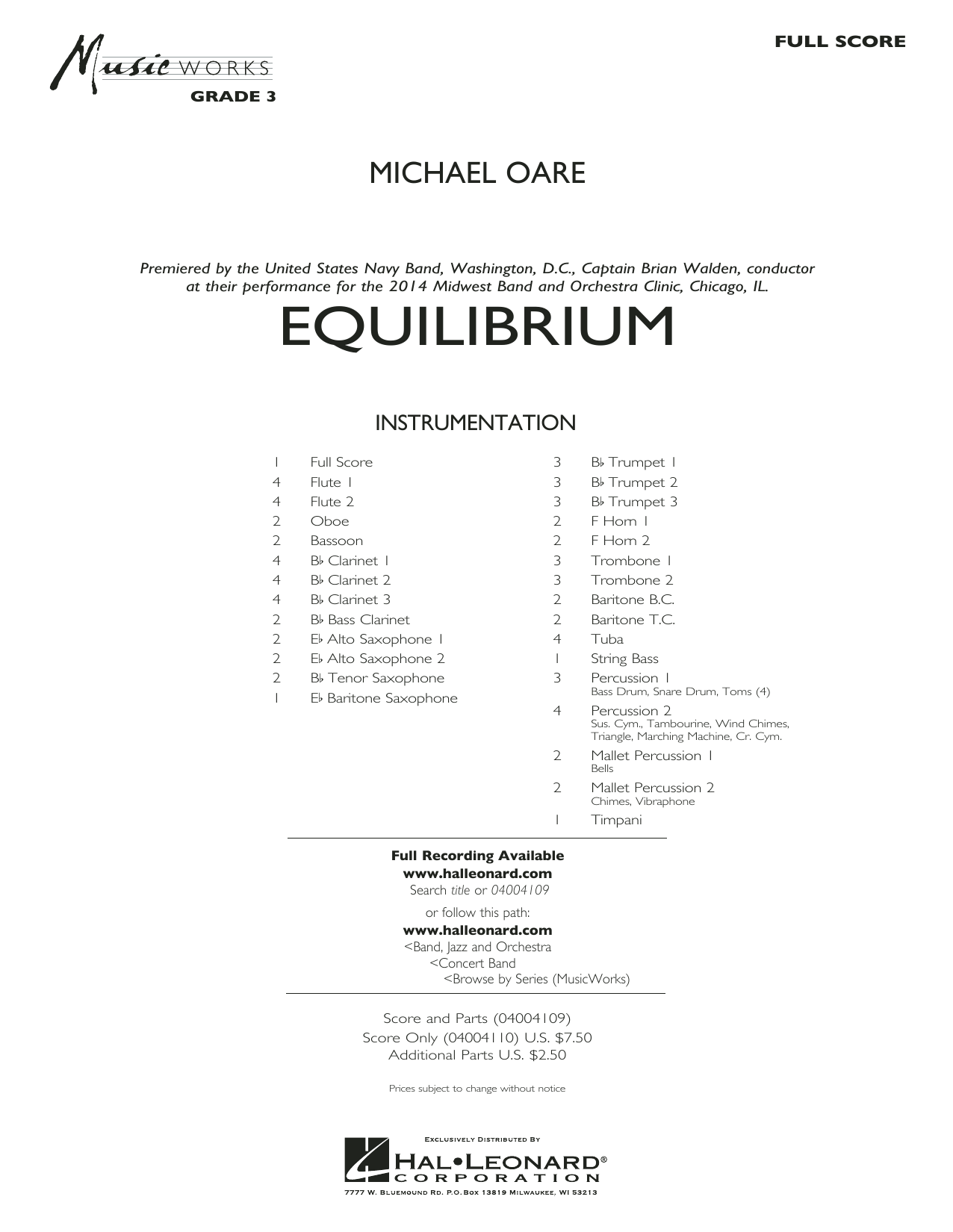

Equilibrium: Concert Band Conductor Score & Parts
By Michael Oare
Grade: 3
Item: 35-PK00306615
$75.00
Pickup currently not available
Buy Extra Parts (Digital PDF Download)
| Product | Price | Quantity |
|---|---|---|
| Equilibrium - Conductor Score (Full Score) | $10.00 | |
| Equilibrium - Flute 1 | $6.00 | |
| Equilibrium - Flute 2 | $6.00 | |
| Equilibrium - Oboe | $6.00 | |
| Equilibrium - Bassoon | $6.00 | |
| Equilibrium - Bb Clarinet 1 | $6.00 | |
| Equilibrium - Bb Clarinet 2 | $6.00 | |
| Equilibrium - Bb Clarinet 3 | $6.00 | |
| Equilibrium - Bb Bass Clarinet | $6.00 | |
| Equilibrium - Eb Alto Saxophone 1 | $6.00 | |
| Equilibrium - Eb Alto Saxophone 2 | $6.00 | |
| Equilibrium - Bb Tenor Saxophone | $6.00 | |
| Equilibrium - Eb Baritone Saxophone | $6.00 | |
| Equilibrium - Bb Trumpet 1 | $6.00 | |
| Equilibrium - Bb Trumpet 2 | $6.00 | |
| Equilibrium - Bb Trumpet 3 | $6.00 | |
| Equilibrium - F Horn 1 | $6.00 | |
| Equilibrium - F Horn 2 | $6.00 | |
| Equilibrium - Trombone 1 | $6.00 | |
| Equilibrium - Trombone 2 | $6.00 | |
| Equilibrium - Baritone B.C. | $6.00 | |
| Equilibrium - Baritone T.C. | $6.00 | |
| Equilibrium - Tuba | $6.00 | |
| Equilibrium - String Bass | $6.00 | |
| Equilibrium - Percussion 1 | $6.00 | |
| Equilibrium - Percussion 2 | $6.00 | |
| Equilibrium - Mallet Percussion 1 | $6.00 | |
| Equilibrium - Mallet Percussion 2 | $6.00 | |
| Equilibrium - Timpani | $6.00 |
Parts Added to Cart!
Description
Propelled throughout by a constant driving pulse, Michael Oare's exciting work pits opposing elements of harmony and rhythm against each other, portraying a sense of musical equilibrium. Creative interplay between winds and percussion, along with shifting meters and changing textures, adds to the effectiveness of this unique piece commissioned by the U.S Navy Band for their performance at the 2014 Midwest Clinic in Chicago, Illinois.
Dur: 4:00


Discover MakeMusic Cloud: thousands of interactive titles your students can play along with today.
Sample Audio
No sample audio found.
Sample Video
Additional Details
Publisher:
Hal Leonard
SKU:
35-PK00306615
More about this title
About the Composer: Michael Oare

Michael Oare trained in composition and music education at Old Dominian University and has spent decades shaping young musicians as both educator and composer. His three-decade tenure directing bands at Great Bridge Middle School in Chesapeake, Virginia, yielded an extraordinary track record: 32 consecutive years of superior ratings on state assessments, performances at state conferences, and a body of compositions that have become repertoire standards for developing ensembles.
Oare's work appears in the prestigious Teaching Music Through Performance series published by GIA, a distinction earned by only the most pedagogically sound compositions. Beyond the classroom, he conducts the Bay Youth Orchestras of Virginia Concert Band, serves as an adjudicator, and maintains active involvement with state and national music organizations. His recognitions include the 2016 Chesapeake Public Schools Middle School Teacher of the Year award and multiple Citations of Excellence from the National Band Association.
Why we love this
Oare understood what makes Grade 3 bands tick when he composed Equilibrium for the U.S. Navy Band's Midwest Clinic premiere. The writing balances genuine musical substance with accessibility, creating a piece that demands focused ensemble work without overwhelming developing musicians. A constant pulse locks the rhythm section, but shifting meters and wind-percussion dialogue keep players engaged with something that feels genuinely compositional rather than formulaic.
What to expect
Propulsive and purposeful, like watching opposing forces find temporary equilibrium. The constant forward motion creates energy, while the shifting weights between harmony and rhythm prevent the piece from ever feeling static or predictable.
Who it's for
Grade 3 concert bands ready to tackle metric modulation and sectional interplay without needing material for raw beginners. Directors seeking a four-minute work that programs well alongside traditional festival fare, bringing contemporary compositional thinking to the podium.
How to get the most out of it
- Anchor the pulse early in rehearsals by having the entire section lock onto the driving rhythmic foundation before layering harmonic material; this becomes the grid against which all other elements operate.
- Bring out the opposing harmonic and rhythmic ideas through deliberate sectional balancing rather than trying to obscure the compositional concept. If listeners hear the tension between elements, the piece works.
- Shape the texture changes as deliberate shifts in density, not just dynamic adjustments. When material redistributes between winds and percussion, conduct it as a conversation that passes focus from one color to another.
- Experiment with the meter shifts in isolated sections first, drilling them as rhythm patterns before students worry about pitch, since the compositional argument depends on rhythmic clarity.
How to use it
This works exceptionally well as a concert opener or closer, using its distinct character and driving momentum to mark a structural moment in your program. The four-minute duration makes it ideal for festival configurations or shorter concert slots where impact matters more than length.
Skills your students will build
- Reading mixed meters and maintaining pulse during meter changes
- Balancing sectional independence while serving ensemble cohesion
- Responding to texture redistribution between wind and percussion families
- Sustaining focus through repetitive rhythmic material while tracking harmonic change
- Executing rhythmic precision that serves the compositional argument rather than just counting beats