
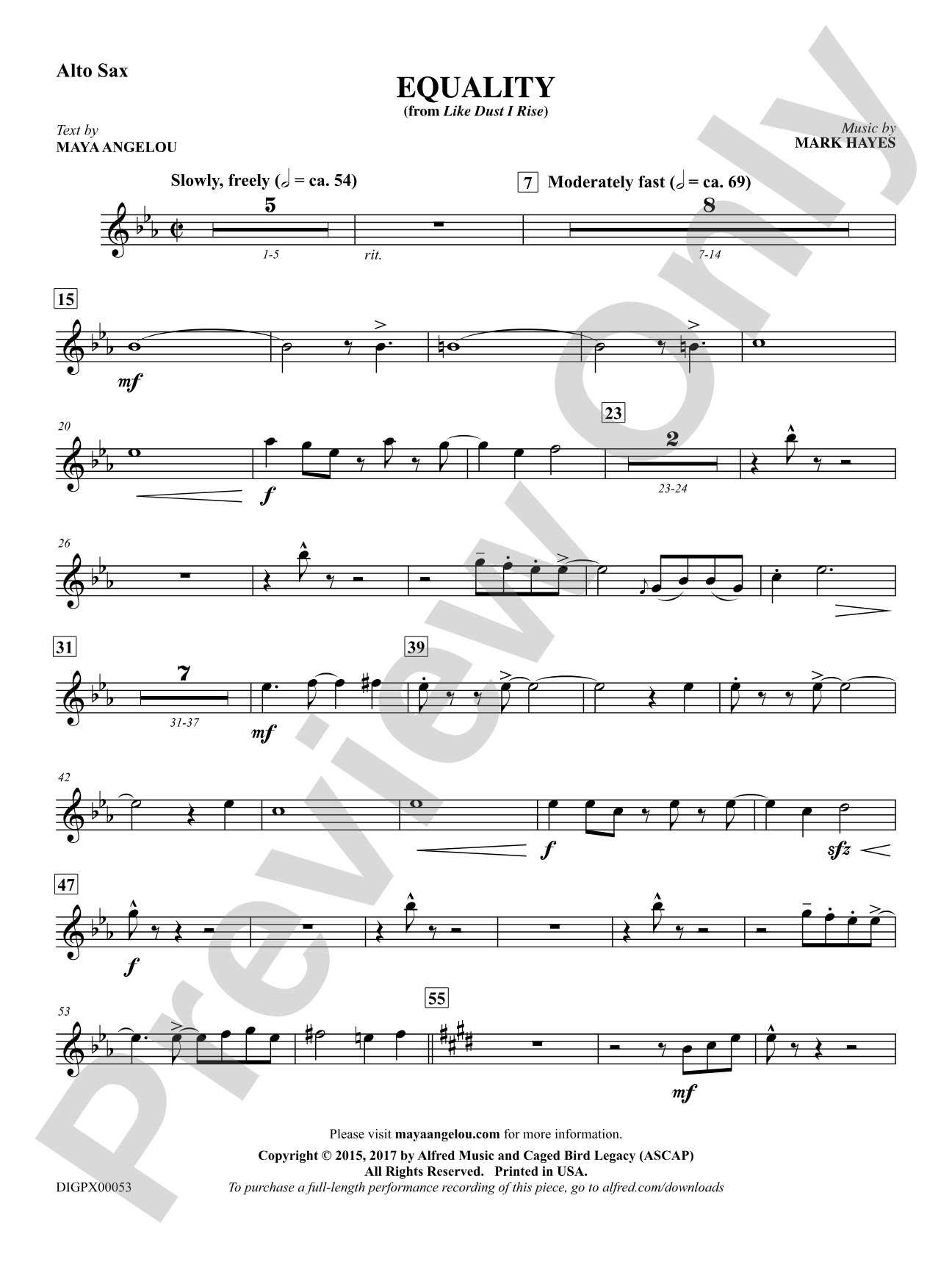

Equality: E-flat Alto Saxophone
From Like Dust I Rise (A Choral Song Cycle)
Text by Maya Angelou, music by Mark Hayes
Item: 00-PC-0017787_AX1
$3.00
Pickup currently not available
Description
This contemporary gospel-style rouser denounces oppression and serves as a choral anthem for equal rights. A confident solo voice helps deliver a determined message in the unwavering words of Maya Angelou. If performing as a set, an alternate ending segues directly into the closing movement of "Like Dust I Rise." When performing separately, Mark Hayes includes an upward modulation that propels us to the final, most spirited refrain.


Don't just read it, hear it, play along with it, and watch your students grow with it. In MakeMusic Cloud, Equality: E-flat Alto Saxophone comes alive with professional accompaniment, adjustable tempo, and built-in practice tools that turn solo practice into real progress.
Open in the Player
Jump straight in and assign it today.
Start Your Free Trial
Open this title and explore the full library in minutes.
Sample Audio
No sample audio found.
Sample Video
No sample videos found.
Additional Details
Series:
Alfred Choral Designs
Publisher:
Alfred Music
Page Count:
52
SKU:
00-PC-0017787_AX1
Instrumentation:
SoundPax
More about this title
About the Composer: Mark Hayes
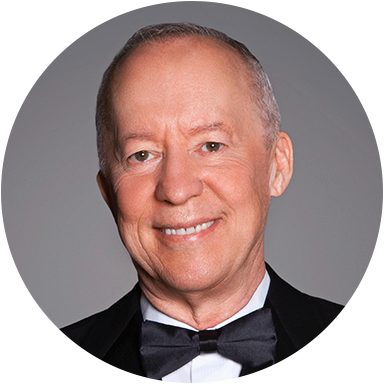
Mark Hayes has established himself as one of the most prolific composers in contemporary choral and piano music, with over 1,750 published works spanning sacred and secular genres. A summa cum laude graduate in Piano Performance from Baylor University (1975), he has conducted major ensembles at Lincoln Center, the National Cathedral, and Carnegie Hall, and his large-scale works including the Requiem, Te Deum, and Magnificat have received performances across the globe. In 2010, Baylor University recognized his contributions with the Award for Exemplary Leadership in Christian Music.
Beyond choral composition, Hayes is an accomplished orchestrator, record producer, and passionate advocate for piano music, with over 100 piano books in print covering classical, gospel, jazz, and Broadway styles. He has written for musical theater, composed commemorative works for major institutions, and continues to create music grounded in his mission to craft beautiful works for audiences worldwide.
Why we love this
Mark Hayes captures the power of Maya Angelou's words without sentimentality, using a contemporary gospel idiom that energizes choirs while respecting the gravity of the message. The solo voice creates an intimate counterpoint to the ensemble, giving singers a focal point for emotional delivery rather than simply unison proclamation. The modulation design shows Hayes's sophisticated understanding of how to build momentum toward a final statement that feels earned rather than imposed.
What to expect
The opening carries urgency and determination, building through accumulated voices and harmonic support rather than driving force alone. As the solo voice emerges, there is an intimacy that draws the listener into personal conviction, before the ensemble gathers strength for the final statement. The modulation at the end propels toward resolution with the sense of a movement that cannot be stopped, leaving singers and listeners alike in a state of collective affirmation.
Who it's for
Choirs seeking repertoire that addresses social justice with musical substance rather than didacticism. Intermediate to advanced ensembles will find the blend of gospel idiom, ensemble writing, and solo role fully rewarding. Directors programming contemporary music alongside classical or spiritual literature will value this as a work that stands on its own artistic merit while speaking directly to ensemble and audience.
How to get the most out of it
- Balance the solo voice clearly without overshadowing the choir; the solo is a guide, not a soloist performing over accompaniment. Rehearse the solo part first with full ensemble sound to establish the relationship.
- Shape the text rhythmically as speech first, then add harmonic weight. Gospel-style phrasing often lags slightly behind the beat on affirmations, so conduct with flexibility through the refrain.
- Use the recorded accompaniment to lock sectional entrances and to guide the placement of the final modulation, which requires precise ensemble response.
- Emphasize the upward key change as a moment of collective resolve rather than merely volume. Each section should feel the shift as a renewed commitment to the message.
How to use it
Program this as a closing anthem for a concert centered on themes of justice, resilience, or human rights. Its length and emotional weight make it ideal as the final substantial work before a brief closing number, or as the finale itself. If performing the companion piece "Like Dust I Rise," use the alternate ending to create a seamless two-work statement that deepens the impact of both movements.
Skills your students will build
- Singing gospel-inflected rhythms and phrasing within ensemble contexts
- Balancing solo and choral voices with mutual support
- Responding to key modulation as a textual and emotional tool
- Interpreting poetic text with conviction and clarity
- Sustaining ensemble focus through building dynamics and harmonic complexity