
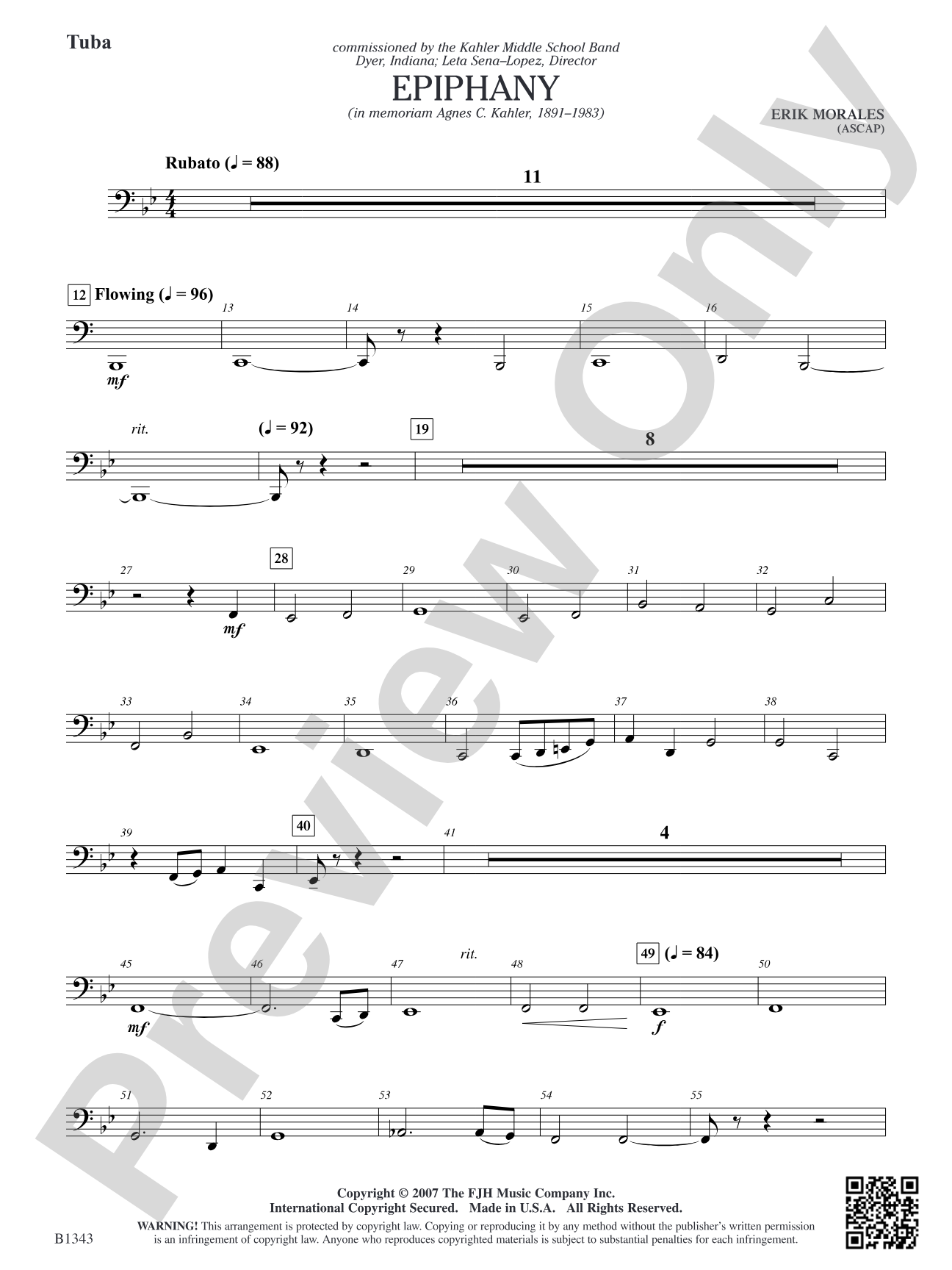

Epiphany: Tuba
By Erik Morales
Grade: 2.5
Item: 98-PC-DB1343_TB1
$7.00
Pickup currently not available
Description
This sensitive contemporary work was written in memory of a former teacher at a middle school that is now thought to be haunted. Crystal glasses help set the ethereal mood as the theme is developed and ultimately juxtaposed with two other themes presented later in the work. Extremely musical and emotional, yet approachable by younger bands. This is serious literature.


Don't just read it, hear it, play along with it, and watch your students grow with it. In MakeMusic Cloud, Epiphany: Tuba comes alive with professional accompaniment, adjustable tempo, and built-in practice tools that turn solo practice into real progress.
Open in the Player
Jump straight in and assign it today.
Start Your Free Trial
Open this title and explore the full library in minutes.
Sample Audio
1
Audio File
--:--
0:00
0:00
Sample Video
No sample videos found.
Additional Details
Series:
FJH Young Band
Publisher:
The FJH Music Company, Inc.
SKU:
98-PC-DB1343_TB1
More about this title
About the Composer: Erik Morales

Erik Morales was born in New York City on December 10, 1966, and began composing as a teenager when his high school band director asked him to arrange music for the marching ensemble in 1985. He earned his bachelor's degree from the University of Louisiana, Lafayette in 1989, and later studied composition at Florida International University. Since 2002, his works have been published and performed worldwide across wind, orchestral, jazz, and chamber settings.
With over 150 publications to his name, Morales has become known for finding the balance between artistic integrity and pedagogical accessibility. His trumpet works have earned particular recognition, including first-place awards at the 2006 and 2008 National Trumpet Competitions and premieres at major conferences including the International Trumpet Guild. Schools and organizations across the country regularly commission new works from him, and in 2016 he was inducted into the Louisiana Association for Jazz Education's Hall of Fame.
Why we love this
Morales writes with genuine compassion for student musicians, and this piece proves it. The emotional core is real and substantial, yet the Grade 2.5 scoring never talks down to your ensemble; instead, it gives younger players access to serious literature that moves audiences. The unconventional use of crystal glasses creates an immediate sonic signature that captures attention without requiring extended technique.
What to expect
The opening unfolds like remembrance, with crystalline sounds suggesting something precious and fragile. As the primary theme emerges, the mood becomes contemplative and genuinely moving, then gradually darkens and complexifies when the additional themes arrive. The overall arc honors seriousness while remaining approachable.
Who it's for
This work reaches Grade 2.5 bands that are ready for emotional maturity beyond their technical level. Young ensembles preparing for festival or contest, or any band looking to program substantial literature that challenges musicians' musicianship without frustrating their technique, will find this accessible and rewarding.
How to get the most out of it
- Let the initial crystal glass passages establish the ethereal foundation without rushing. The texture sets the entire emotional premise, so give it space and clarity in rehearsal before layering the band underneath.
- Shape the thematic development with long-line phrasing rather than phrase-by-phrase attacks. Young musicians often default to sectional thinking; guide them toward hearing the arc that connects all three themes across the work.
- Balance transparency with fullness when the themes interact. The juxtaposition is only effective if audiences hear each melodic idea distinctly, which means watching dynamic relationships across different sections simultaneously.
How to use it
Program this at festival or contest when you want your young band to represent your group's depth of musicianship rather than technical flashiness. It also works beautifully on a concert paired with lighter, more energetic pieces, where it can serve as the emotional centerpiece that reminds audiences why you do this work.
Skills your students will build
- Sustaining long melodic lines across multiple phrases
- Responding to emotional and textural cues in contemporary music
- Balancing ensemble transparency with fullness
- Listening to thematic relationships and development across an entire work
- Interpreting unconventional instruments and timbral effects (crystal glasses)