
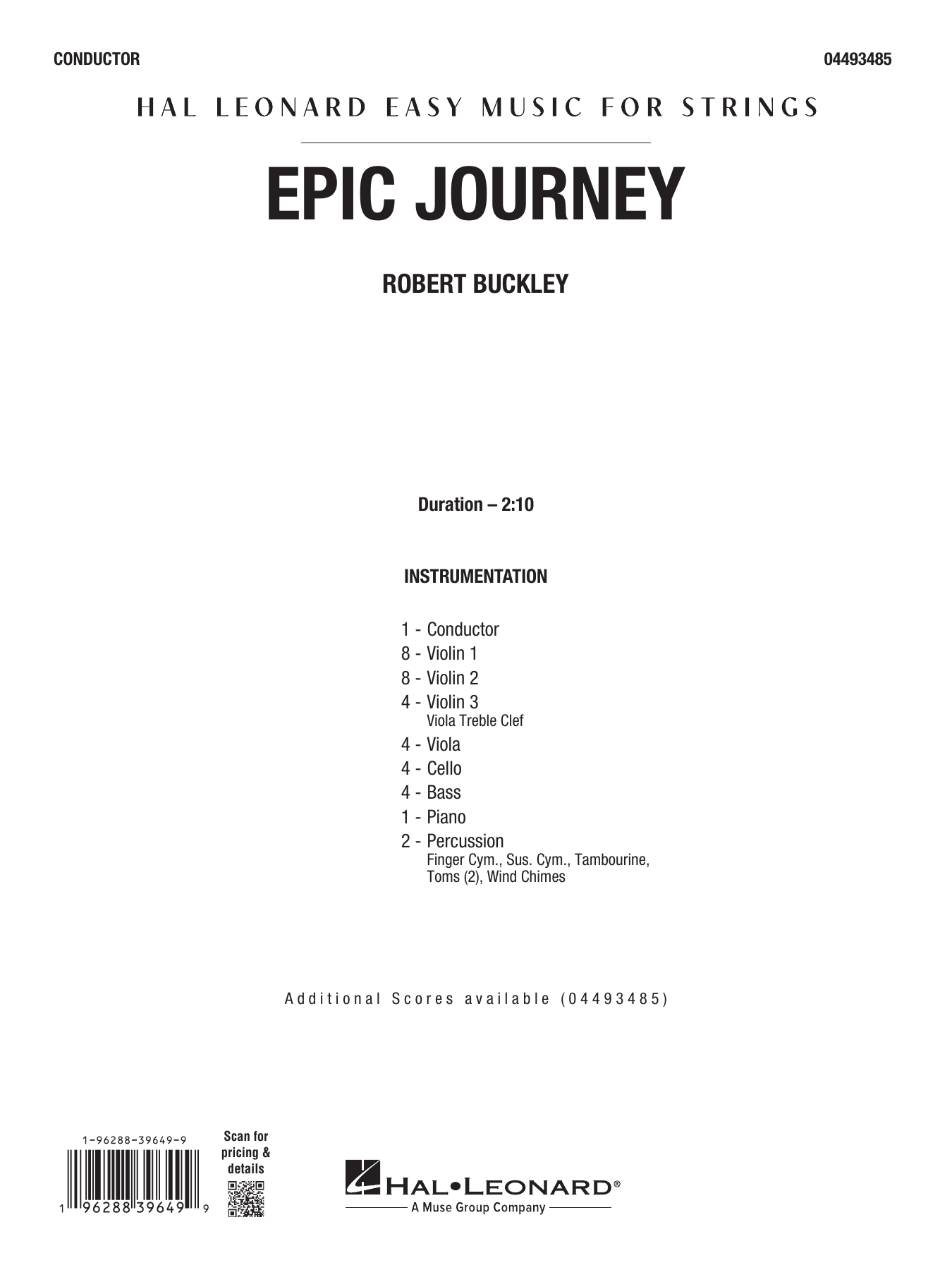

Epic Journey: String Orchestra Conductor Score & Parts
By Robert Buckley
Grade: 2
Item: 35-PK01919473
$45.00
Pickup currently not available
Buy Extra Parts (Digital PDF Download)
| Product | Price | Quantity |
|---|---|---|
| Epic Journey - Conductor Score (Full Score) | $7.50 | |
| Epic Journey - Violin 1 | $7.00 | |
| Epic Journey - Violin 2 | $7.00 | |
| Epic Journey - Violin 3 (Viola Treble Clef) | $7.00 | |
| Epic Journey - Viola | $7.00 | |
| Epic Journey - Cello | $7.00 | |
| Epic Journey - Bass | $7.00 | |
| Epic Journey - Piano | $7.00 | |
| Epic Journey - Percussion | $7.00 |
Parts Added to Cart!
Description
Adapted for string orchestra from the popular concert band work, this arrangement begins as a soft and majestic statement and builds to a soaring conclusion. The legato melody against staccato harmony creates a great contrast that propels the music forward and an array of percussion including Triangle, Toms, Tambourine and Suspended Cymbal add to the color and intensity. Perfect for reinforcing 4-note slurs and high and low 4th finger. Shifting in 1st Violins.


Epic Journey: String Orchestra Conductor Score & Parts isn't in MakeMusic Cloud just yet...but it could be. Let us know you'd like to see it, and you'll help shape what comes next. In the meantime, start a free trial and dive into thousands of interactive titles your students can play along with today.
Request This Title
Tell us you want it.
Start Your Free Trial
Explore everything that's ready to play right now.
Sample Audio
No sample audio found.
Sample Video
No sample videos found.
Additional Details
Publisher:
Hal Leonard
SKU:
35-PK01919473
More about this title
About the Composer: Robert Buckley
Robert Buckley has established himself as a composer who understands the practical needs of school ensembles while refusing to compromise on musical substance. His catalog demonstrates a consistent ability to write music that sounds more advanced than its technical grade level would suggest, making his work accessible to developing musicians without feeling condescending.
Why we love this
Buckley crafted this arrangement with genuine attention to what makes string players grow as musicians. The interplay between legato melody and staccato harmony isn't just effective texture work; it's a teaching device that forces students to listen across sections and control their own bow articulation with real purpose. The percussion layering builds the drama without overwhelming young string players, and the shifting passage in first violins gives advanced members a concrete technical challenge without derailing the ensemble.
What to expect
The music opens with quiet nobility, drawing the listener inward. As layers accumulate and the 4th finger demands shift upward on the fingerboard, the energy becomes undeniable; by the conclusion, what began as introspective has transformed into something genuinely heroic and propulsive.
Who it's for
Grade 2 string orchestras ready to work on controlled articulation and position shifts without needing to tackle complex rhythmic or harmonic material. This works especially well for ensembles with reliable first violin sections and players comfortable with independent rhythm section responsibility.
How to get the most out of it
- Balance the staccato harmony against the legato line by asking accompaniment players to think 'crisp, short' rather than 'detached.' This keeps the contrast vivid without losing the forward momentum the piece needs.
- Work the 4-note slurs separately from the shifting passages in first violins. Once each is solid, layer them together at a slower tempo before moving to performance speed.
- Let your percussionists drive the final build. The triangle, toms, tambourine, and suspended cymbal orchestration isn't decoration; it's structural. Rehearse them with the string orchestra so transitions feel unified, not tacked on.
- Mark the transition from soft to soaring clearly in parts. Many young players will need a visual or verbal cue to recognize when the music shifts into its full intensity.
How to use it
Pair this as a contrasting work alongside a folk song arrangement or lighter contemporary piece. Its arc from intimate to grand makes it an excellent concert opener or the dramatic centerpiece of a festival program where you want to showcase both your string section's musicality and their technical growth.
Skills your students will build
- Four-note slurs with controlled pressure and bow speed
- Position shifts in first violins (primarily 1st position to higher positions)
- High and low 4th finger intonation and reliability
- Staccato articulation that maintains rhythmic precision across an ensemble
- Dynamic control across a wide range (soft, majestic statements to soaring conclusions)
- Listening across sections to balance melody against harmonic accompaniment