
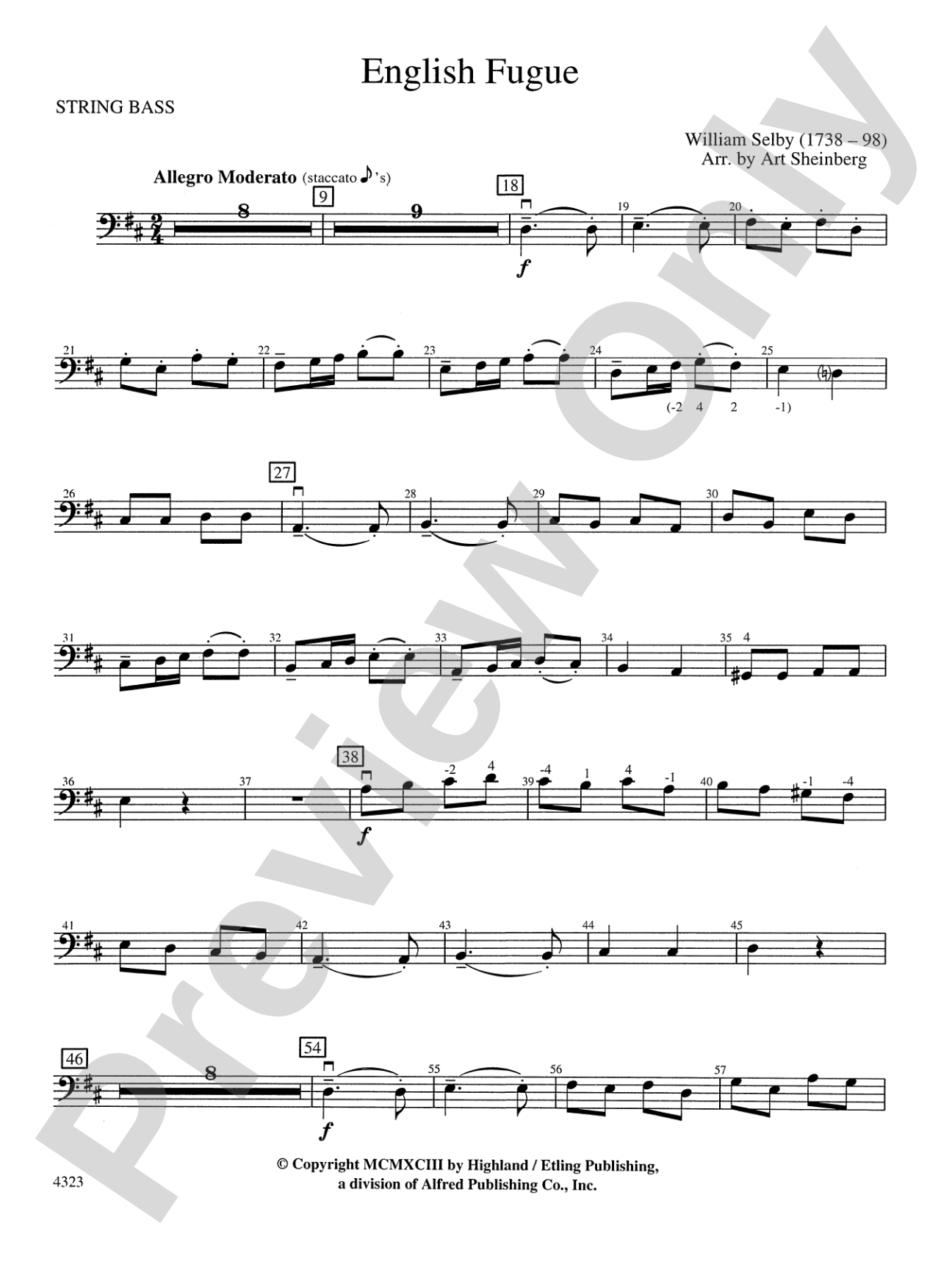

English Fugue: String Bass
By William Selby / arr. Art Sheinberg
Grade: 3
Item: 00-PC-0001850_SB
$5.99
Pickup currently not available
Description
Art Sheinberg has discovered a gem from the late English Baroque keyboard literature and expertly scored it to sound as if it were originally for strings. The violin ll and viola parts are often doubled, as are the cello and bass parts; there are essentially three parts throughout. This gives a full and balanced sound which accommodates uneven instrumentation. Violin l parts are in third position much of the time, and alternate fingerings given for the other parts will keep other advanced players busy. The piece is in D major throughout, with the exception of brief excursions into A and B minor. Full of rhythmic drive and sparkling counterpoint, the piece is a sure winner with students and an excellent vehicle to teach detached style and ensemble independence. This title is available in MakeMusic Cloud.


Don't just read it, hear it, play along with it, and watch your students grow with it. In MakeMusic Cloud, English Fugue: String Bass comes alive with professional accompaniment, adjustable tempo, and built-in practice tools that turn solo practice into real progress.
Open in the Player
Jump straight in and assign it today.
Start Your Free Trial
Open this title and explore the full library in minutes.
Sample Audio
1
Audio File
--:--
0:00
0:00
Sample Video
No sample videos found.
Additional Details
Series:
Highland/Etling String Orchestra
Publisher:
Alfred Music
Page Count:
136
SKU:
00-PC-0001850_SB
More about this title
About the Composer: William Selby
William Selby (1738–1798) was an English organist and composer whose keyboard works represent the sophisticated counterpoint and harmonic language of the late Baroque in Britain. Active in London during a period when keyboard music was central to both church and domestic musical life, Selby wrote inventive fugues and other works that demonstrate mastery of the Baroque contrapuntal tradition while maintaining accessibility for skilled amateurs.
Selby's fugues remain valuable teaching tools because they combine technical rigor with musical vitality. His ability to sustain energetic rhythmic drive across multiple voices makes his keyboard works natural candidates for arrangement, as this string orchestra adaptation demonstrates.
Why we love this
This arrangement transforms a keyboard gem into a orchestral showpiece that sounds inevitable on strings. The three-part texture with strategic doublings means you can field this successfully even with uneven instrumentation, while the writing still challenges advanced players through high positions, alternate fingerings, and the constant give-and-take of independent lines. Directors get a contrapuntal masterwork with genuine Baroque craft and modern pedagogical wisdom built into every page.
What to expect
Spirited and crystalline. Selby's fugue subject has rhythmic snap and harmonic forward motion; in this orchestral dress it sparkles with period style and transparency. The piece never sits still, yet its three interlocking lines create a sense of inevitability rather than restlessness. You hear keyboard brilliance reimagined for strings.
Who it's for
Grade 3 string orchestras with a mix of skill levels and section sizes. The three-part writing absorbs players who cannot yet carry a full orchestral line, while advanced violinists find real work in third position and the alternate fingerings throughout. This is ideal for groups ready to tackle Baroque counterpoint with style and conviction.
How to get the most out of it
- Establish clarity in the detached articulation early; the piece's rhythmic energy depends on crisp, unified tonguing across all sections, not on tempo alone.
- Balance the three active lines so each voice emerges distinctly without any section overpowering the others, especially where violin II and viola double together.
- Lock the cello and bass parts as a unified foundation; their doublings anchor the harmonic progression and give the ensemble room to breathe on the faster passagework above.
- Rehearse the brief modulations to A and B minor as tonal events worth hearing; they should register as purposeful shifts, not surprise detours.
How to use it
Program this on a concert dedicated to Baroque or masterwork arrangements, where it can sit alongside other period pieces or serve as a bridge between keyboard and orchestral literature. Its contest and festival appeal makes it equally valuable for festivals emphasizing technical skill and ensemble independence. The modest length and high engagement factor also make it rewarding as a mid-season rehearsal goal that keeps momentum strong through winter.
Skills your students will build
- Detached articulation and style in Baroque contexts
- Part independence and listening within three-part counterpoint
- String techniques in higher positions (violin I in third position)
- Reading and executing alternate fingerings
- Ensemble balance across doublings and harmonic shifts