Engines of Resistance: Viola Sheet Music Preview

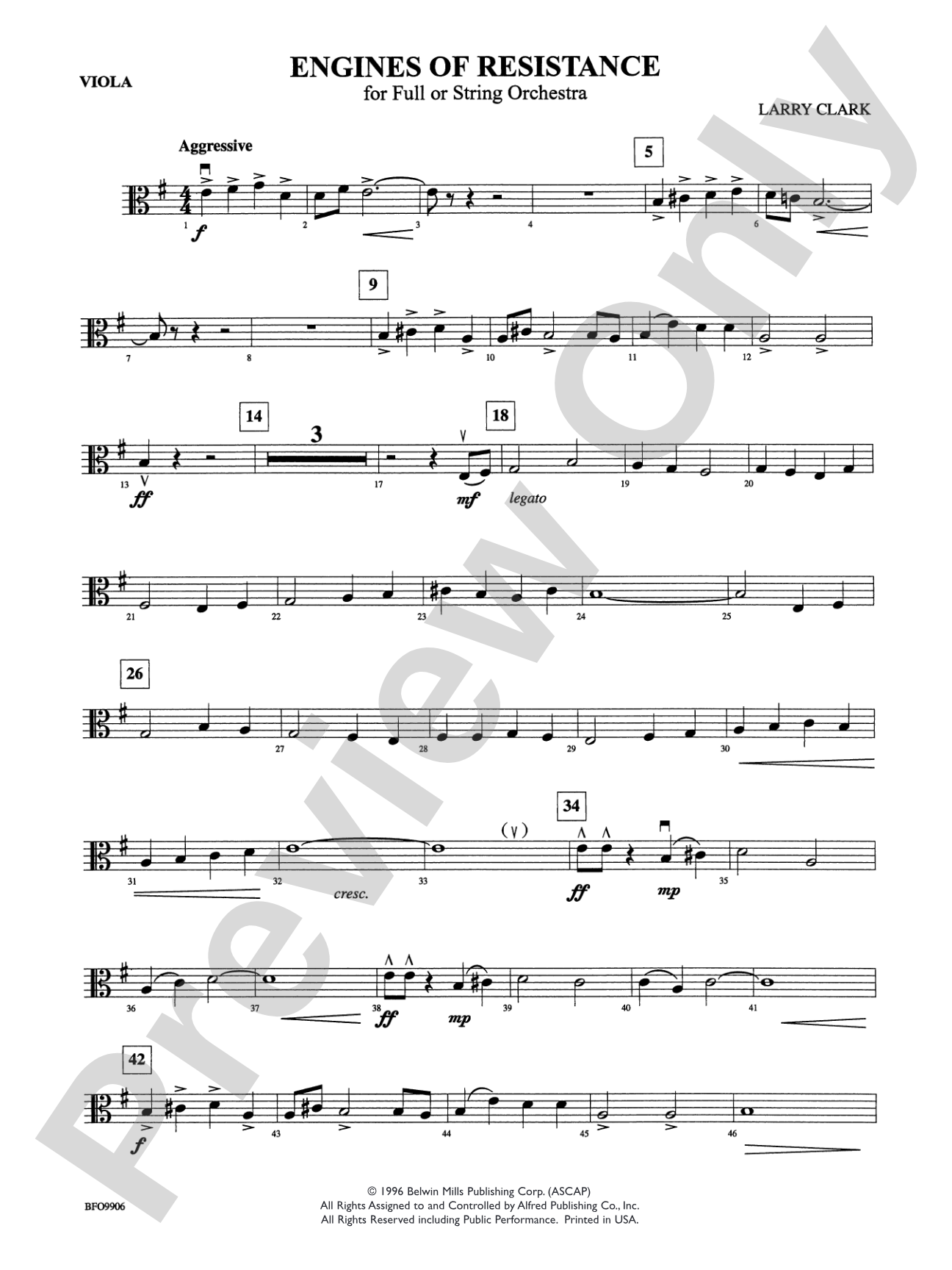
Engines of Resistance: Viola

By Larry Clark

Grade: 2.5

Item: 00-PC-0002217_VA1

Digital Download
$3.00
Description
Take notice! Seldom, if ever, have we heard a more musically exciting venture for orchestra (playable by string orchestra and with the addition of any winds and percussion up to full orchestra). Composer Larry Clark, in a highly creative period, has developed this stunning new work. Two opposing themes resist one another. A constant motor element fights the lyrical melodic material. Each new angular theme is more forceful than the last. Engines of Resistance is unique and tightly written, with fantastic program potential. (2:05) A Federation Festivals 2020-2024 selection.

Don't just read it, hear it, play along with it, and watch your students grow with it. In MakeMusic Cloud, Engines of Resistance: Viola comes alive with professional accompaniment, adjustable tempo, and built-in practice tools that turn solo practice into real progress.

Sample Audio
No sample audio found.
Sample Video
Additional Details
Series: Belwin Intermediate String/Full Orchestra
Publisher: Alfred Music
Page Count: 246
SKU: 00-PC-0002217_VA1

More about this title

About the Composer: Larry Clark

Larry Clark is a prolific composer for young and intermediate ensembles whose works consistently appear on festival and contest programs across North America. His understanding of what orchestras at this level can achieve has made him a trusted voice in band and orchestra education, with a catalog that balances accessibility and genuine musical substance.

Why we love this

Clark refuses to condescend at this grade level. Instead of padding the texture with busywork, he constructs a genuinely dramatic argument between two musical ideas, and the orchestration remains lean and purposeful throughout. Directors will find the motor rhythms infectious enough to hold a student orchestra's focus while the lyrical material gives musicians something emotionally real to play.

What to expect

Two forces collide and wrestle throughout this piece. Driving, mechanical rhythms push insistently against singing, angular melodies that become increasingly sharp and angular with each return. The work builds momentum rather than resolution, leaving performers and audiences in the grip of creative tension.

Who it's for

This conductor score and parts set serves orchestras at the upper intermediate level (Grade 2.5) looking for a work with real dramatic content and flexible instrumentation. Whether your ensemble is strings only or full orchestra, this piece scales to your available forces without sacrificing its musical integrity.

How to get the most out of it

  • Balance the motor element against the lyrical material as if they are two characters in conversation; the rhythm section and lower strings drive the pulse while the melodic voices must sing through.
  • Clarify the angular, increasingly forceful themes by sharpening attacks and maintaining clean releases; these moments drive the dramatic arc.
  • Use the 2:05 runtime to pace the work's accumulation; resist rushing through the contrasting sections, which gain power through deliberate phrasing.
  • With string orchestra alone, the lyrical passages will resonate clearly; adding winds and percussion sharpens the rhythmic engine and thickens the climaxes without losing transparency.

How to use it

Program this as a centerpiece for a concert or festival appearance where you want to showcase the orchestra's ability to balance rhythmic precision with expressive playing. Its Federation Festivals 2020-2024 selection status makes it an excellent contest choice, and at just over two minutes, it pairs well with longer works or as a dramatic interlude in a mixed program.

Skills your students will build

  • Sustaining rhythmic accuracy against lyrical material (polyrhythmic listening)
  • Balancing contrasting musical ideas within a single ensemble texture
  • Responding to angular, jagged melodic gestures with precise articulation
  • Pacing and accumulation across a tightly written formal structure
  • Adapting to flexible instrumentation (string orchestra to full orchestra)

You May Also Like