
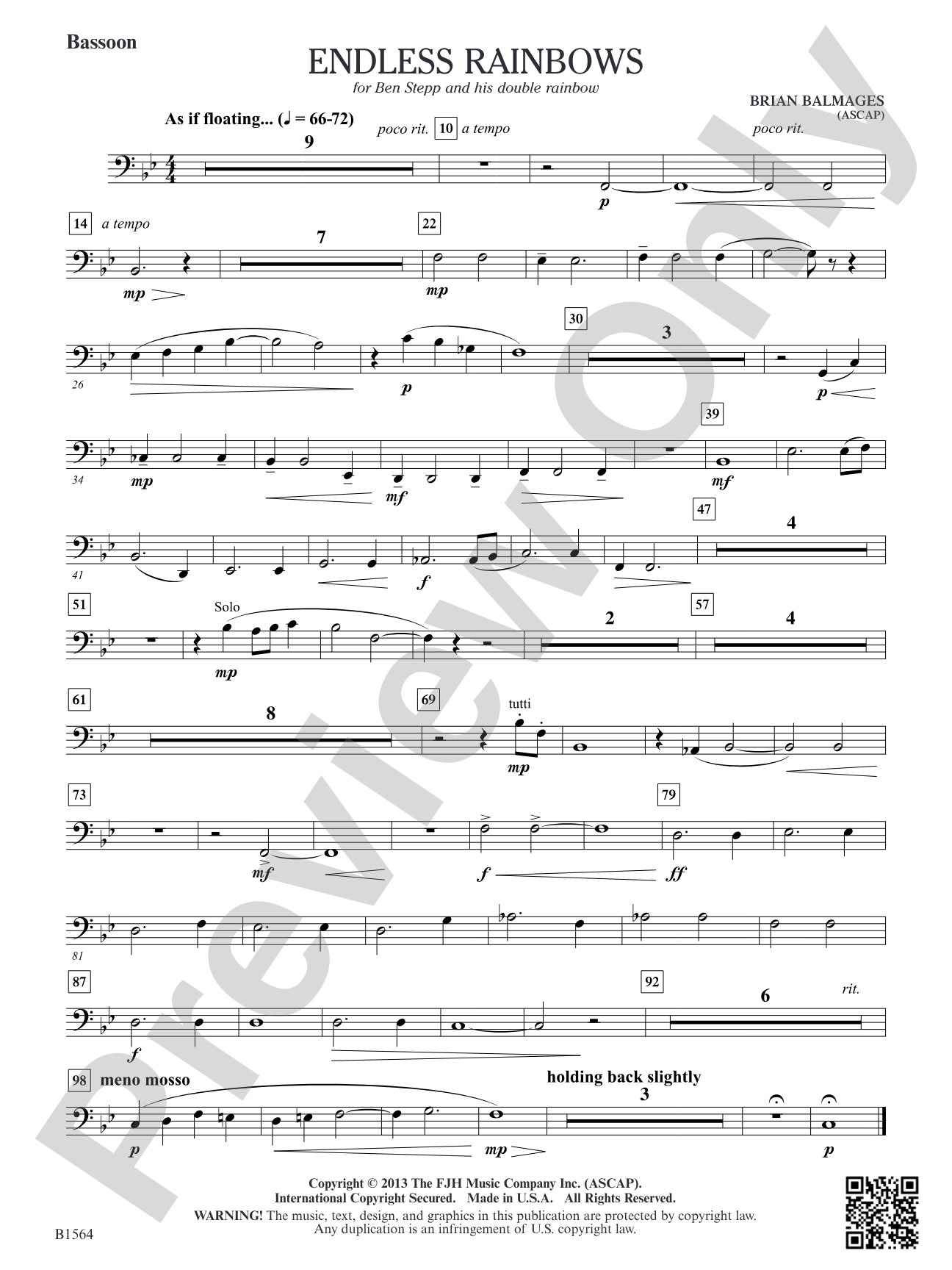

Endless Rainbows: Bassoon
By Brian Balmages
Grade: 3
Item: 98-PC-DB1564_B1
$7.00
Pickup currently not available
Description
This heartfelt, lyrical work juxtaposes the theme of loss with an everpresent sense of uplifting joy. Very cinematic in nature, this emotional rollercoaster moves through passages of solitude and tranquility into moments of epic power - from darkness into light. It seeks to epitomize an endless rainbow that will forever illuminate the skies as far as the eye can see.


Don't just read it, hear it, play along with it, and watch your students grow with it. In MakeMusic Cloud, Endless Rainbows: Bassoon comes alive with professional accompaniment, adjustable tempo, and built-in practice tools that turn solo practice into real progress.
Open in the Player
Jump straight in and assign it today.
Start Your Free Trial
Open this title and explore the full library in minutes.
Sample Audio
1
Audio File
--:--
0:00
0:00
Sample Video
No sample videos found.
Additional Details
Series:
FJH Concert Band
Publisher:
The FJH Music Company, Inc.
SKU:
98-PC-DB1564_B1
More about this title
About the Composer: Brian Balmages

Brian Balmages has built an international reputation as a composer and conductor working across orchestral, band, and chamber music idioms. His works have been performed by ensembles ranging from professional orchestras to elementary school bands in prestigious venues including Carnegie Hall, the Kennedy Center, Sydney Opera House, and Toronto Centre for the Arts. He received the A. Austin Harding Award from the American School Band Directors Association, won the 2020 NBA William D. Revelli Composition Contest for Love and Light, and holds membership in the American Bandmasters Association.
Balmages has received significant commissions and honors throughout his career, including the inaugural James Madison University Distinguished Alumni Award and a commission from the University of Miami for music celebrating the inauguration of the institution's 6th president. His music was featured in the 2013 Presidential Inaugural Prayer Service. As a guest conductor, he regularly works with all-state ensembles, university orchestras, and professional groups worldwide, with notable appearances at the Midwest Clinic, Western International Band Clinic, and conferences throughout Australia and Europe. He currently serves as Director of MakeMusic Publications and Digital Education for Alfred and MakeMusic.
Why we love this
Balmages crafts emotional architecture that Grade 3 ensembles can actually execute. The piece doesn't rely on technical display to convey depth; instead, it uses accessible orchestration and lyrical phrasing to guide students through genuine emotional storytelling, moving from vulnerability to triumph in ways that feel earned rather than imposed.
What to expect
A journey through shadow and light, beginning in quiet introspection before gradually opening into moments of soaring beauty. The piece holds contrasts without jarring the listener; passages of tranquility give way to expansive, orchestrally rich climaxes that feel triumphant rather than bombastic.
Who it's for
Grade 3 concert bands seeking repertoire that honors student musicianship while exploring meaningful emotional content. This work suits ensembles ready to move beyond technical exercises into genuine interpretive performance, whether for festival competition or concert programming.
How to get the most out of it
- Shape the opening passages with restraint. Resist the urge to drive forward; allow the solitude sections to breathe and settle into the listeners' ears before the energy builds.
- Balance the ensemble carefully during the transition from darkness into light. The shift should feel inevitable rather than abrupt, with dynamic changes gradual enough that the band feels the shift happening together.
- Reserve your full ensemble sound for the epic power passages. If the band commits their best sound only in climactic moments, those sections will land with genuine impact.
- Mark phrase endings clearly so students understand where the music is heading emotionally. This cinematic work relies on purposeful musical gestures rather than technical precision.
How to use it
This works beautifully as a centerpiece on a concert that balances accessible fare with deeper repertoire. The emotional arc makes it particularly effective as a second-half opener, settling the audience into focused listening before launching into other selections. Its festival potential also makes it suitable for competitions seeking substantial yet Grade 3-appropriate literature.
Skills your students will build
- Sustaining lyrical phrasing across longer melodic lines
- Dynamic control and expressive gradation (particularly in soft passages)
- Balancing individual section sounds within the full ensemble texture
- Responding to emotional arc rather than relying solely on written symbols
- Ensemble listening and rhythmic cohesion through cinematic transitions