
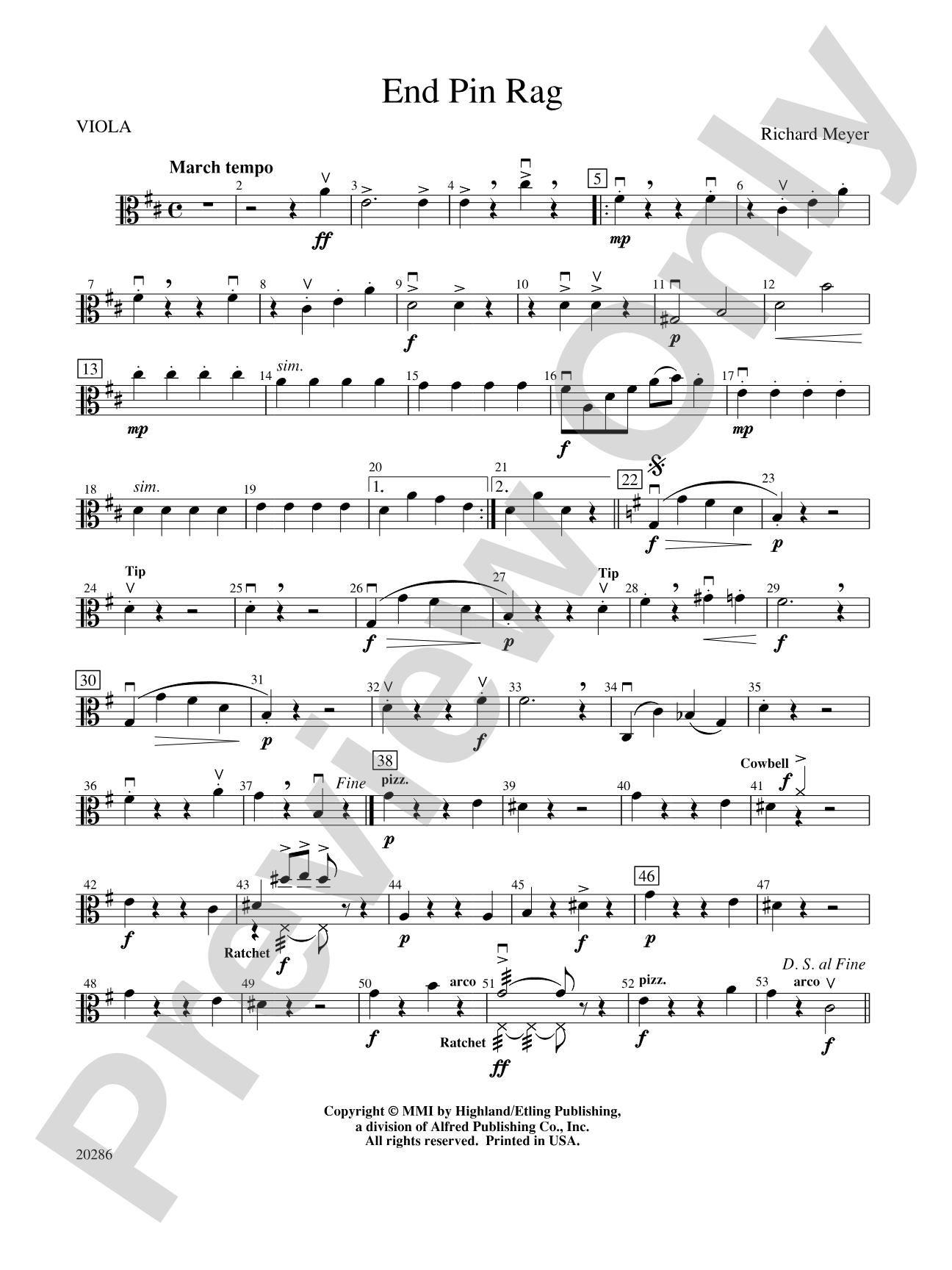

End Pin Rag (Cello and Bass Section Feature): Viola
Cello and Bass Section Feature
By Richard Meyer
Grade: 2
Item: 00-PC-0000378_VA1
$5.99
Pickup currently not available
Description
Your cellos and basses will shine in this fun, educational, and very playable section feature by Richard Meyer. A great introduction to ragtime, this charming work uses the harmonies and stylistic features made famous by Scott Joplin at the turn of the twentieth century. Particularly enjoyable is the minor-key pizzicato section, which features an amusing array of "silent movie-style" sound effects such as slide whistle, ratchet and cowbell.


Don't just read it, hear it, play along with it, and watch your students grow with it. In MakeMusic Cloud, End Pin Rag (Cello and Bass Section Feature): Viola comes alive with professional accompaniment, adjustable tempo, and built-in practice tools that turn solo practice into real progress.
Open in the Player
Jump straight in and assign it today.
Start Your Free Trial
Open this title and explore the full library in minutes.
Sample Audio
1
Audio File
--:--
0:00
0:00
Sample Video
Additional Details
Series:
Highland/Etling String Orchestra
Publisher:
Alfred Music
Page Count:
62
SKU:
00-PC-0000378_VA1
More about this title
About the Composer: Richard Meyer

Richard Meyer spent 35 years teaching strings at the elementary, middle, and high school levels in Southern California public schools. At Oak Avenue Intermediate School in Temple City, he directed orchestras for 22 years while simultaneously overseeing the district's elementary string program, growing the intermediate orchestra from 29 students to 200. He also served as music director of the Pasadena Youth Symphony Orchestra for 16 years, leading the ensemble in performances across North America, Europe, and Australia.
Meyer's educational impact extends beyond the classroom. In 2009, he created the "Giving Bach" program, an initiative that uses interactive concerts to serve students with special needs and those in under-resourced schools throughout Southern California, earning national recognition for its innovative approach. As a composer, Meyer has published over 190 works and arrangements; he spent 16 years as string editor for Alfred Publishing Company and co-authored the String Explorer Series and Sight-read It for Strings. He has been a featured clinician at the A.S.T.A. National Conference, the Texas Orchestra Directors' Association Conference, and regional string teacher workshops.
Why we love this
Meyer understands exactly what makes a section feature work at the Grade 2 level: the cello and bass players get genuine musical material that sounds impressive, the rhythmic pizzicato pattern sits comfortably under the fingers, and the sound effects section breaks up rehearsal monotony while building rhythmic precision. The ragtime idiom gives students immediate context for understanding a major American musical tradition without requiring advanced harmonic or technical skills.
What to expect
End Pin Rag captures the charm and syncopated energy of early ragtime music through a string orchestra lens. The minor-key pizzicato sections pulse with comedic flair as students produce cartoon-style sound effects, while the harmonic language sits squarely in the Joplin tradition, making the style recognizable even at this accessible level.
Who it's for
This piece belongs in any Grade 2 string orchestra where cellists and bassists deserve a moment in the spotlight. Directors building young ensembles will find it particularly valuable for students who need encouragement and engagement, since the playful character and section ownership create real ownership in rehearsal.
How to get the most out of it
- Establish the pizzicato rhythm as a unit before adding the pitched lines above it; use the recurring bass pattern as your rehearsal anchor throughout the piece.
- Assign the sound effects (slide whistle, ratchet, cowbell) to different sections of each part to maximize student engagement and distribute the playful character across the ensemble.
- Lock in the syncopated figures typical of ragtime by clapping the rhythms separately before the first note; students often rush these patterns without isolation work.
- Balance the section feature carefully so the lower strings are clearly audible without overwhelming the upper strings when they enter with supporting material.
How to use it
Program this early in the rehearsal season when students need confidence-building repertoire, or save it for a concert that celebrates sectional achievement. It pairs naturally with other Grade 2 ragtime arrangements or early American music, and the playful character makes it an excellent choice for family concerts or school assemblies where engagement and entertainment matter alongside musical learning.
Skills your students will build
- Reading and performing syncopated rhythms in ragtime style
- Coordinated pizzicato technique with rhythmic precision
- Understanding major and minor tonality through harmonic context
- Ensemble balance and blend when a section feature is supported by other voices
- Stylistic interpretation of early twentieth-century American music