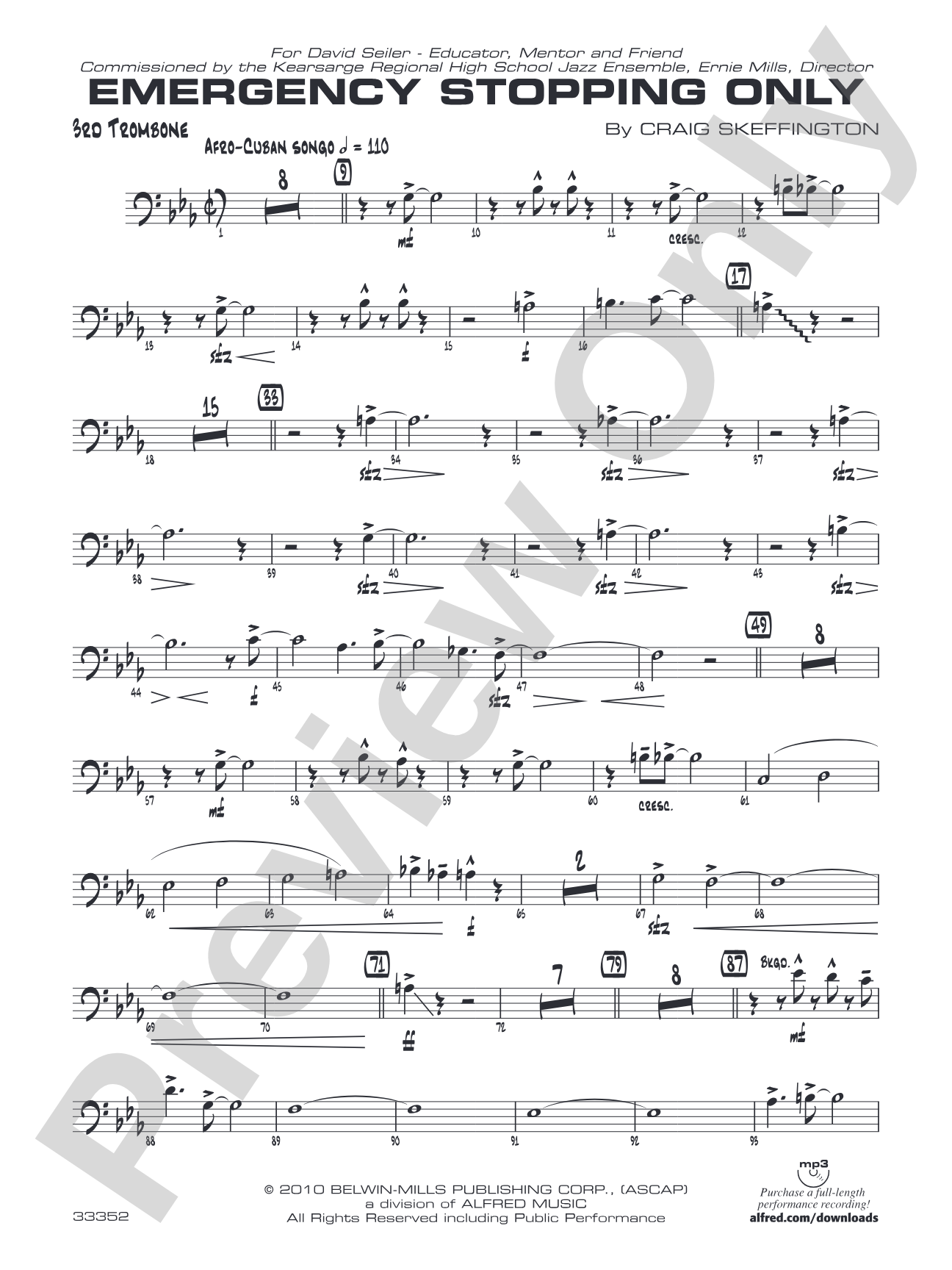
Emergency Stopping Only: 3rd Trombone Sheet Music Preview

Emergency Stopping Only: 3rd Trombone

By Craig Skeffington

Grade: 3 (Medium)

Item: 00-PC-0016205_TN3

Digital Download
$3.00
Description
A fiery Latin Afro-Cuban song with a unison sax melody sets up the high-energy level for this chart. Solos are for trumpet 2, trombone 1 (both written), and drums. Lead trumpet range is to written B-flat above the staff with an optional D. The bari sax and bass 'bone players both get a lot of action in the interlude. This one does not stop! This title is available in MakeMusic Cloud.

Don't just read it, hear it, play along with it, and watch your students grow with it. In MakeMusic Cloud, Emergency Stopping Only: 3rd Trombone comes alive with professional accompaniment, adjustable tempo, and built-in practice tools that turn solo practice into real progress.

Sample Audio
0:00
0:00
Sample Video
Additional Details
Series: Jazz Band Series
Publisher: Alfred Music
Page Count: 98
SKU: 00-PC-0016205_TN3

More about this title

About the Composer: Craig Skeffington

Craig Skeffington

Craig Skeffington brings two decades of New England composition to jazz, wind band, and marching music, with numerous commissions shaping his portfolio. His fifteen years directing high school band earned him the 2003 MMEA Teacher of the Year award, and he currently serves on the faculty at the University of Southern Maine. Beyond the concert hall, Skeffington has performed professionally alongside Barry Manilow and Natalie Cole, and toured as a musician with the Artie Shaw Orchestra, blending his performance experience directly into his writing for student ensembles.

Why we love this

Skeffington writes with real knowledge of what a jazz ensemble can deliver at Grade 3, building momentum through a unison sax melody and Latin Afro-Cuban grooves without overcomplicating the harmonic landscape. The solos for trumpet 2, trombone 1, and drums sit in playable ranges while keeping performers engaged, and the interlude gives bari sax and bass trombone genuine musical moments. This chart drives forward relentlessly, which is exactly what students need to experience when learning to sustain energy and ensemble cohesion in jazz.

What to expect

The unison sax opening hits hard with Latin Afro-Cuban fire, immediately setting a high-energy pulse that doesn't relent. Solos emerge with natural space for improvisation while the rhythm section locks into the groove, and the interlude lifts the texture with active lower voices that pull the ensemble forward without losing the relentless forward motion.

Who it's for

Jazz ensembles at the intermediate level will find a rewarding chart that demands tight ensemble playing without requiring advanced harmonic reading or extended range work beyond Grade 3 capabilities. This works equally well for high school groups building their jazz library and middle school ensembles ready to move beyond fundamentals into real groove and style.

How to get the most out of it

  • Lock the rhythm section (drums, bass, and piano) into the Latin Afro-Cuban groove from the downbeat; the precision here carries everything else.
  • Balance the unison sax melody so it locks with the trumpet section rather than floating on top; this sets the ensemble's collective confidence.
  • Give trumpet 2 and trombone 1 time to solidify their solo passages in sectionals before full ensemble run-throughs; written solos demand melodic authority.
  • Lean into the interlude as a showcase moment for bari sax and bass trombone; their activity here deserves space to be heard clearly in the mix.

How to use it

Program this as a set-closing or finale number when you need the ensemble's energy to carry the room; the nonstop momentum makes it an excellent closer rather than an opening statement. It pairs well on jazz concert setlists with ballads or mid-tempo swingers, providing stark textural contrast while showing range within your jazz program.

Skills your students will build

  • Latin Afro-Cuban groove vocabulary and rhythmic precision
  • Unison melody alignment across sections (saxophones and brass)
  • Solo construction and melodic phrasing in written passages (trumpet, trombone, drums)
  • Ensemble balance with active lower voice parts (bari sax, bass trombone)
  • Sustained high-energy ensemble playing and groove maintenance

You May Also Like