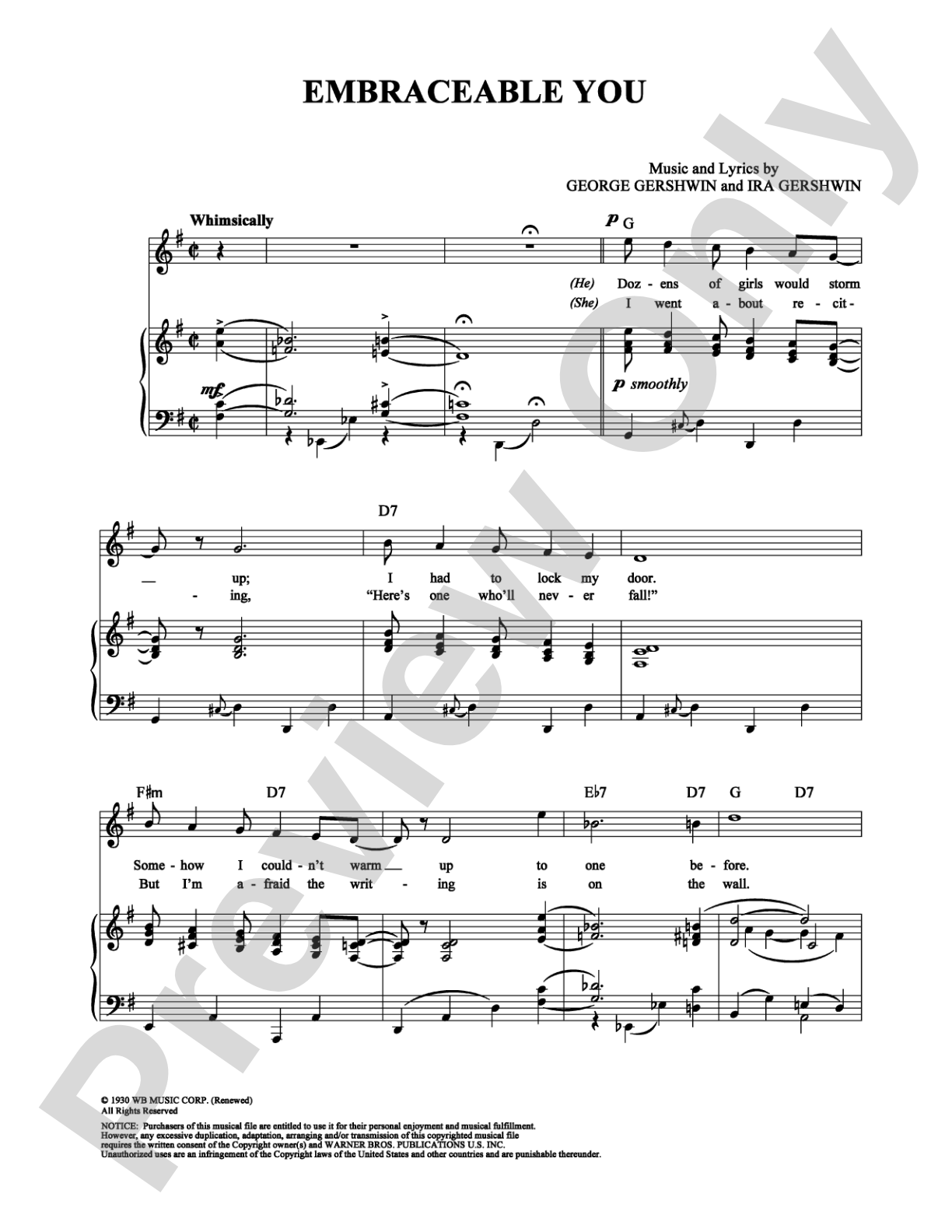
Embraceable You: Piano/Vocal/Chords Digital Sheet Music

Embraceable You: Piano/Vocal/Chords Digital Sheet Music

George Gershwin, Judy Garland, Gene Kelly, Ginger Rogers

Item: 00-PS-0005366

Digital Download
$3.99
Description

Embraceable You: Piano/Vocal/Chords Digital Sheet Music isn't in MakeMusic Cloud just yet...but it could be. Let us know you'd like to see it, and you'll help shape what comes next. In the meantime, start a free trial and dive into thousands of interactive titles your students can play along with today.

Sample Audio
No sample audio found.
Sample Video
Additional Details
SKU: 00-PS-0005366

More about this title

About the Artist: Judy Garland

Judy Garland (1922-1969) was a singer and actress whose instrument was her voice: warm, flexible, and capable of conveying genuine emotion in a single phrase. She defined the Great American Songbook standard for generations of performers, whether in film, concert, or on the radio. Her interpretations of songs like this one became the blueprints that pianists and singers still study and reference today.

Garland's legacy in music education extends beyond her recordings. Her approach to phrasing, her control of dynamics within a verse, and her willingness to reshape a melody for emotional truth offer singers and collaborative pianists a masterclass in how to inhabit a song rather than simply perform it.

Why we love this

This George and Ira Gershwin standard has earned its place in the recital repertoire because it sits in that sweet spot between jazz-influenced sophistication and genuine melodic charm. Your singers will find material worth returning to again and again: the harmonic movement invites tasteful reharmonization, the form gives plenty of room for rubato and interpretation, and the lyric rewards singers who understand both diction and vulnerability.

What to expect

The song unfolds as a warm, slightly playful admission of being captivated by someone. The harmonic language slides and turns in unexpected ways, suggesting both the ease of the moment and the complexity of attraction. There's elegance here, but never coldness; humor, but never mockery.

Who it's for

Singers working through the American Songbook repertoire will find this an essential addition to their recital materials. Pianists studying collaborative accompaniment will appreciate the chord chart and the opportunity to support a vocalist through a piece that rewards genuine partnership. Music teachers looking to introduce jazz-influenced harmony to advanced singers have a canonical text here.

How to get the most out of it

  • Treat the piano part as a full partner to the vocal line, not mere accompaniment. The harmonic progressions often move beneath the melody, and a pianist who leans into those changes will frame the singer's choices effectively.
  • Experiment with the timing of the lyric. This song reveals different colors depending on whether you rush slightly forward or settle back into the beat. Find the pocket that suits your voice and your accompanist's sensitivity.
  • Balance legit vocal production with a conversational tone. The song is a declaration of affection, but it works best when it feels like you're telling someone something true rather than performing at them.
  • Use the chord changes as harmonic landmarks for phrasing. Many of the most effective musical phrases align with chord movements, so your pianist's clarity helps shape your breathing and line.

How to use it

This works beautifully as a solo recital piece for an advanced singer, or as part of a jazz standards or American Songbook set. It pairs naturally with other Gershwin songs or with contemporary jazz-influenced art song. In an educational setting, it serves as a bridge between traditional vocal repertoire and jazz performance practice, since the published chord chart invites improvisation and reharmonization without requiring the singer to abandon legit vocal technique.

Skills your students will build

  • Reading lead sheets and understanding chord symbols in context
  • Interpreting jazz-influenced harmony within a lyrical melodic framework
  • Collaborative listening between vocalist and pianist
  • Phrasing over harmonic movement rather than strictly with bar lines
  • Using rubato expressively within a jazz-standard context

You May Also Like