
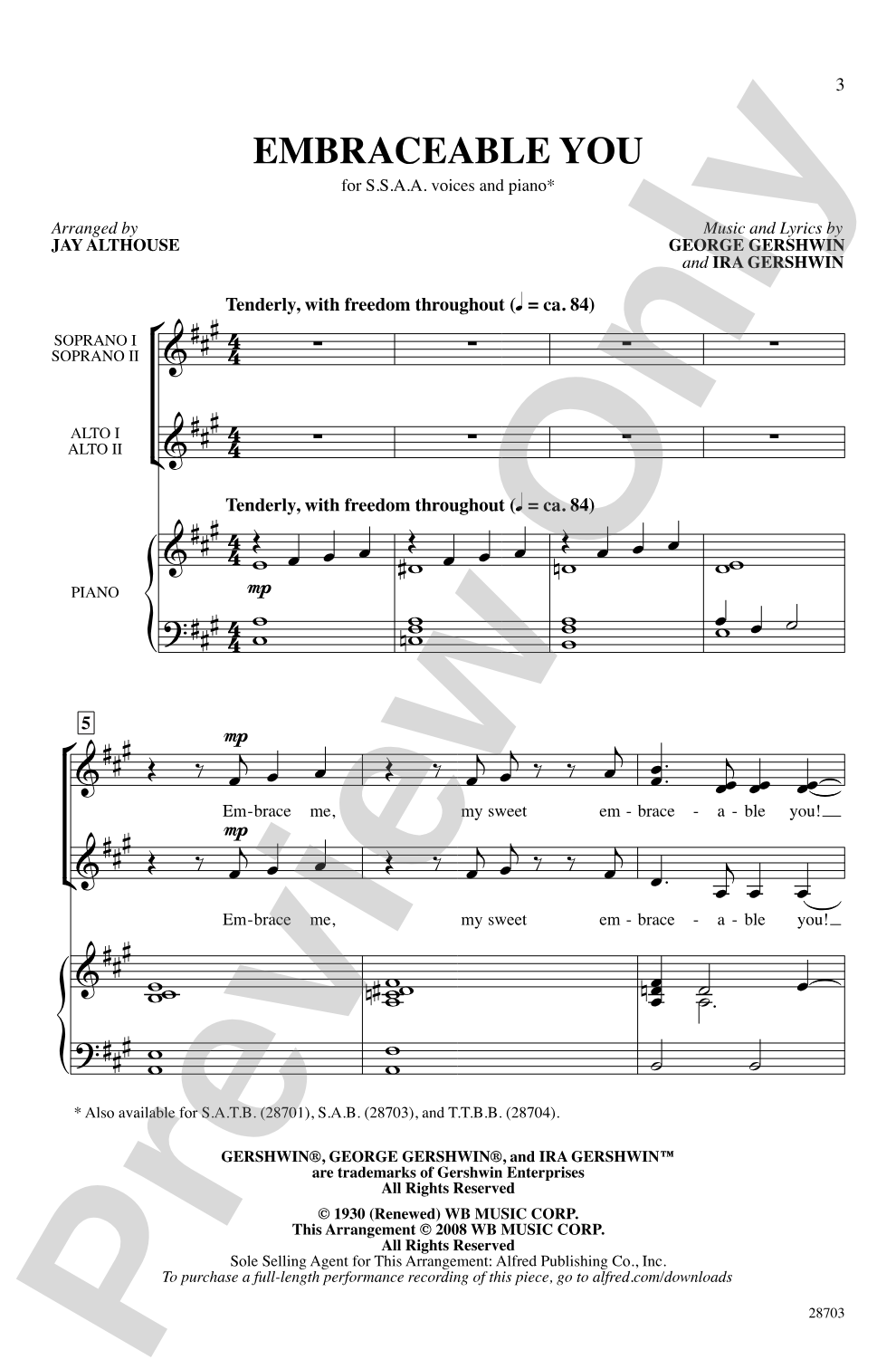

Embraceable You: SSAA Choral Octavo
Music and Lyrics by George Gershwin and Ira Gershwin, Arranged by Jay Althouse
Item: 00-PO-0006581
$1.85
Minimum order quantity: 20 copies
One moment…
Description


Embraceable You: SSAA Choral Octavo isn't in MakeMusic Cloud just yet...but it could be. Let us know you'd like to see it, and you'll help shape what comes next. In the meantime, start a free trial and dive into thousands of interactive titles your students can play along with today.
Request This Title
Tell us you want it.
Start Your Free Trial
Explore everything that's ready to play right now.
Sample Audio
1
Audio File
--:--
0:00
0:00
Sample Video
No sample videos found.
Additional Details
Series:
Alfred Pop Choral Series
Publisher:
Alfred Music
Page Count:
8
SKU:
00-PO-0006581
More about this title
About the Composer: George Gershwin
George Gershwin (1898, 1937) stands as one of the most influential composers of the American twentieth century, equally at home writing for Broadway, concert hall, and film. His gift for melody was extraordinary: he could craft lines that felt both sophisticated and instantly memorable, which is precisely why his songs have endured in the standard repertoire for nearly a century. Gershwin's work bridged classical and popular idioms in ways that few composers managed, and his collaborations with lyricist Ira Gershwin produced some of musical theater's most enduring moments.
For music educators, Gershwin's catalog offers a remarkable teaching resource. His harmonies reward close listening and analysis; his rhythmic language introduces students to jazz and swing idioms within an accessible framework. That a tune like "Embraceable You" can work equally well in a concert hall or a jazz club demonstrates the timeless appeal of his songwriting craft.
Why we love this
Jay Althouse's arrangement captures the essence of Gershwin's melody while creating a texture that sits naturally for women's voices, and the harmonies hint at jazz without overwhelming singers still building their jazz vocabulary. The octavo length keeps it manageable for ensembles with limited rehearsal time, yet the arrangement demands enough musical maturity to land its expressive moments convincingly.
What to expect
Warm, intimate, and gently swinging. The melody wraps around you like a familiar embrace (the title tells you exactly what Gershwin intended), and the arrangement keeps things conversational rather than grand. There's elegance here, but no pretension.
Who it's for
Women's choirs looking to expand beyond traditional repertoire into the American songbook will find this arrangement both accessible and rewarding. It works for intermediate ensembles that have solid blend and basic jazz vocabulary; advanced high school or college groups will appreciate the harmonic sophistication beneath what appears simple on the surface.
How to get the most out of it
- Shape the opening phrases with a gentle rubato; Gershwin's melodies breathe, and a straight reading will feel stiff. Let your singers find the natural lean into each phrase.
- Balance the harmony voices so the counterline supports rather than obscures the main tune. In a jazz standard, clarity of melody is everything.
- The harmonies contain jazz sonorities that won't sound right if the intonation is sharp or the blend is scattered. Tune the chord moments with particular care, especially the 7th and 9th chords.
- Record a reference track and use it only sparingly in rehearsal. Your singers should build independence and develop an ear for the changes rather than leaning on the accompaniment.
How to use it
Slot this into a concert alongside other standards or American songbook selections to show your singers' range beyond classical choral repertoire. It also pairs beautifully with a concert that explores twentieth-century American music or serves as an accessible introduction to jazz harmony within a more traditional concert setting.
Skills your students will build
- Reading and performing jazz harmony (seventh chords, jazz voicings)
- Balancing melody and harmony voices in a sectional texture
- Singing with swing feel and subtle rhythmic nuance
- Expressive phrasing in a song-like context rather than choral-formal style
- Blend and tuning in tertian harmony specific to jazz sonorities