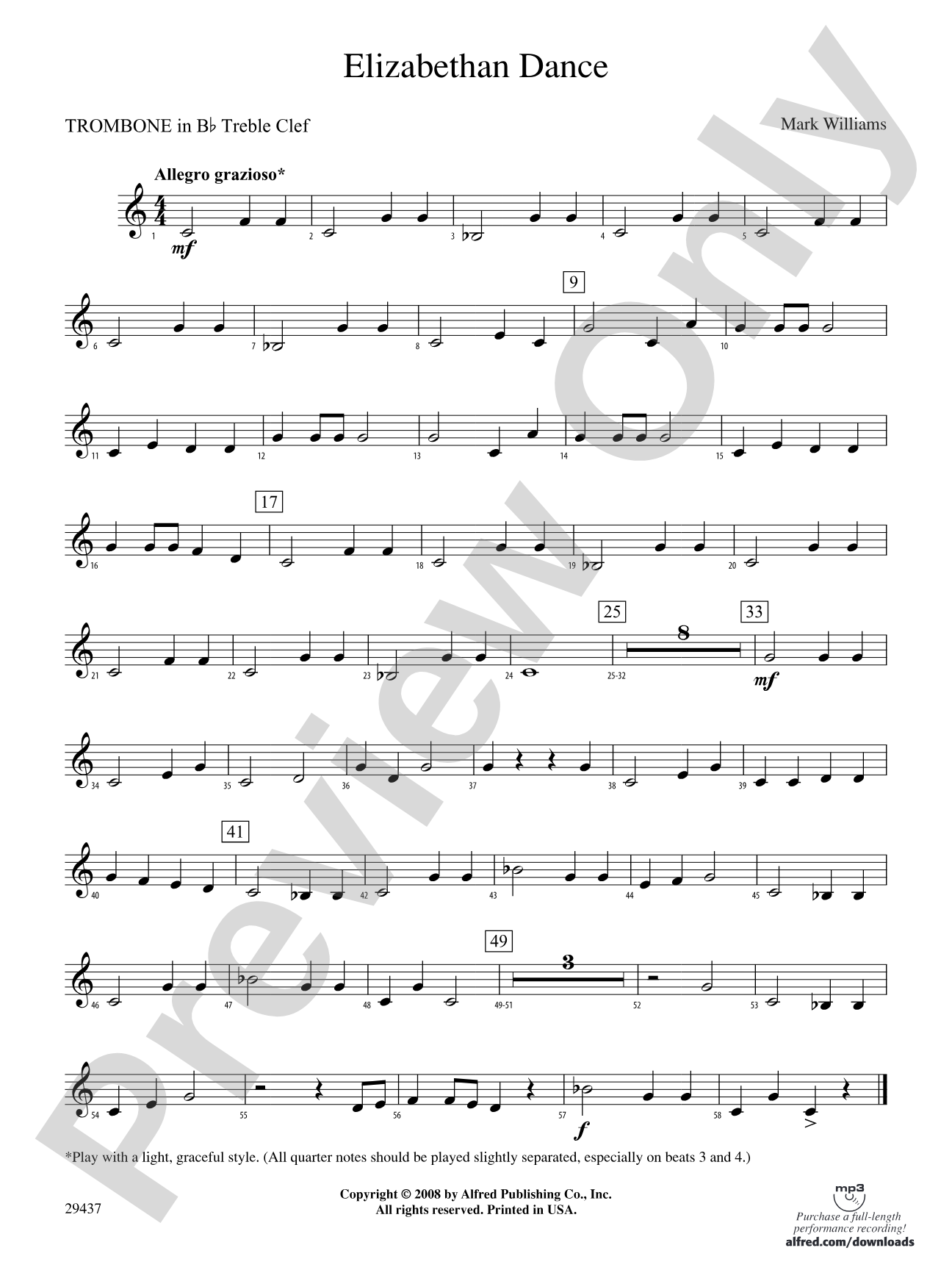
Elizabethan Dance: (wp) 1st B-flat Trombone T.C. Sheet Music Preview

Elizabethan Dance: (wp) 1st B-flat Trombone T.C.

By Mark Williams

Grade: 1 (Very Easy)

Item: 00-PC-0001394_wpTN1TC

Digital Download
$3.00
Description
Experience the merry sounds of Olde England in this easy, but authentic sounding work in the Renaissance style. Written in a mixture of mixolydian and major tonalities, this piece is a great tool for exposing students to the sounds and traditions of an essential time in musical history. This is an excellent selection for working on dynamic control and playing with delicacy. (2:00)

Correlated with Accent on Achievement, Book 1, page 19. This title is available in MakeMusic Cloud.

Don't just read it, hear it, play along with it, and watch your students grow with it. In MakeMusic Cloud, Elizabethan Dance: (wp) 1st B-flat Trombone T.C. comes alive with professional accompaniment, adjustable tempo, and built-in practice tools that turn solo practice into real progress.

Sample Audio
0:00
0:00
Sample Video
Additional Details
Series: Accent on Achievement
Publisher: Alfred Music
Page Count: 120
SKU: 00-PC-0001394_wpTN1TC

More about this title

About the Composer: Mark Williams

Mark Williams

Mark Williams shaped generations of young musicians through his prolific output of over 200 compositions for band and orchestra. A specialist in elementary band instruction, he authored the Accent on Achievement Band Method alongside his own concert works, earning recognition through competitions like the Western International Band Clinic's Gralia Competition and multiple ASCAP Special Awards. His influence extended across North America and Australia as a clinician and guest conductor.

Williams earned his degrees from Eastern Washington University and spent his teaching career in Washington state, where he also performed bassoon with the 560th Air Force Band and served as conductor and artistic director of the Spokane British Brass Band. His compositions balance accessibility with musical substance, making them essential repertoire for developing bands.

Why we love this

This piece gives your first-year band genuine Renaissance flavor without requiring advanced technique. The mixolydian inflections and period-appropriate gestures create authentic color, while the two-minute length and Grade 1 difficulty make it truly achievable. Directors love it because students hear themselves making historically informed music from day one, building confidence and cultural awareness simultaneously.

What to expect

Imagine stepping into a Tudor hall where musicians are playing for courtly entertainment. The music dances with lightness and joy, avoiding heaviness while remaining unmistakably Renaissance in flavor. There's elegance here, not complexity; delicacy, not difficulty.

Who it's for

Grade 1 concert bands ready to explore tonalities beyond major and minor. This piece works perfectly for ensembles using Accent on Achievement Book 1 and gives early-career students meaningful exposure to historical musical contexts without overwhelming technical demands.

How to get the most out of it

  • Shape the dynamics carefully through each phrase; Renaissance dances rely on subtle dynamic sculpting rather than sudden changes. Distinguish between the merry outer sections and any more restrained interior passages.
  • Lean into the mixolydian character by giving the raised 7th scale degree gentle emphasis where it appears, allowing students to hear how this mode differs from standard major tonality.
  • Keep articulation light and crisp, treating this as a courtly dance rather than a march. Tonguing should be delicate, and releases clean and unified.

How to use it

Use this in a concert that explores musical history or as a brief bridge between longer works. Its two-minute duration makes it an ideal opener or palate cleanser, and it pairs naturally with other early-grade selections that build cultural literacy.

Skills your students will build

  • Dynamic control and playing with delicacy
  • Reading and performing in mixolydian mode
  • Understanding Renaissance musical style and ornamentation
  • Controlled articulation in period style
  • Ensemble balance in historically informed contexts

You May Also Like