
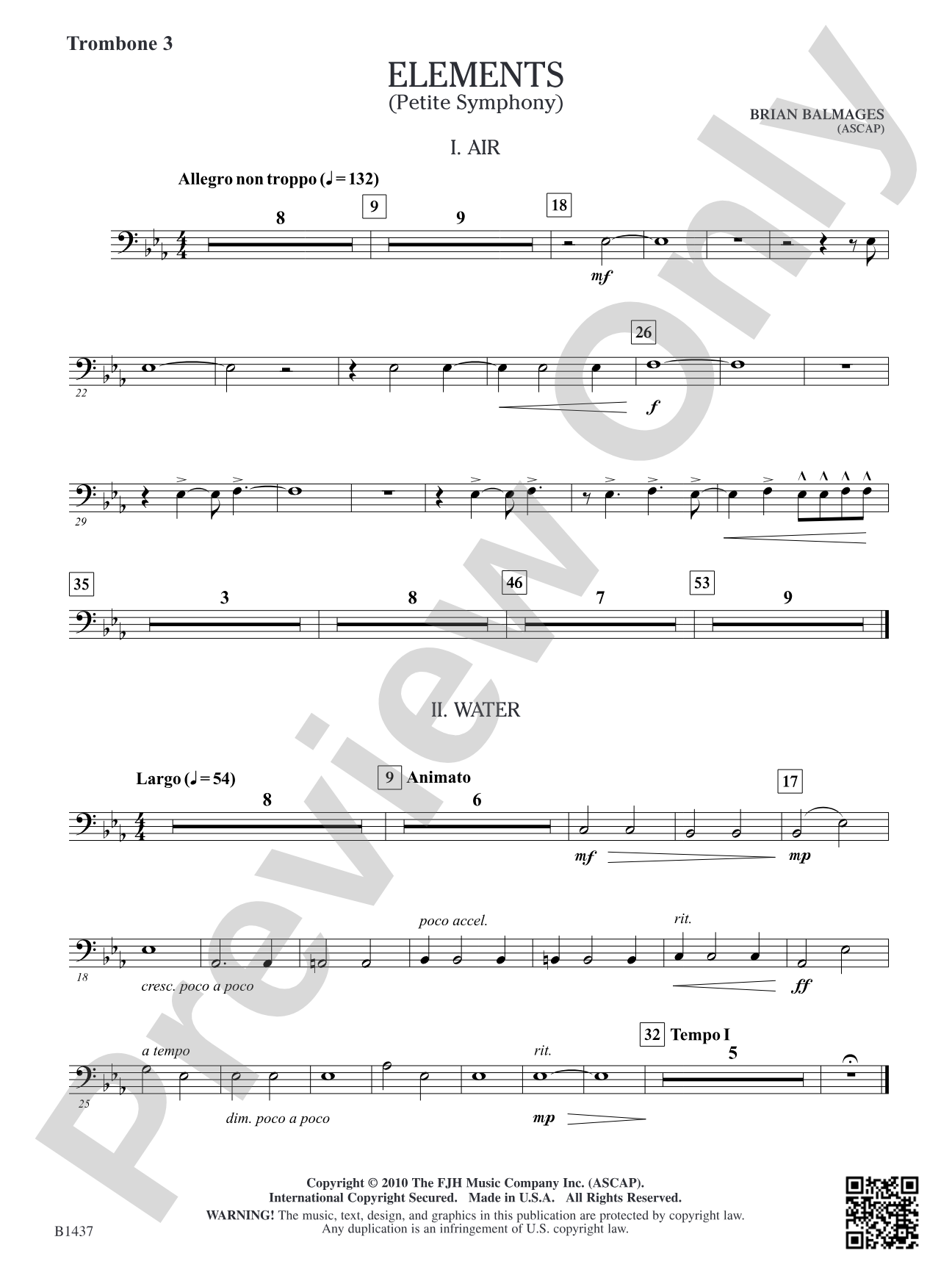

Elements (Petite Symphony): Trombone 3
Petite Symphony
By Brian Balmages
Grade: 4
Item: 98-PC-DB1437_TN3
$7.00
Pickup currently not available
Description
This medium-length four-movement work is structured in the same form as a traditional symphony (though much shorter) and corresponds with specific elements. Air, the first movement has a minimalistic quality to it and the entire movement develops around a four-note motif. The second movement, Water, is very impressionistic and describes a quiet body of water with a glass-like surface. The third movement, Earth, is a light and playful scherzo that pays homage to Holst’s Mercury from The Planets. The final movement, Fire, is aggressive and relentless as dissonance and rhythm become the focus before a wildly powerful fugue ensues. Dramatic and engaging!


Don't just read it, hear it, play along with it, and watch your students grow with it. In MakeMusic Cloud, Elements (Petite Symphony): Trombone 3 comes alive with professional accompaniment, adjustable tempo, and built-in practice tools that turn solo practice into real progress.
Open in the Player
Jump straight in and assign it today.
Start Your Free Trial
Open this title and explore the full library in minutes.
Sample Audio
1
Audio File
--:--
0:00
0:00
Sample Video
No sample videos found.
Additional Details
Series:
FJH Symphonic Band
Publisher:
The FJH Music Company, Inc.
SKU:
98-PC-DB1437_TN3
More about this title
About the Composer: Brian Balmages

Brian Balmages has built an international reputation as both composer and conductor, with commissions and performances spanning orchestral, band, and chamber music across premier venues including Carnegie Hall, the Kennedy Center, and Sydney Opera House. His achievements include the A. Austin Harding Award from the American School Band Directors Association, the 2020 NBA William D. Revelli Composition Contest, and election to the American Bandmasters Association. He has conducted all-state ensembles, university groups, and professional orchestras worldwide, with guest appearances at the Midwest Clinic, Western International Band Clinic, and numerous international conferences.
Balmages' work has reached audiences from professional symphony orchestras to elementary school ensembles. His music was performed during the 2013 Presidential Inaugural Prayer Service, and he has received commissions from major institutions including the University of Miami for its presidential inauguration. He currently serves as Director of MakeMusic Publications and Digital Education for Alfred and MakeMusic.
Why we love this
This four-movement work delivers the architecture and weight of a full symphony in an accessible Grade 4 package, making it ideal for bands ready to tackle sophisticated formal structures without excessive technical demands. Each movement's musical character is immediately distinctive, helping conductors and students understand how thematic development and orchestration shape a larger narrative. The writing balances genuine compositional craft (the fugue finale is genuinely exciting) with the practical needs of high school ensembles.
What to expect
Elements moves you through four distinct emotional and textural worlds: a spare, introspective beginning that builds gradually; a shimmering, almost ethereal middle section; a lighthearted scherzo with rhythmic wit; and a relentless final push that combines aggressive dissonance with the intellectual satisfaction of a fully realized fugue. The journey feels cohesive despite these contrasts, as if each element naturally leads to the next.
Who it's for
High school concert bands at the Grade 4 level who have developed solid fundamentals and are ready for multi-movement works that explore different compositional approaches. This score works especially well for bands preparing for festival competition or seeking a substantial, engaging centerpiece that showcases both technical control and musical maturity.
How to get the most out of it
- Establish the four-note motif in Air with crystalline precision during sectional rehearsals; this minimalistic opening sets the work's architectural foundation and requires intonation focus rather than aggressive articulation.
- Shape Water's impressionistic harmonies by conducting with a broader, more legato gesture; encourage the ensemble to listen for the glass-like surface quality rather than punching individual notes.
- Balance the rhythmic playfulness in Earth by letting the scherzo breathe between phrases; the Holst homage works best when the lightness comes from phrasing, not tempo rushing.
- Build the Fire finale's fugue through deliberate sectional layering in rehearsal; add voices one at a time so students hear both their own line's independence and the overall contrapuntal texture.
How to use it
Program this as a concert centerpiece that demonstrates your ensemble's range and sophistication, or use it strategically in a festival context where judges value both structural clarity and modern compositional language. The four-movement form makes it substantial enough to anchor a concert program while the individual movements' character could also work in thematic programming (pairing movements with other pieces that explore similar musical ideas).
Skills your students will build
- Reading and executing multi-movement formal structures (sonata-like opening, impressionistic development, scherzo form, fugal writing)
- Sustaining ensemble focus across a longer work with contrasting musical characters
- Balancing minimalistic texture in Air (precision intonation and restraint)
- Creating impressionistic sonority in Water (blended color and sustained legato)
- Executing rhythmic independence and layering in the Fire fugue