
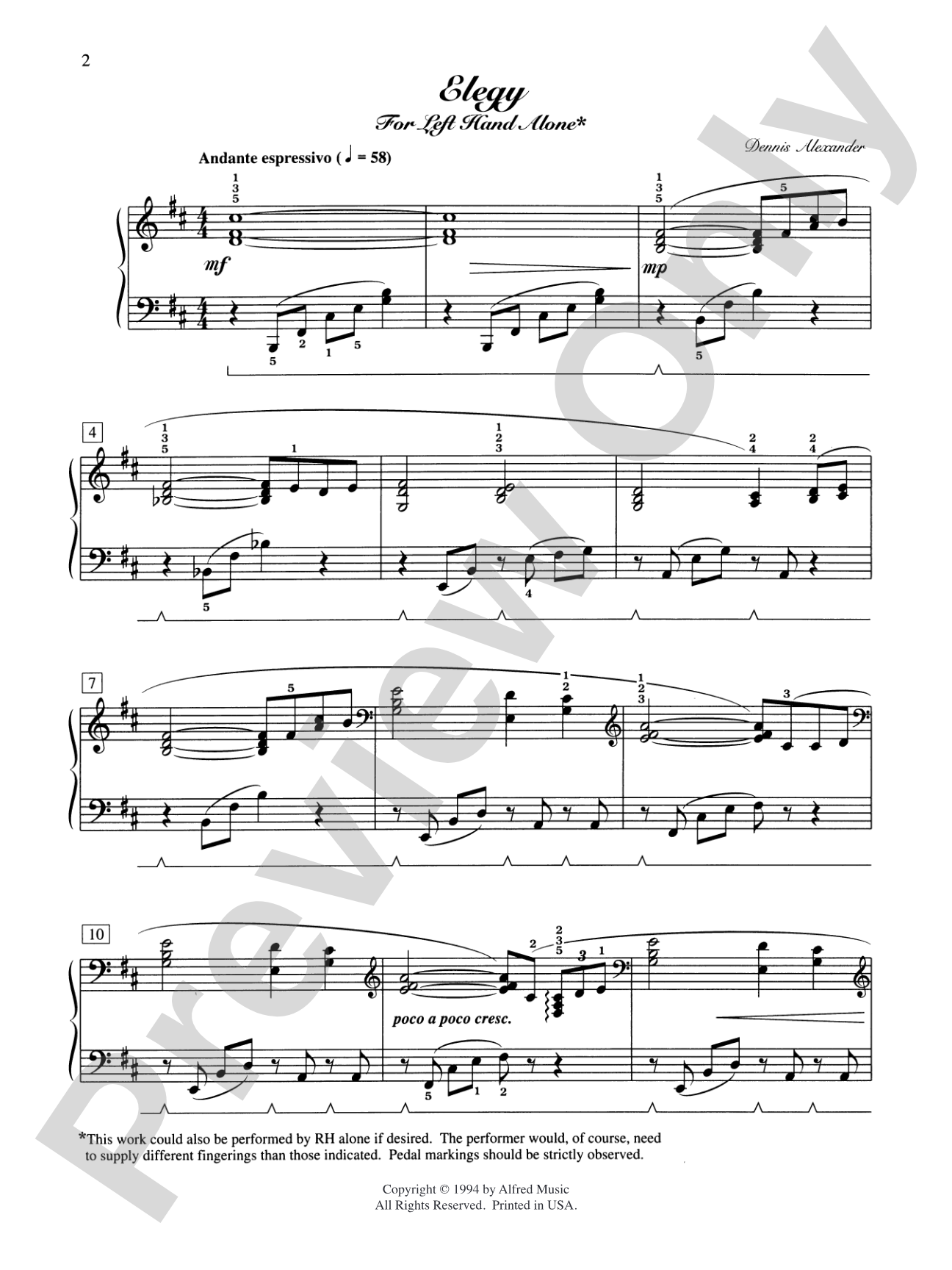

Elegy (for left hand alone) - Piano Solo: Piano
By Dennis Alexander
Level: Late Intermediate
Item: 00-PB-0000762
$3.50
Pickup currently not available
Related Items
Elegy (for left hand alone): Piano Sheet |
$3.50
|
View |
Description
Even though the left hand alone is featured in this beautiful "Andante Espressivo" piece, the artist will be playing above the center of the keyboard as well as below. It is set in D Major with a predominantly eighth note rhythm and a very legato, sustained flow, nicely balanced between melody and accompaniment. A Federation Festivals 2024-2028 selection.


Elegy (for left hand alone) - Piano Solo: Piano isn't in MakeMusic Cloud just yet...but it could be. Let us know you'd like to see it, and you'll help shape what comes next. In the meantime, start a free trial and dive into thousands of interactive titles your students can play along with today.
Request This Title
Tell us you want it.
Start Your Free Trial
Explore everything that's ready to play right now.
Sample Audio
1
Elegy LH
--:--
Elegy LH
0:00
0:00
Sample Video
No sample videos found.
Additional Details
Publisher:
Alfred Music
Page Count:
4
SKU:
00-PB-0000762
More about this title
About the Composer: Dennis Alexander

Dennis Alexander has built a career as one of the most published composers of educational piano repertoire, with over 400 compositions created for Alfred Music Publishing since 1986. His work spans all levels of difficulty and has earned international recognition for its musicality and pedagogical soundness. Alexander earned his degrees from the University of Kansas and spent 24 years teaching piano pedagogy at the University of Montana, where he also served as piano department chair. He has maintained an active schedule as a recitalist, chamber musician, and collaborative artist, performing across North America and Asia.
Beyond composition, Alexander has shaped music education through clinics at state and national conventions and adjudication work. He has been commissioned by numerous organizations and associations throughout his career. Based in Albuquerque, New Mexico, he continues to compose and tour regularly while remaining connected to the educational communities that have defined his work.
Why we love this
Alexander writes with a gift for lyrical left-hand writing that sounds fuller than its technical demands suggest. The piece balances genuine musical substance with accessibility, giving late intermediate students something worth caring about rather than a mere exercise. Its Federation Festivals recognition speaks to its quality and appeal across competitive contexts.
What to expect
The piece unfolds with quiet dignity, its D Major warmth and flowing eighth-note patterns creating an unhurried, introspective mood. The writing sits comfortably in the hand despite the left-hand alone requirement, offering moments of lyrical tenderness that feel neither precious nor overly sentimental. There is a mature, song-like quality that invites the pianist to listen as much as to play.
Who it's for
Late intermediate pianists preparing for festivals, recitals, or repertoire expansion will find this piece both musically rewarding and technically approachable. Students working on independence and control in the left hand benefit from the sustained legato and melodic focus. Teachers seeking Federation Festivals repertoire with genuine artistic merit will appreciate Alexander's craftsmanship.
How to get the most out of it
- Shape the left-hand melody with the same attention to phrasing and rubato you would give a right-hand line; this piece asks the pianist to sing through the lower register.
- Pay close attention to the balance between melody and accompaniment within the left hand; let the melodic material speak while keeping accompaniment figures rhythmically precise and understated.
- Sustain the legato flow across the break at the center of the keyboard; imagine the hand movement as one continuous gesture rather than a technical shift between registers.
- Use the Andante Espressivo marking as permission to shape tempo subtly; allow the phrasing to breathe naturally without rigidity.
How to use it
This works beautifully as a prelude or interlude in a student recital, offering contrast to more dramatic or virtuosic selections. Its registration in D Major and meditative character make it an effective bridge piece between groups of contrasting works. The piece is equally suited to festival programs or as a stepping stone toward solo repertoire that explores more complex technical terrain.
Skills your students will build
- Melodic shaping and phrasing in the left hand
- Hand independence and coordination across the keyboard center
- Legato pedaling and sustain control
- Balance between melody and accompaniment texture
- Expressive rubato and tempo flexibility within a sustained framework