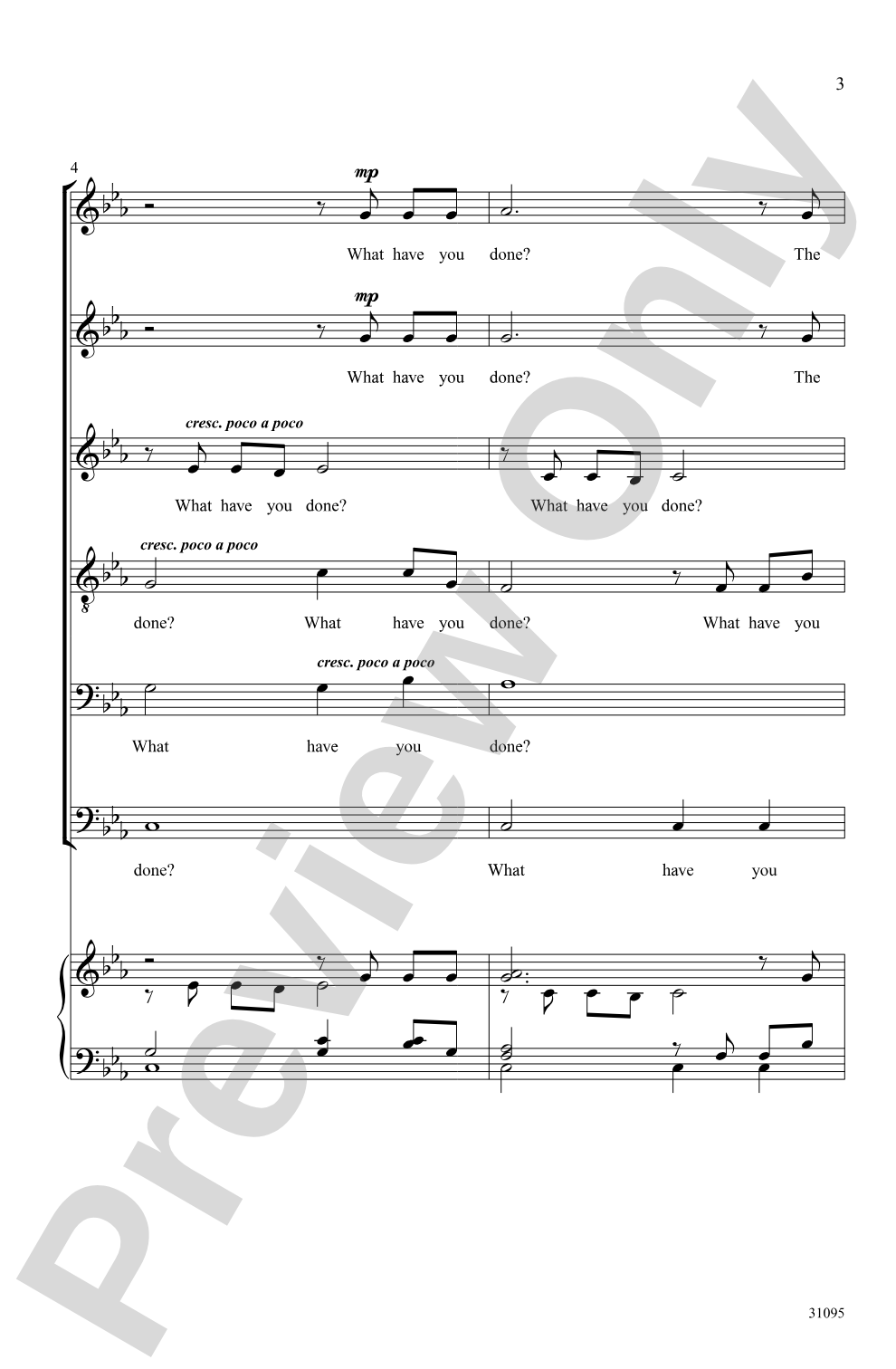
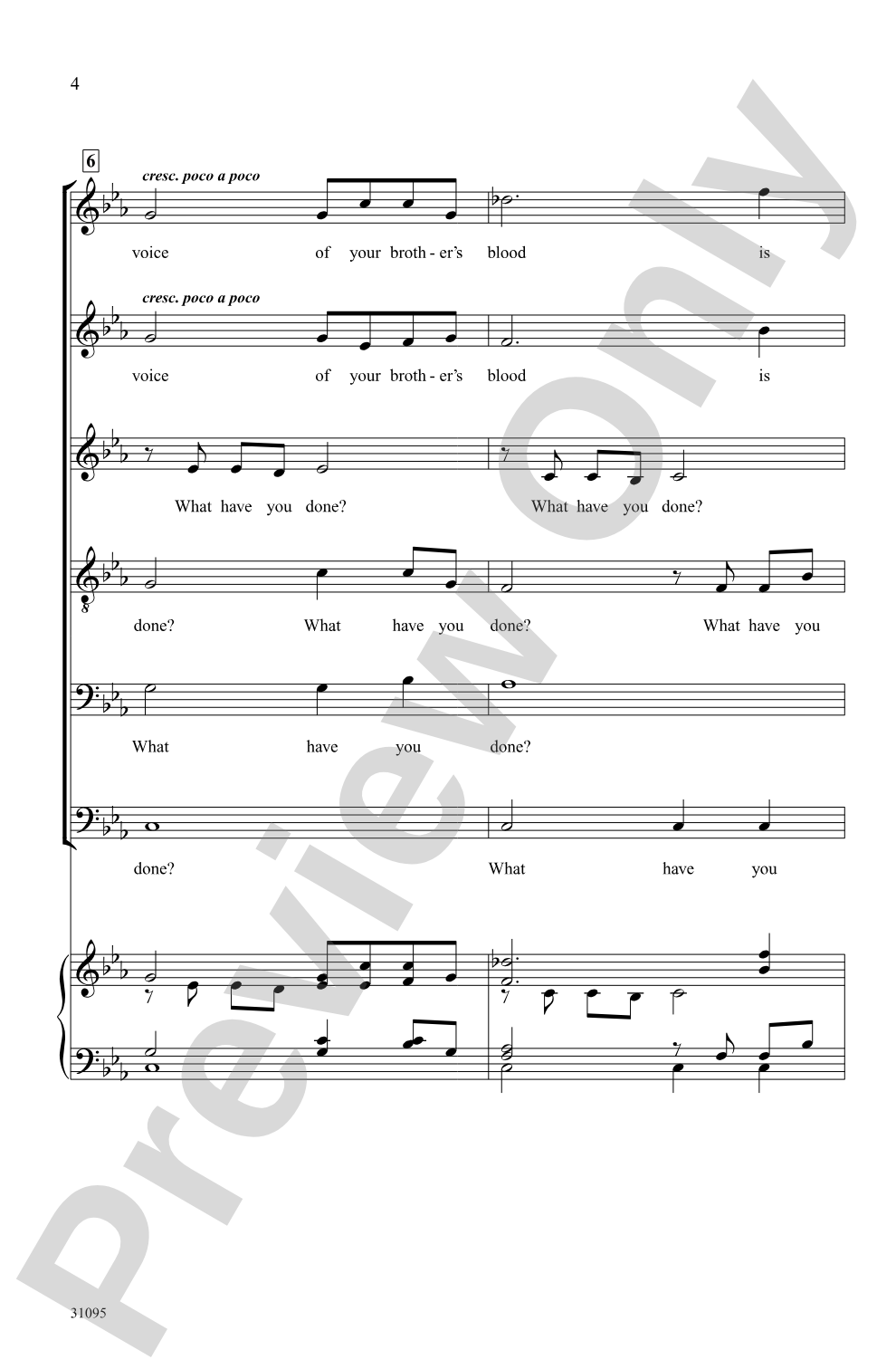
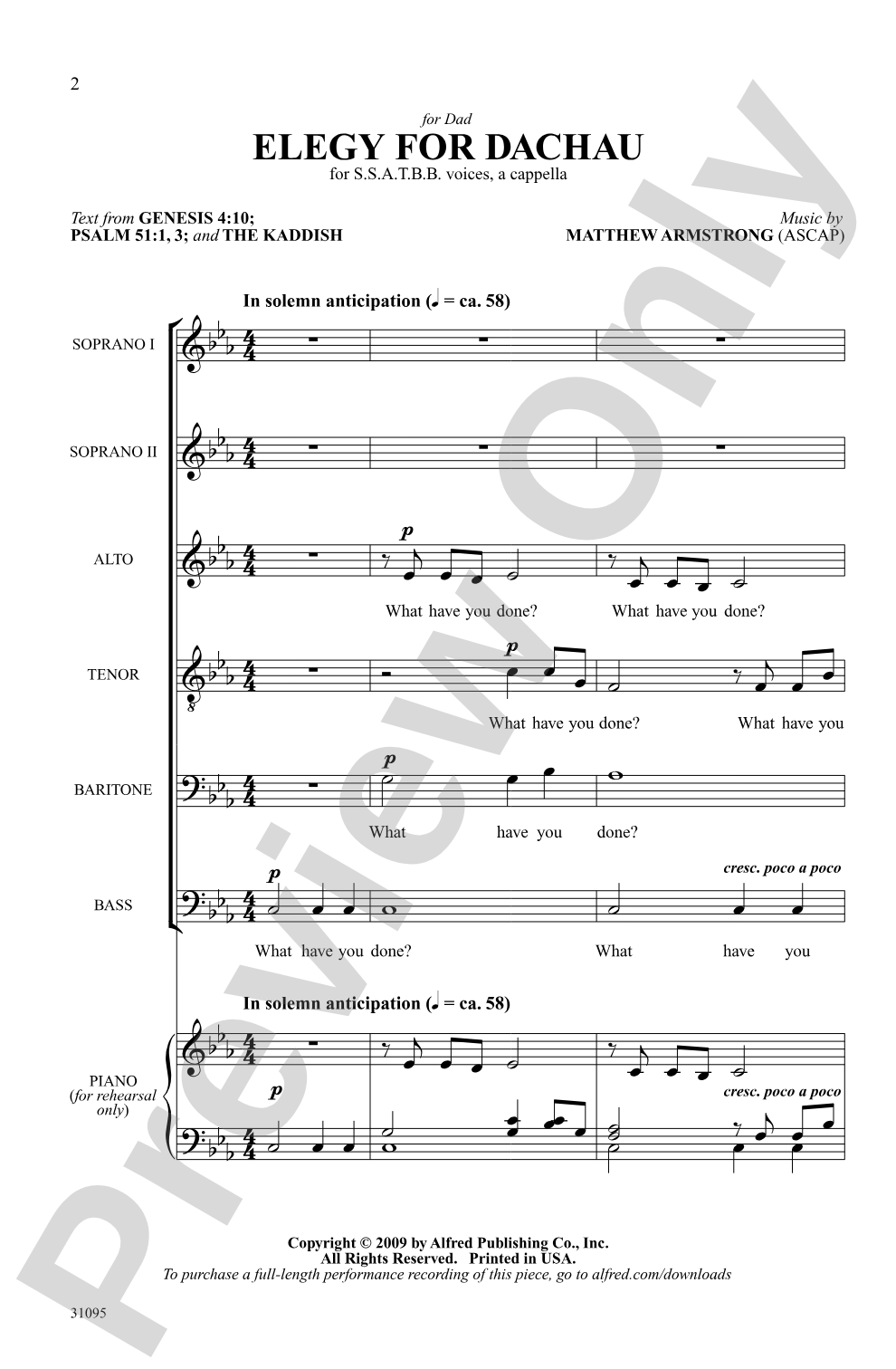
Elegy for Dachau Sheet Music Preview

Elegy for Dachau: SSATBB a cappella Choral Octavo

Text from Genesis 4:10, Psalm 51:1, 3; and The Kaddish, music by Matthew Armstrong

Item: 00-PO-0000784

Digital Download
$1.95

Minimum order quantity: 20 copies

Description
Inspired by the composer's visit to the memorial grounds of the former Nazi concentration camp in Dachau. Texts from Genesis 4 and Psalm 51 are first presented in haunting C minor layers. Then the piece blossoms into a reverent C major setting of the Kaddish, the Jewish Prayer of Mourning. Recorded by the Bowling Green State University Collegiate Chorale, Dr. William Skoog, Director.

Elegy for Dachau: SSATBB a cappella Choral Octavo isn't in MakeMusic Cloud just yet...but it could be. Let us know you'd like to see it, and you'll help shape what comes next. In the meantime, start a free trial and dive into thousands of interactive titles your students can play along with today.

Sample Audio
0:00
0:00
Sample Video
Additional Details
Series: Lawson-Gould
Publisher: Alfred Music
Page Count: 16
SKU: 00-PO-0000784

More about this title

About the Composer: Matthew Armstrong

Matthew Armstrong has established himself as a composer whose work engages with profound historical and spiritual themes. His choral writing demonstrates a sophisticated approach to text setting, particularly when working with sacred and commemorative material, balancing technical demands with emotional accessibility for singers.

Why we love this

Armstrong's treatment of this profound subject moves beyond sentiment into genuine liturgical and emotional depth. The structural arc from lament to affirmation gives your choir a piece that demands focused musicianship and rewards it with real spiritual weight, making it memorable for both singers and audience.

What to expect

The opening layers unfold like a prayer spoken in shadow, with tight harmonic clusters creating an atmosphere of grief and witness. As the piece opens into the Kaddish's C major light, the sound expands into something reverent and ultimately transcendent, leaving singers and listeners in a space of quiet reflection.

Who it's for

Advanced high school choirs and college ensembles with secure intonation and the vocal maturity to sustain extended a cappella passages. This work demands singers who can hold complex harmonies and embrace the emotional and spiritual demands of the text.

How to get the most out of it

  • Balance the layered C minor sections with care; each voice part carries textural significance, so avoid letting any line recede into the background during the Genesis and Psalm passages.
  • The transition into C major and the Kaddish requires a subtle shift in sound quality rather than a sudden dynamic change. Work toward a gradually brightening tone that feels inevitable rather than imposed.
  • Attend closely to breath placement across the six-part texture. With no instrumental support, staggered breathing patterns will keep the line alive without creating obvious gaps.
  • Allow silence to land fully at structural breaks. The contrast between dense harmonic writing and moments of rest deepens the piece's meditative power.

How to use it

This belongs on a concert addressing themes of remembrance, social justice, or spiritual resilience. It pairs naturally with other sacred a cappella work or as a standalone centerpiece in a program focused on music of witness and testimony. The piece's length and intensity suit a mid-concert moment where it can command full attention.

Skills your students will build

  • Reading six-part a cappella writing with chromatic harmonic movement
  • Sustaining intonation across extended passages without instrumental reference
  • Interpreting Hebrew liturgical text with appropriate phrasing and emotional nuance
  • Managing breath control in dense, layered textures
  • Responding to large-scale structural shifts in harmonic language and musical mood

You May Also Like