
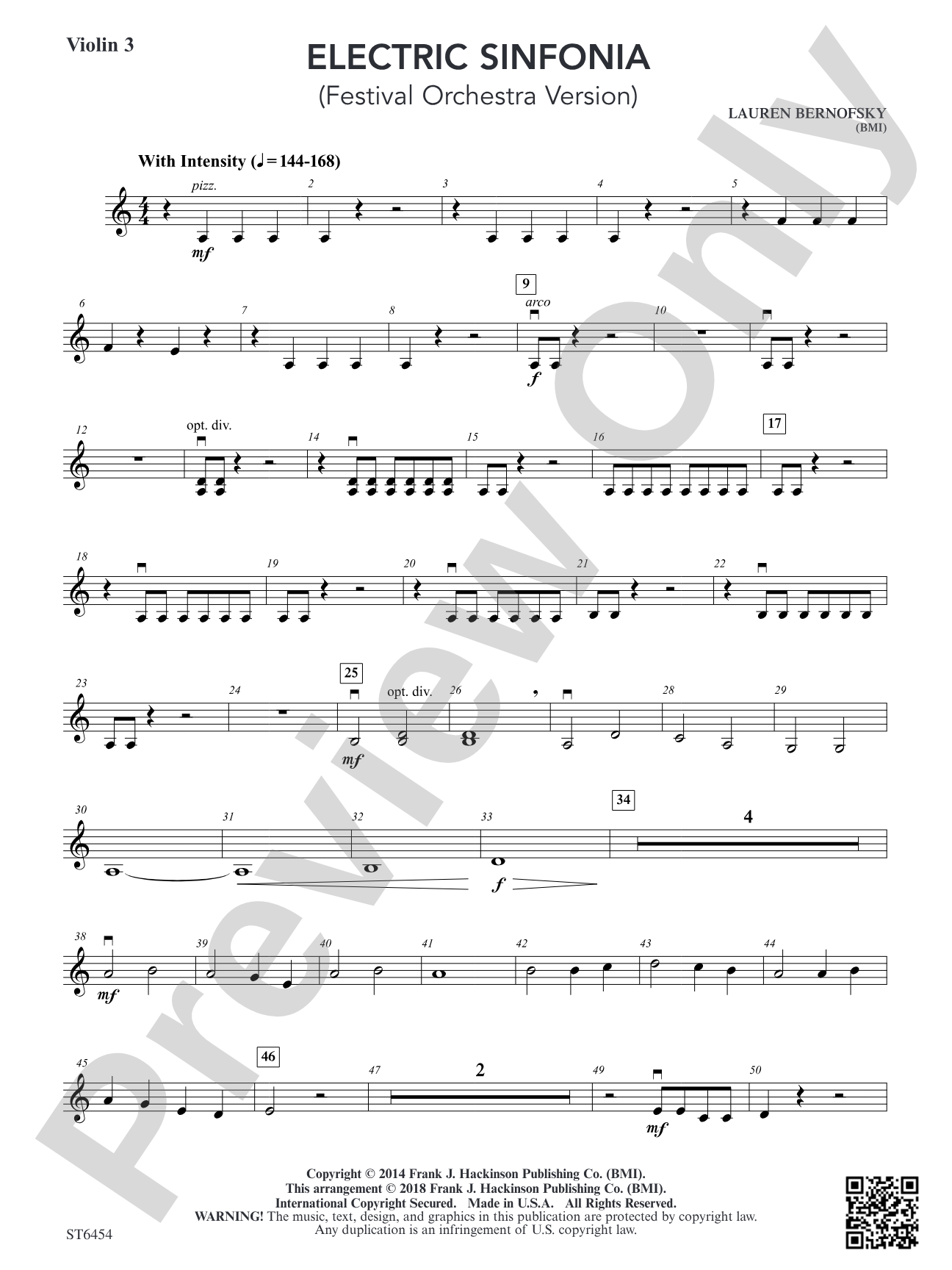

Electric Sinfonia: Violin 3 (Viola 1 T.C.)
By Lauren Bernofsky
Grade: 0.5;1;1.5;2;2.5
Item: 98-PC-DST6454_VN3
$7.00
Pickup currently not available
Description
This festival arrangement of Electric Sinfonia allows students from your entire strings program to play together! The set includes the required grade 2.5 parts along with easier grade 1 parts and a very easy grade ½ level, which uses only pizzicato. In a modal A minor, the piece has hints of rock music and a white-hot intensity that runs through the entire work. Perfect for building confidence - the individual parts are quite easy to play, but all together as a group... sensational!


Don't just read it, hear it, play along with it, and watch your students grow with it. In MakeMusic Cloud, Electric Sinfonia: Violin 3 (Viola 1 T.C.) comes alive with professional accompaniment, adjustable tempo, and built-in practice tools that turn solo practice into real progress.
Open in the Player
Jump straight in and assign it today.
Start Your Free Trial
Open this title and explore the full library in minutes.
Sample Audio
1
Audio File
--:--
0:00
0:00
Sample Video
Additional Details
Series:
FJH Developing Strings
Publisher:
The FJH Music Company, Inc.
SKU:
98-PC-DST6454_VN3
More about this title
About the Composer: Lauren Bernofsky

Lauren Bernofsky brings decades of compositional experience to works across virtually every medium. A recipient of grants from the National Foundation for the Advancement of the Arts, American Music Center, and American Composers Forum, she has created over a hundred compositions ranging from intimate solo works to large-scale orchestral and operatic projects. Her string quartet Anacostia Journal appeared on PBS, and her choral work Prayer of Shantideva was commissioned for a prayer service honoring the Dalai Lama, who attended the premiere.
Bernofsky holds degrees from the Hartt School (Bachelor's in violin and composition), New England Conservatory (Master's in composition), and Boston University (Doctorate of Musical Arts in composition). She has taught at the Peabody Institute and Interlochen Center for the Arts, and her music has been performed internationally by ensembles ranging from orchestras and ballet companies to chamber groups and soloists.
Why we love this
This arrangement solves the perennial multigrade problem by creating genuine musical cohesion across five ability levels, not just a lowest-common-denominator compromise. Every student plays something that matters to the overall sound, and the rock-inflected modal writing gives all parts real character, so your youngest players hear themselves as essential contributors rather than tag-alongs.
What to expect
Contemporary energy meets accessible string writing. The modal foundation and pizzicato drive create a rhythmic thrust that feels alive and modern, while the melodic lines reward careful, expressive playing without demanding technical pyrotechnics. This piece has the intensity of a festival opener but none of the anxiety.
Who it's for
String orchestra directors who work with mixed-ability ensembles and want a single piece that genuinely accommodates their entire program. Whether you're running a school orchestra with 10 players or a youth orchestra with 50 across multiple levels, this arrangement lets everyone perform together in a way that sounds cohesive and feels rewarding.
How to get the most out of it
- Balance the pizzicato foundation in the half-step parts. Those students are providing harmonic and rhythmic stability for the entire ensemble; make sure their groove cuts through without overwhelming the melody.
- Lean into the modal A minor sound by keeping vibrato minimal in the lower grade parts and encouraging it selectively in the upper parts. The hint of rock will come through more naturally if the sound stays clean and direct.
- Lock in as a full group before sectional rehearsals. Run through the complete texture at least once so all grades hear how their individual parts fit into the larger work; sectional work later will be far more focused when students understand the bigger picture.
How to use it
Program this as a festival contest piece or as your program's climactic full-ensemble work, especially early in the school year when mixed-grade collaboration builds community. It also works beautifully as a standalone concert piece that demonstrates your entire strings program's range and cohesion to families and donors.
Skills your students will build
- Playing with consistent pulse in modal contexts
- Balancing parts across multiple ability levels and registers
- Maintaining rhythmic precision in pizzicato accompaniment patterns
- Reading parts that sit comfortably within beginner and intermediate ranges
- Listening across the ensemble and adjusting tone quality to blend with other grades