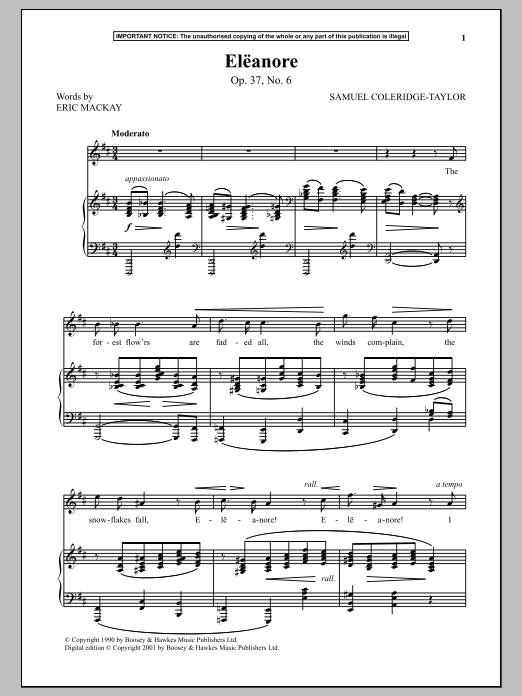
Eleanore, Op. 37, No. 6 Sheet Music Preview

Eleanore, Op. 37, No. 6: Piano Vocal

As performed by Samuel Coleridge-Taylor

Item: 35-DS00237793

Digital Download
$5.99
Description

Eleanore, Op. 37, No. 6: Piano Vocal isn't in MakeMusic Cloud just yet...but it could be. Let us know you'd like to see it, and you'll help shape what comes next. In the meantime, start a free trial and dive into thousands of interactive titles your students can play along with today.

Sample Audio
No sample audio found.
Sample Video
Additional Details
Publisher: Hal Leonard
Page Count: 4
SKU: 35-DS00237793

More about this title

About the Artist: Samuel Coleridge-Taylor

Samuel Coleridge-Taylor (1875–1912) was a trailblazing British composer whose work bridged Victorian concert traditions and emerging modernist voices. Born in London to a British mother and Sierra Leonean father, he became the first Black conductor of a major British orchestra and used his platform to champion inclusive music-making across social classes.

Coleridge-Taylor's vocal works reveal a sophisticated gift for text setting and melodic invention. His art songs and choral pieces drew on English folk traditions while embracing chromatic harmony and structural innovation that surprised and delighted audiences of his era. Though his life was cut short at 37, his legacy shaped how British composers approached the human voice.

Why we love this

This song distills Coleridge-Taylor's lyrical gift into a compact, singable form that rewards both amateur and accomplished singers. The piano part sits comfortably under the voice without demanding virtuosity, making it an intelligent choice for recital programs where text clarity and emotional directness matter more than technical display.

What to expect

A moment of intimate reflection; the piano creates a warm harmonic envelope while the voice carries a melody that feels both personal and universally human. There is restraint here, and grace.

Who it's for

Solo singers preparing art song recitals, advanced high school vocalists, and chamber music programs seeking substantive British repertoire. The modest accompaniment and accessible tessitura make it suitable for singers building confidence in the solo literature.

How to get the most out of it

  • Shape the melody with long, connected phrases rather than dwelling on individual notes. Coleridge-Taylor's lines breathe best when singers think in two and four-bar units.
  • Balance the vocal line against a supportive (not subordinate) piano part. The accompaniment contains harmonic color and rhythmic momentum; let the pianist feel equal to the singer.
  • Test the high points of your phrases in rehearsal to ensure they sit comfortably in your voice. Adjust any register transitions well before performance.

How to use it

Pair this with other British art songs or heritage repertoire to build a focused recital section, or use it as a bridge between longer, more virtuosic showpieces. At four pages, it programs efficiently and serves as a refreshing alternative to the standard German and French vocal canon.

Skills your students will build

  • Sustained legit singing without vibrato interference
  • Harmonic listening in relation to a moving piano part
  • Phrasing across four-bar melodic units
  • Interpretive choices in understated repertoire

You May Also Like