
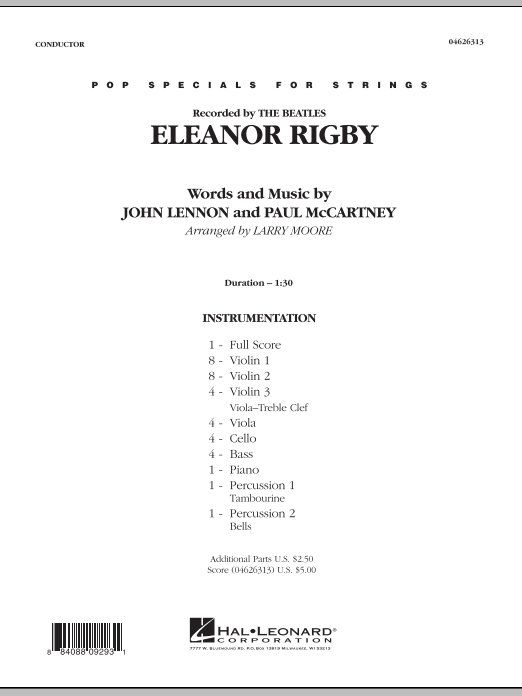

Eleanor Rigby: String Orchestra Conductor Score & Parts
By John Lennon / By Paul McCartney / As performed by The Beatles / Arranged by Larry Moore
Grade: 3
Item: 35-PK00143439
$50.00
Pickup currently not available
Buy Extra Parts (Digital PDF Download)
| Product | Price | Quantity |
|---|---|---|
| Eleanor Rigby - Full Score | $7.50 | |
| Eleanor Rigby - Violin 1 | $7.00 | |
| Eleanor Rigby - Violin 2 | $7.00 | |
| Eleanor Rigby - Violin 3 (Viola T.C.) | $7.00 | |
| Eleanor Rigby - Viola | $7.00 | |
| Eleanor Rigby - Cello | $7.00 | |
| Eleanor Rigby - Bass | $7.00 | |
| Eleanor Rigby - Piano | $7.00 | |
| Eleanor Rigby - Percussion 1 | $7.00 | |
| Eleanor Rigby - Percussion 2 | $7.00 |
Parts Added to Cart!
Description
Rhythmic drive and modal harmonies are just a part of the intrigue of this Beatles classic, known for its revolutionary inclusion of a string quartet with a pop-rock song. Larry Moore gives us a solid arrangement that features the unique blend of the classical and pop-rock style that is Eleanor Rigby's continuing legacy. Dur: 1:30


Eleanor Rigby: String Orchestra Conductor Score & Parts isn't in MakeMusic Cloud just yet...but it could be. Let us know you'd like to see it, and you'll help shape what comes next. In the meantime, start a free trial and dive into thousands of interactive titles your students can play along with today.
Request This Title
Tell us you want it.
Start Your Free Trial
Explore everything that's ready to play right now.
Sample Audio
No sample audio found.
Sample Video
No sample videos found.
Additional Details
Publisher:
Hal Leonard
SKU:
35-PK00143439
More about this title
About the Composer: John Lennon
John Lennon transformed popular music by refusing to accept the boundaries between genres. As a member of The Beatles, he pioneered the use of strings and orchestral textures in rock music, proving that formal classical arrangements could enhance rather than dilute a song's emotional core. His compositional approach emphasized melody, harmonic sophistication, and studio experimentation.
Lennon's legacy in music education extends beyond his recordings. Teachers use his songs to demonstrate how constraints breed creativity, how unconventional instrumentation can elevate a composition, and how pop music can demand the same serious musicianship as any classical work. Eleanor Rigby stands as a perfect example of this philosophy.
Why we love this
This arrangement captures the song's meditative quality while giving string players genuine musical substance to engage with. The Grade 3 scoring makes this accessible without sacrificing the modal harmonies and rhythmic subtlety that made the original so innovative; your ensemble can feel the difference between playing pop and playing music that happens to be pop.
What to expect
Sparse and contemplative, with an undercurrent of forward motion. The piece inhabits the minor mode without melodrama, allowing the story of the text to exist in the listeners' minds rather than imposed through lush orchestration. There's a quiet dignity here.
Who it's for
String orchestras seeking repertoire that bridges classical and contemporary idioms. This works equally well for ensembles exploring 20th century composition through popular music or for directors building programming that demonstrates how serious arranging elevates familiar songs.
How to get the most out of it
- Anchor the rhythmic drive in the lower strings. The piece's forward momentum depends on the cellos and basses maintaining a steady pulse without rushing; if they drag, the entire arrangement loses its hypnotic quality.
- Shape the modal phrases with care. Lennon's harmonic language doesn't follow traditional functional progressions, so resist the urge to apply standard phrase dynamics. Instead, listen for the internal shape of each melodic line.
- Let the recorded accompaniment serve as a reference for balance and articulation style. The original recording's austerity is part of its power; avoid lush, romantic interpretations that would contradict the song's understated character.
- Honor the silence. This piece is built on negative space as much as notes. Clear articulation of rests will deepen the listener's connection to the melody.
How to use it
Pair this with a thematic concert exploring strings in rock music or place it alongside other Grade 3 works that demand maturity in ensemble listening. This works beautifully as a concert opener or closer, creating a moment of reflection in an otherwise traditional or contemporary program.
Skills your students will build
- Reading modal melodies without functional harmonic anchors
- Maintaining pulse-driven ensemble rhythm across sustained textures
- Balancing melodic and accompaniment lines in a rhythmically-driven context
- Executing clean articulation with minimal dynamic variance
- Responding to the emotional content of a familiar melody through fresh interpretation