Eleanor Rigby Sheet Music Preview

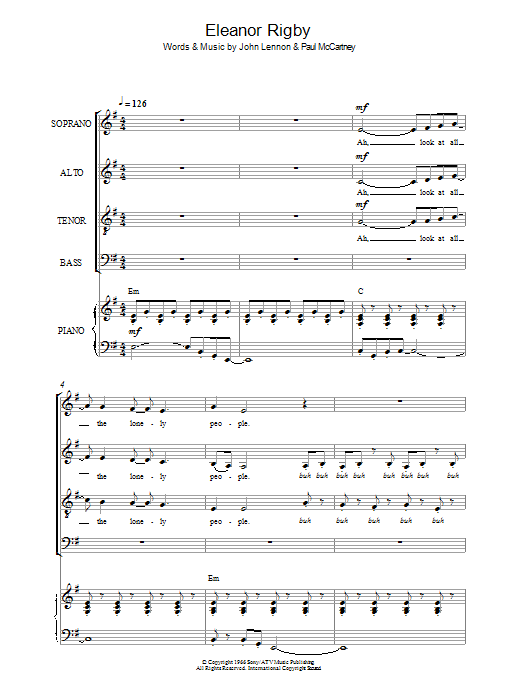
Eleanor Rigby: Choral Octavo

As performed by The Beatles

Item: 35-DS00279556

Digital Download
$2.99
Description

Eleanor Rigby: Choral Octavo isn't in MakeMusic Cloud just yet...but it could be. Let us know you'd like to see it, and you'll help shape what comes next. In the meantime, start a free trial and dive into thousands of interactive titles your students can play along with today.

Sample Audio
No sample audio found.
Sample Video
Additional Details
Publisher: Hal Leonard
Page Count: 14
SKU: 35-DS00279556

More about this title

About the Artist: The Beatles

The Beatles fundamentally changed what popular music could be, moving far beyond their early pop hits to embrace studio experimentation, orchestral arrangements, and literary depth. By the mid-1960s, they were composing songs of genuine artistic ambition, and "Eleanor Rigby" stands as a perfect example of their evolution into serious songwriters.

For choral directors, The Beatles' catalog offers something rare: rock repertoire with melodic sophistication and emotional substance. Their work has proven durable in educational settings because it engages singers with contemporary idioms while demanding genuine musical attention.

Why we love this

This arrangement captures the distinctive melancholy and orchestral texture of the original without requiring a full ensemble, making it genuinely achievable for high school and college choirs. The song's serious lyrical content and sophisticated harmonic language signal to audiences that you're programming music with real artistic weight, not novelty.

What to expect

Somber and spare, with an almost chamber music quality despite the group setting. The arrangement respects the original's quiet dignity, creating space for reflection rather than grandeur.

Who it's for

This piece works for choirs that can handle straightforward but emotionally nuanced music. It suits high school groups with solid fundamentals and college ensembles looking for repertoire that bridges classical and contemporary idioms.

How to get the most out of it

  • Shape the vocal lines with the contour of the original melody; avoid a bouncy rhythmic approach that would undermine the song's introspective character
  • Balance the parts so no single voice dominates; this arrangement works best when listeners hear the composite texture rather than individual lines
  • Let silences breathe between phrases to emphasize the isolation that the lyric describes

How to use it

Pair this with other songs about social observation or loneliness to build a thematic concert. It also serves as an excellent counterpoint in a program that includes more energetic pop arrangements, offering audiences a moment of genuine introspection.

Skills your students will build

  • Singing sustained, lyrical lines with minimal vibrato
  • Balancing independent melodic parts in four-part harmony
  • Interpreting popular music with dramatic sensitivity rather than rhythmic energy
  • Ensemble cohesion without doubling support from instruments

You May Also Like