
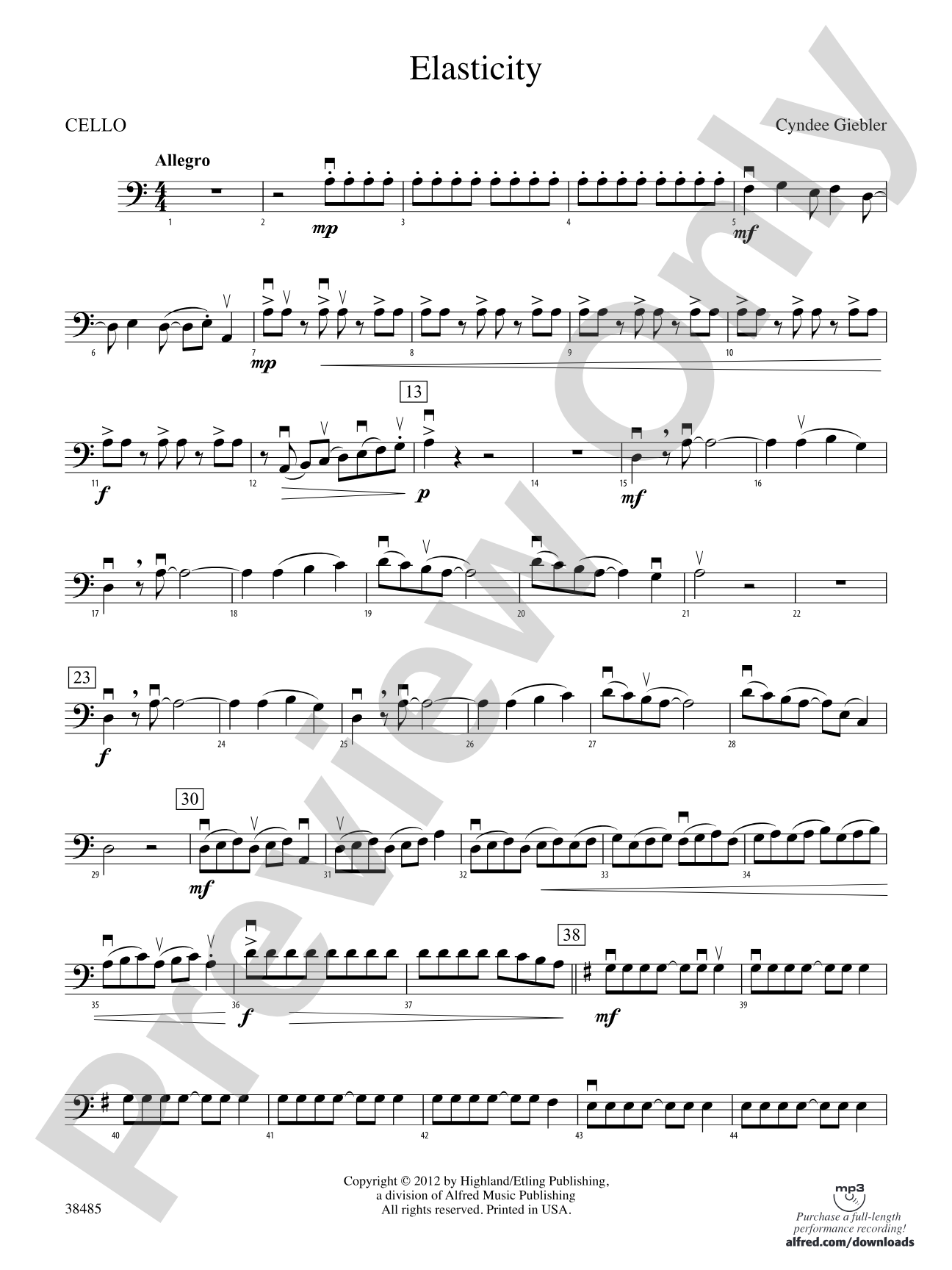

Elasticity: Cello
By Cyndee Giebler
Grade: 2
Item: 00-PC-0015533_VC1
$5.99
Pickup currently not available
Description
This original composition is a study in contrasts fueled by relentless rhythmic propulsion. All sections have a chance to be featured as well as accompany. This piece will sharpen your group's ensemble skills with its infectious syncopated melody. First violins have some easy third position work in the lyrical middle section. Snap pizzicatos provide delightful and unexpected sonic interest. Your group will ask to play this again and again. Your audience will love it, too!


Don't just read it, hear it, play along with it, and watch your students grow with it. In MakeMusic Cloud, Elasticity: Cello comes alive with professional accompaniment, adjustable tempo, and built-in practice tools that turn solo practice into real progress.
Open in the Player
Jump straight in and assign it today.
Start Your Free Trial
Open this title and explore the full library in minutes.
Sample Audio
1
Audio File
--:--
0:00
0:00
Sample Video
No sample videos found.
Additional Details
Series:
Highland/Etling String Orchestra
Publisher:
Alfred Music
Page Count:
124
SKU:
00-PC-0015533_VC1
More about this title
About the Composer: Cyndee Giebler

Cyndee Giebler brings together classroom teaching experience and formal training in composition and pedagogy. Based in northeast Wisconsin, she studied at the University of Wisconsin and earned her Master's Degree from the University of St. Thomas. Her distinctive preparation includes the first Barbara Potter Scholarship for study at the Orff Institut in Salzburg, Austria, where she deepened her understanding of music-making rooted in movement and creativity.
Giebler's compositional voice reflects her work across multiple settings. She writes regularly for classroom music, children's choirs, string ensembles, and beginning band programs, always with an ear toward what students actually need to grow as musicians and what teachers can realistically bring to life in rehearsal.
Why we love this
Giebler builds this piece around rhythmic momentum and textural variety rather than technical complexity, which means your orchestra stays engaged without losing cohesion. The balanced scoring gives every section meaningful material to play, so no one checks out, and the syncopated melody sticks with audiences long after the final pizzicato snap. String orchestras at this level rarely encounter work this musically satisfying and this genuinely fun to rehearse.
What to expect
Elasticity moves with infectious forward motion, built from syncopated lines that snap into focus. The middle section opens into something more lyrical and spacious before the rhythmic energy returns, creating a satisfying arc that feels both contemporary and organic.
Who it's for
String orchestras working at Grade 2 will find this accessible without feeling simplistic. Teachers developing ensemble balance and rhythmic precision will appreciate repertoire that challenges listening without overwhelming technique.
How to get the most out of it
- Anchor the syncopated melodic figures with a steady pulse from the lower strings; rhythmic clarity here prevents the piece from feeling rushed and lets the accompaniment patterns breathe.
- Approach the snap pizzicatos as articulation, not afterthought. Clean, simultaneous attacks make them the delightful moment Giebler intends, not a distraction.
- In the lyrical middle section, use the easy third position work for first violins as an opportunity to develop intonation awareness across the entire section; the simpler technical demand frees players to listen vertically.
- Let the contrast between sections breathe. Resist the urge to smooth transitions; the piece gains its identity from moving between energetic rhythmic sections and more lyrical material.
How to use it
This works brilliantly as a concert opener or closer, where its approachable energy and audience appeal create an immediate connection. Consider pairing it with contrasting lyrical or dramatic pieces to showcase your orchestra's range within a single concert, or program it in a festival setting where its rhythmic clarity and clean musicality will impress adjudicators.
Skills your students will build
- Syncopated rhythm reading and execution
- Balance between melody and accompaniment parts
- Pizzicato articulation and timing
- Third position intonation on first violin
- Sectional ensemble cohesion under rhythmic propulsion