
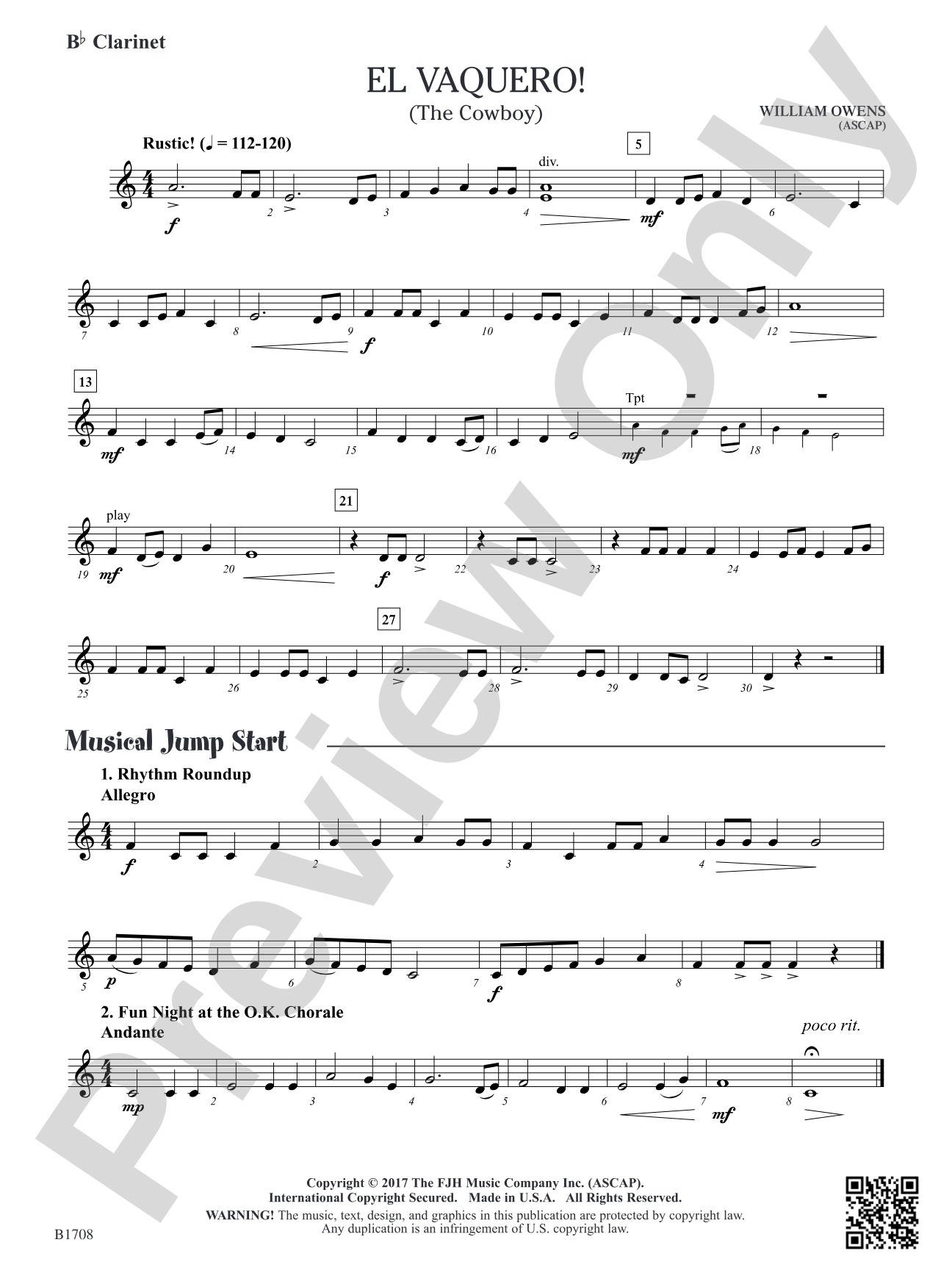

El Vaquero!: B-flat Clarinet
By William Owens
Level:.5
Item: 98-PC-DB1708_C1
$7.00
Pickup currently not available
Description
Take an exciting ride across the open range with this bold Spanish-flavored work! Your students will sound mature beyond their years with this strategically orchestrated work using only six notes! A wealth of intelligently scored auxiliary percussion adds a great deal to the character of the work. Giddyup!


El Vaquero!: B-flat Clarinet isn't in MakeMusic Cloud just yet...but it could be. Let us know you'd like to see it, and you'll help shape what comes next. In the meantime, start a free trial and dive into thousands of interactive titles your students can play along with today.
Request This Title
Tell us you want it.
Start Your Free Trial
Explore everything that's ready to play right now.
Sample Audio
1
Audio File
--:--
0:00
0:00
Sample Video
Additional Details
Series:
FJH Starter Series
Publisher:
The FJH Music Company, Inc.
SKU:
98-PC-DB1708_C1
More about this title
About the Composer: William Owens
William Owens has spent three decades as both a band director and prolific composer, earning recognition as one of the most practical and effective writers for young ensembles in America. A 1985 graduate of VanderCook College of Music, he has since created over 300 works for concert band, string orchestra, and chamber groups, many of which appear on state required music lists and in music education texts. His compositions for developing musicians balance accessibility with genuine musical substance, a philosophy grounded in his years teaching in Texas public schools.
Owens has received commissions from major organizations including the American Bandmasters Association and Phi Beta Mu International, and holds membership in ASCAP. He was honored as a Distinguished Alumnus by VanderCook and received the Texas Bandmasters Association's Meritorious Achievement Award. After retiring from full-time teaching in 2014, he continues to compose and conduct clinics throughout North America.
Why we love this
Owens crafts pieces that let beginning bands sound confident and polished without requiring technical wizardry. Using only six notes across the ensemble while layering percussion in musically intelligent ways, he creates the illusion of greater complexity than what sits on the stands. Your students will feel like they're performing real concert music from day one.
What to expect
A vivid ride across wide-open country with the swagger of a Spanish bolero. The orchestration creates movement and color through rhythmic layers and percussion color, evoking both the romance of the theme and the energy of the open range. Every note has a reason to exist, and students will feel the satisfaction of contributing to something that sounds genuinely professional.
Who it's for
Beginning and early intermediate concert bands looking for repertoire that sounds mature without overwhelming developing musicians. This works equally well for bands just starting out and those transitioning from method book studies into independent parts and fuller ensemble textures.
How to get the most out of it
- Establish the Latin character through the auxiliary percussion. The ensemble's maturity depends on rhythmic confidence from timpani, woodblock, and other auxiliary instruments; rehearse these parts with the precision you'd give to a wind melody.
- Lock the brass on their articulation patterns early. The Spanish-flavored figures benefit from tight, unified tonguing; spend time on this before worrying about blend.
- Balance the full band mix by letting clarinet and saxophone lines sit slightly forward. With such limited pitch material, the arrangement's personality lives in color and line placement rather than harmonic thickness.
- Use the score's orchestration as a teaching tool. Point out how Owens achieves momentum and variation through doublings and reorchestrations rather than new melodic material; this builds understanding of arrangement principles.
How to use it
Program this as a concert opener or early-fall showcase piece when you need something that demonstrates polish without requiring weeks of refinement. Its multicultural character also makes it a natural fit for programming around folk traditions or global music themes, and it pairs well before or after more traditional march-style works to show stylistic range.
Skills your students will build
- Reading six-note limited pitch vocabulary across full concert band instrumentation
- Articulation consistency in Spanish-flavored rhythmic figures
- Percussion ensemble reading and rhythmic independence
- Understanding color and orchestration as compositional tools
- Confident playing in unfamiliar cultural style