
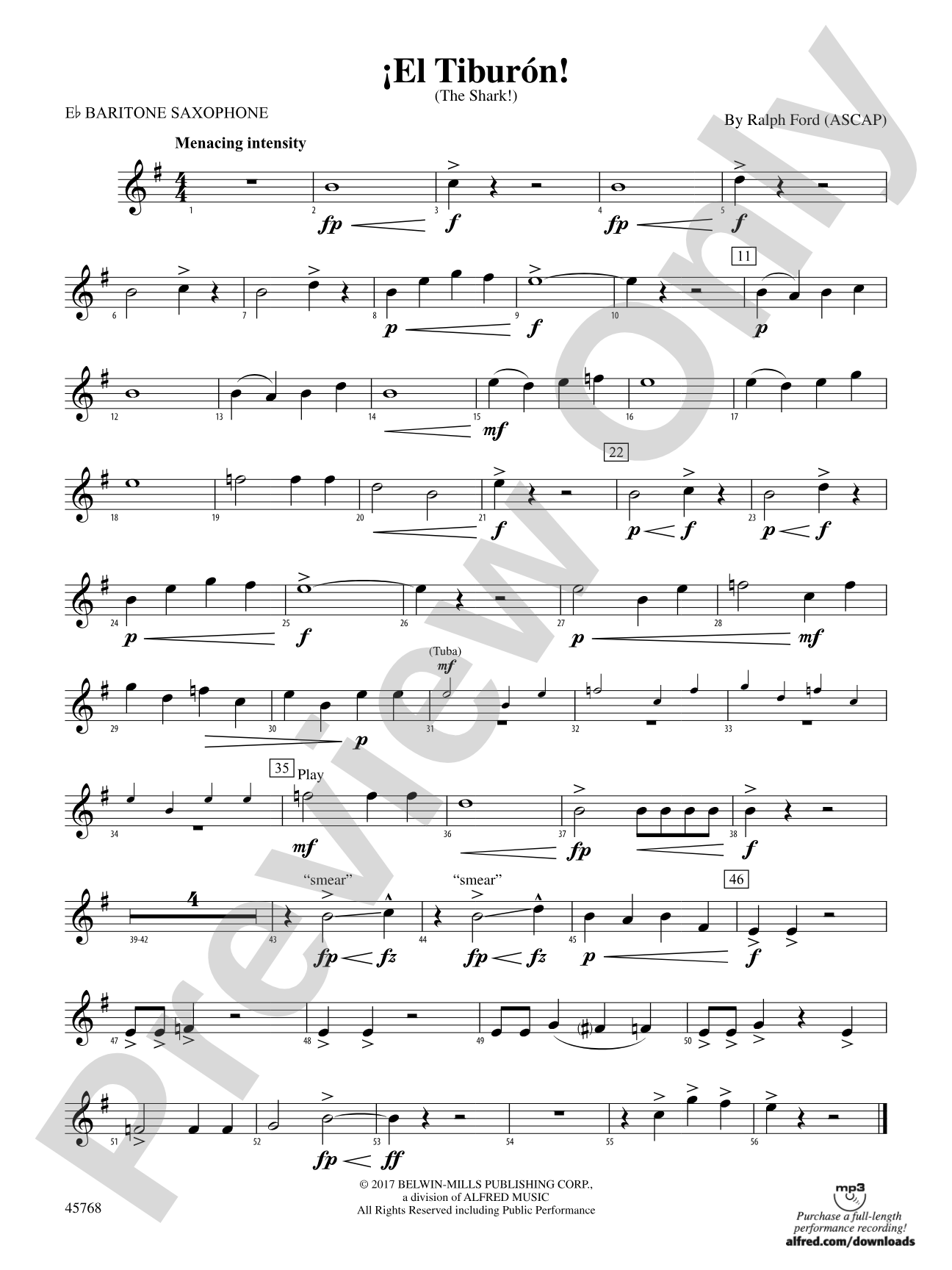

¡El Tiburón!: E-flat Baritone Saxophone
(The Shark!)
By Ralph Ford
Grade: 1.5 (Very Easy to Easy)
Item: 00-PC-0017579_BTX
$3.00
Pickup currently not available
Description
Cast in G minor, this compelling original work contains all the anticipated components with a musical depiction of circling the prey and the strike. The effects are complete with the use of vivid dynamic shifts and a solid percussion contribution. All musical components are easily attainable by beginning students. Dating back to more than 420 million years ago, these continuously moving "soulless eating machines" have been the subject extensive study and graphic horror. "¡El Tiburón!" by Ralph Ford is musically menacing yet audience pleasing! (2:00)


Don't just read it, hear it, play along with it, and watch your students grow with it. In MakeMusic Cloud, ¡El Tiburón!: E-flat Baritone Saxophone comes alive with professional accompaniment, adjustable tempo, and built-in practice tools that turn solo practice into real progress.
Open in the Player
Jump straight in and assign it today.
Start Your Free Trial
Open this title and explore the full library in minutes.
Sample Audio
1
Audio File
--:--
0:00
0:00
Sample Video
Additional Details
Series:
Belwin Beginning Band
Publisher:
Alfred Music
Page Count:
136
SKU:
00-PC-0017579_BTX
More about this title
About the Composer: Ralph Ford

Ralph Ford has spent nearly three decades on university music faculties while maintaining an active career as a composer, arranger, and clinician. His dual focus on academic instruction and professional composition has resulted in over 250 published works across orchestra, concert band, jazz ensemble, and marching band repertoire, all distributed through Alfred Music's Belwin division.
Beyond the concert hall, Ford has worked extensively in media production, broadcast, and commercial music, earning international recognition for advertising work and audio design. He began arranging professionally at fifteen and held the position of Director of Jazz Ensemble I at Troy State University during his undergraduate years, establishing early the collaborative and mentoring approach that characterizes his teaching.
Why we love this
Ford captures the predatory energy of his subject without sacrificing accessibility. Beginning ensembles rarely get original works with this much musical personality and dramatic arc, and the vivid dynamic contrasts make the piece engaging for student musicians and audiences alike. The percussion writing elevates the entire band sound while remaining within technical reach.
What to expect
The music circles and stalks like its subject, building tension through layered texture and dynamic intensity before delivering a satisfying strike. G minor gives the work a modern, slightly unsettling edge that appeals to young musicians who want their repertoire to sound substantial and dramatic.
Who it's for
First-year and second-year concert band students who benefit from energetic, character-driven original music at an achievable technical level. Directors seeking concert or festival repertoire that captures student imagination while maintaining strict Grade 1.5 accessibility.
How to get the most out of it
- Shape the circling sections with gradual dynamic growth, allowing the percussion foundation to build tension before the strike occurs.
- Balance the G minor tonality by letting woodwinds carry the main line during development passages; don't let brass weigh it down too early.
- Isolate the percussion from the full ensemble in rehearsal to lock the rhythmic backbone before integrating it with the melodic material.
- Mark the dynamic shifts clearly in all parts; these sudden changes are essential to the menacing character and require ensemble precision.
How to use it
Program this in the opening slot of a concert where you want to capture immediate attention, or place it mid-program as a palate cleanser between slower works. Its two-minute duration and strong narrative arc make it ideal for festival circuits where judges reward compositional clarity and ensemble discipline at the novice level.
Skills your students will build
- Dynamic control and sudden shift execution (pp to ff transitions)
- Ensemble balance in G minor tonality
- Rhythmic precision with active percussion parts
- Expressive phrasing guided by programmatic content
- Sectional independence while maintaining ensemble cohesion