
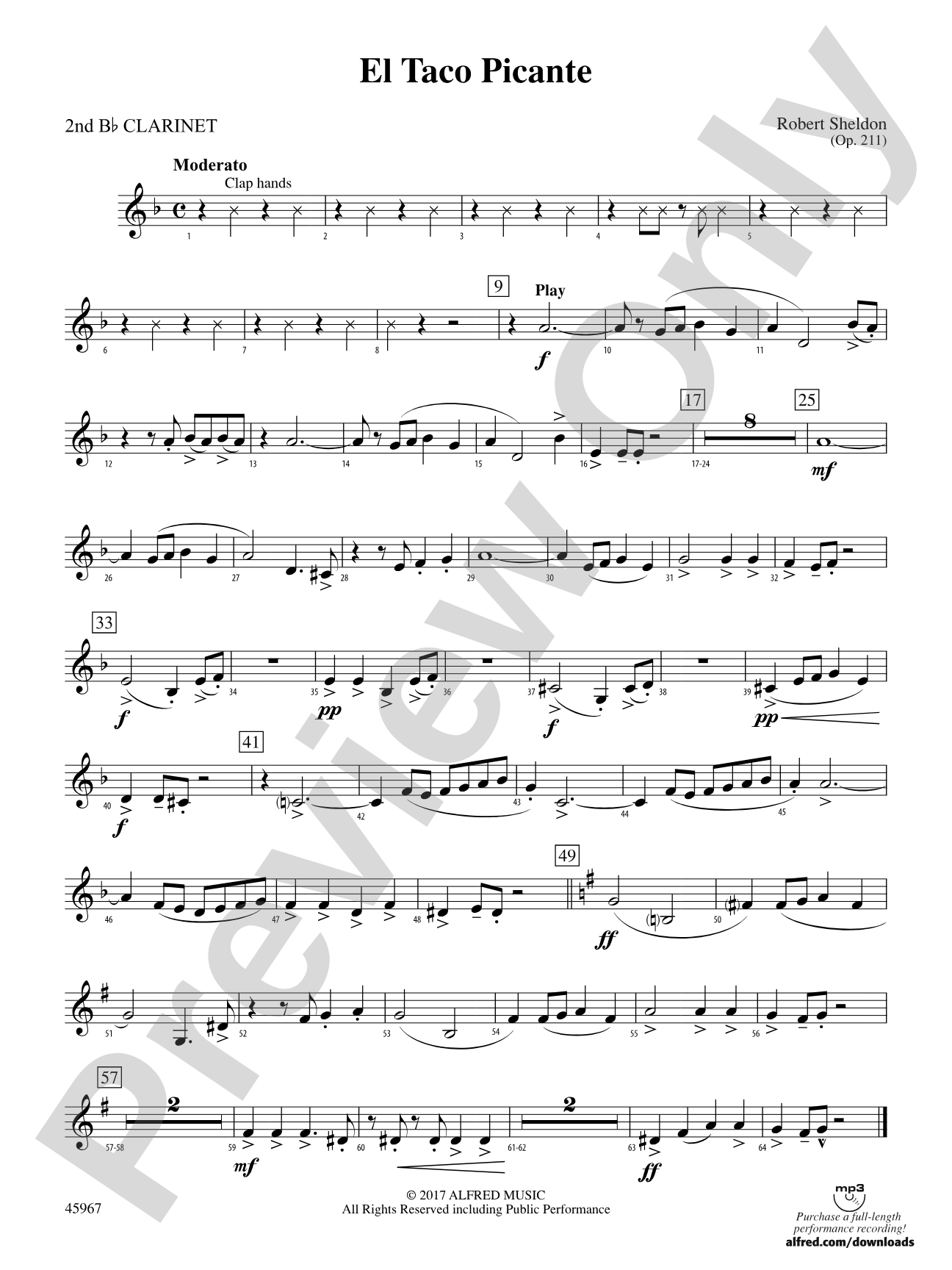

El Taco Picante: 2nd B-flat Clarinet
By Robert Sheldon
Grade: 1.5 (Easy)
Item: 00-PC-0017693_C2
$3.00
Pickup currently not available
Description
Here's a tasty treat for your next concert, full of spice and sure to please. A catchy bass riff sets off hot Latin rhythms and a tune that shifts from minor to major. This is definitely a piece that will get your audience tapping their toes! "Taco Picante" is skillfully arranged by Robert Sheldon. (1:55) Correlates to Book 1, level 6. This title is available in MakeMusic Cloud.


Don't just read it, hear it, play along with it, and watch your students grow with it. In MakeMusic Cloud, El Taco Picante: 2nd B-flat Clarinet comes alive with professional accompaniment, adjustable tempo, and built-in practice tools that turn solo practice into real progress.
Open in the Player
Jump straight in and assign it today.
Start Your Free Trial
Open this title and explore the full library in minutes.
Sample Audio
1
Audio File
--:--
0:00
0:00
Sample Video
Additional Details
Series:
Sound Innovations for Concert Band
Publisher:
Alfred Music
Page Count:
148
SKU:
00-PC-0017693_C2
More about this title
About the Composer: Robert Sheldon

Robert Sheldon stands among the most frequently performed composers in the wind band repertoire today. His work as lead author of Sound Innovations for Concert Band has shaped how countless students learn to read and perform music. Sheldon has earned recognition from the American School Band Director's Association, Phi Beta Mu, and ASCAP, with his compositions gaining traction on international concert and contest programs.
As a guest conductor, clinician, and commissioned composer, Sheldon maintains an active schedule across the United States and internationally, including appearances in Japan, Canada, Italy, Germany, Australia, and China. His works have been performed at Carnegie Hall, Orchestra Hall, Boston's Symphony Hall, the Sydney Opera House, and the Kennedy Center. VanderCook College of Music awarded him an honorary doctorate in 2020.
Why we love this
Sheldon understands what works on the concert stage at this level, and El Taco Picante delivers exactly that: immediate melodic appeal paired with authentic Latin texture that energizes both players and listeners. The minor-to-major harmonic shift gives the piece musical substance beyond its catchy surface, and the foundational bass riff provides security for younger ensembles while remaining genuinely satisfying to perform.
What to expect
Bright, spicy, and instantly engaging, with the infectious pulse of Latin rhythm propelling the melodic line forward. The harmonic movement from minor to major feels like a transition from anticipation to celebration, and the whole work radiates the kind of straightforward joy that makes audiences want to move.
Who it's for
Concert bands working at the Grade 1.5 level or early in their season, regardless of experience. This piece works equally well for groups building confidence on foundational repertoire or for stronger ensembles needing a high-energy filler that delivers real musical satisfaction.
How to get the most out of it
- Establish the bass riff as the rhythmic anchor during early rehearsals. Lock the low brass and percussion into that pattern before layering the melody, so the foundation holds firm even when tutti texture gets full.
- Shape the transition from minor to major with a clear change in dynamic or articulation weight. Let the shift feel like a genuine harmonic pivot rather than simply a chord change.
- Work the Latin percussion parts separately with your rhythm section. These aren't decorative; they're essential to the style and deserve precision rehearsal time.
- Capture the toe-tapping character in your own conducting. A relaxed, groove-oriented tempo will communicate confidence to the band and let the audience feel the infectious energy.
How to use it
Program this as a concert opener or early-set energizer to establish audience engagement from the start. It pairs well alongside other accessible literature of similar length and weight, and its infectious groove provides an ideal contrast to more lyrical or serious works elsewhere on the program.
Skills your students will build
- Latin rhythmic articulation and phrasing
- Playing with stylistic groove and precision alongside percussion
- Reading and executing a harmonic shift from minor to major
- Sectional balance in full ensemble texture at accessible ranges