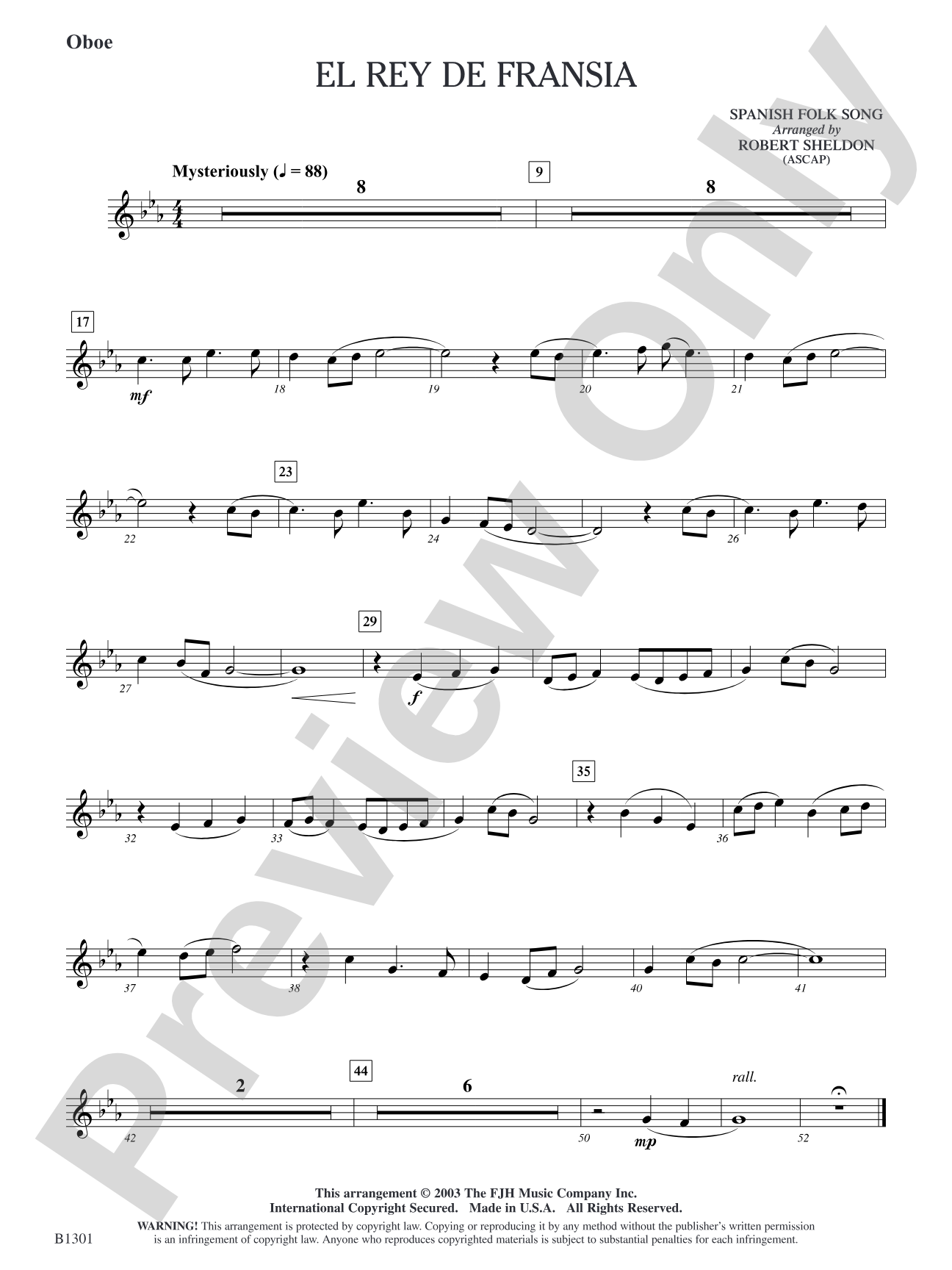
El rey de Fransia: Oboe Sheet Music Preview

El rey de Fransia: Oboe

Arranged by Robert Sheldon

Grade: 1.5

Item: 98-PC-DB1301_O1

Digital Download
$7.00
Description
Showcase the lyrical playing of your ensemble in this medieval sounding work. Intertwined with energizing percussion, the haunting melody is cast in an updated setting, yet Robert Sheldon also manages to maintain much of the colors and exotic elements of the original. Excellent writing, memorable lines, and easy to put together.

El rey de Fransia: Oboe isn't in MakeMusic Cloud just yet...but it could be. Let us know you'd like to see it, and you'll help shape what comes next. In the meantime, start a free trial and dive into thousands of interactive titles your students can play along with today.

Sample Audio
0:00
0:00
Sample Video
Additional Details
Series: FJH Developing Band
Publisher: The FJH Music Company, Inc.
SKU: 98-PC-DB1301_O1

More about this title

About the Composer: Robert Sheldon

Robert Sheldon

Robert Sheldon stands among today's most widely performed composers of wind band music, with works that consistently appear on contest and concert rosters across the globe. His compositions for concert band have earned him numerous accolades from the American School Band Director's Association, Phi Beta Mu, and ASCAP, recognizing his gift for crafting music that speaks to both ensemble and audience. As the lead author of Sound Innovations for Concert Band, Sheldon has shaped how young musicians learn their craft.

Beyond the page, Sheldon maintains an active schedule as guest conductor for All-State and Regional Honor Bands, clinician at universities and state conferences, and commission composer producing substantial new works each year. His music has been performed at Carnegie Hall, Orchestra Hall, the Kennedy Center, and concert halls across Japan, Canada, Italy, Germany, Australia, and China. In 2020, VanderCook College of Music honored him with a doctorate.

Why we love this

Sheldon brings sophistication to an accessible level. The medieval character of the original melody translates into something fresh without sounding academic or detached, and the percussion writing energizes the texture throughout without overwhelming younger players. This is the kind of Grade 1.5 work that doesn't talk down to your ensemble, it respects their musicianship while remaining genuinely manageable to prepare.

What to expect

Medieval yet contemporary; the haunting melody evokes something ancient and distant, while the updated harmonic language keeps the sound modern and engaging. Percussion weaves through like a second voice, creating energy that lifts the piece beyond a simple lyrical statement.

Who it's for

Developing concert bands at the 1.5 level looking for repertoire with genuine melodic substance and cultural interest. This works well for ensembles ready to handle moderate independence across parts but still benefit from accessible voicing.

How to get the most out of it

  • Balance the haunting melody against the percussion accompaniment by asking your woodwinds to shape the line with natural phrase breathing, not mechanical phrasing.
  • Emphasize the exotic harmonic colors by letting the part writing breathe; resist rushing through the quieter moments.
  • Work the rhythmic coordination between melody and percussion as separate units first, then blend them gradually to hear how the interplay creates the overall texture.
  • Pay attention to Sheldon's dynamic markings as architectural cues; they guide the flow of the piece and prevent it from feeling static.

How to use it

Use this as a centerpiece for a world music or cultural studies concert, where it can sit comfortably alongside other multicultural repertoire. It also works as an excellent contrast piece when programmed between more technical or energetic selections, allowing both the ensemble and audience a moment to settle into something contemplative.

Skills your students will build

  • Sustaining lyrical lines without rushes or sags
  • Balancing melody against accompanying textures
  • Reading and executing double and triple meter figures in percussion
  • Shaping phrases across dynamic transitions
  • Responding to non-traditional harmonic language

You May Also Like