
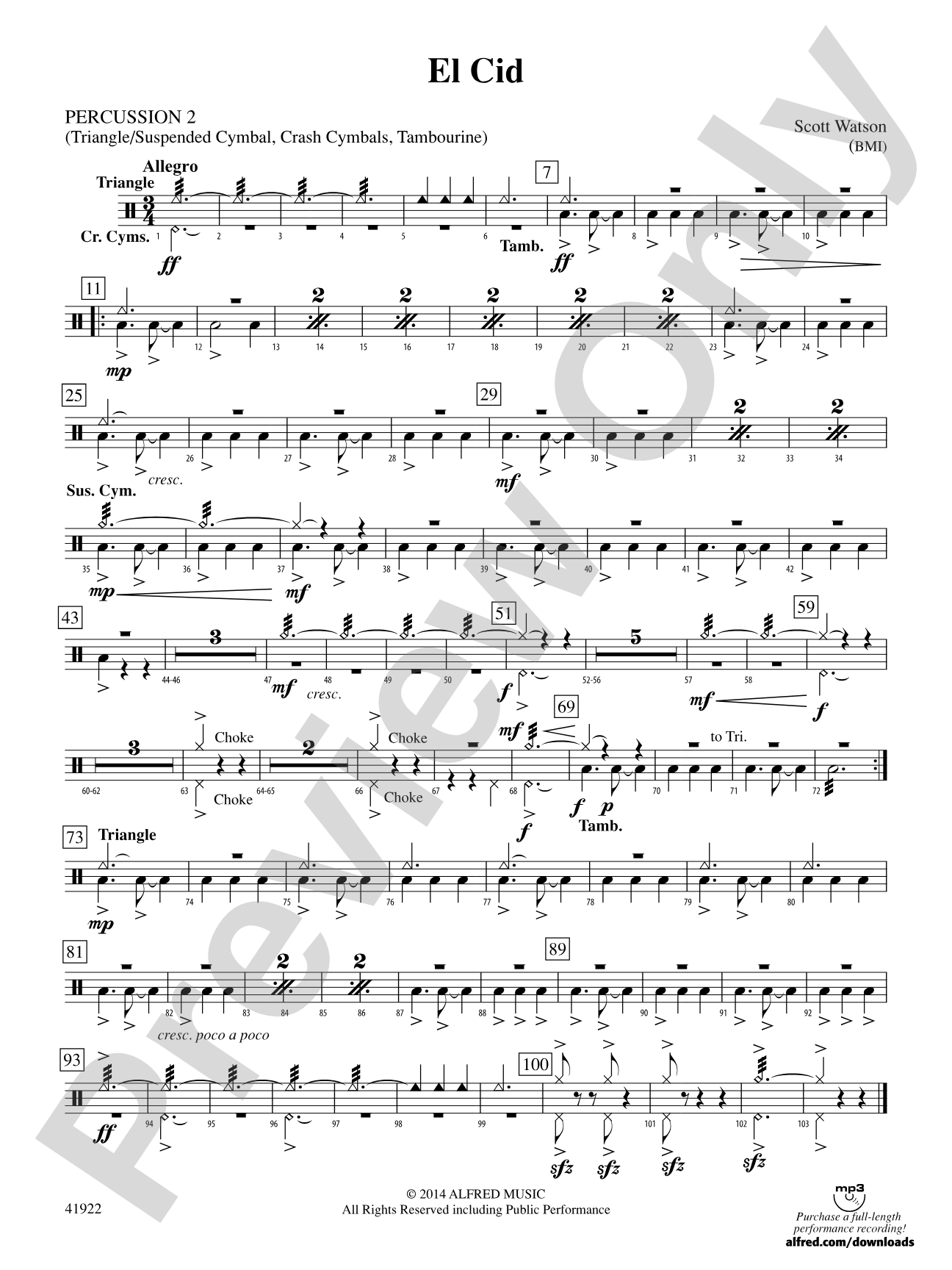

El Cid: 2nd Percussion
By Scott Watson
Grade: 1.5 (Easy)
Item: 00-PC-0016404_PC2
$3.00
Pickup currently not available
Description
"El Cid" musically portrays the thrilling adventures and conquests of Rodrigo Díaz de Vivar, a nobleman and military leader in medieval Spain. This rewarding work uses an infectious Spanish rhythmic ostinato (3+3, 2+2+2 in 3/4 time) that undergirds the main theme, driving the piece as it builds. Ample percussion, including an important tambourine part, contributes to the Spanish feel. (2:55) This title is available in MakeMusic Cloud.


Don't just read it, hear it, play along with it, and watch your students grow with it. In MakeMusic Cloud, El Cid: 2nd Percussion comes alive with professional accompaniment, adjustable tempo, and built-in practice tools that turn solo practice into real progress.
Open in the Player
Jump straight in and assign it today.
Start Your Free Trial
Open this title and explore the full library in minutes.
Sample Audio
1
Audio File
--:--
0:00
0:00
Sample Video
No sample videos found.
Additional Details
Series:
Challenger Band Series
Publisher:
Alfred Music
Page Count:
180
SKU:
00-PC-0016404_PC2
More about this title
About the Composer: Scott Watson

Scott Watson brings three decades of classroom experience into his compositional practice. After leading instrumental programs in the Parkland School District (Allentown, PA), where he directed high school bands and coordinated the elementary strings and band curriculum, Watson joined Cairn University as Associate Professor of Music. His output of more than 120 published works across concert band, string orchestra, and chamber settings reflects dual fluency in both contemporary concert music and the pedagogical demands of school ensembles.
Watson's music has reached audiences at venues including the Academy of Music in Philadelphia, the Midwest Clinic in Chicago, and the White House. Beyond composition, he contributes to Alfred Publications' Sound Innovations series, conducts festival and honor bands, and authored Using Technology to Unlock Musical Creativity (Oxford University Press, 2011). His work is distinguished by accessible writing that never compromises musical substance.
Why we love this
Watson's gift for memorable themes wrapped in propulsive rhythmic frameworks makes this a genuine crowd-pleaser at any concert level. The Spanish rhythmic ostinato feels organic rather than imposed, driving engagement through the full ensemble without requiring advanced technical facility. Directors appreciate that the piece delivers real musical satisfaction in under three minutes while building genuine student excitement.
What to expect
From the first measures, the Spanish rhythmic foundation transports the band into medieval adventure. The piece swells with genuine drama as layered orchestration builds on the ostinato, evoking the sweep of conquest and noble heroism without sacrificing clarity. Energy and clarity define the experience rather than technical showmanship.
Who it's for
Beginning to early intermediate concert bands seeking a concert and festival piece that combines accessibility with genuine musical interest. This works equally well for middle school ensembles developing fundamentals or high school bands looking for a confident, satisfying opener.
How to get the most out of it
- Establish the rhythmic ostinato as the heartbeat of the arrangement. Have the ensemble play the 3+3, 2+2+2 pattern several times with just one sustained harmony before introducing the main theme, so the underlying pulse becomes second nature.
- Balance the tambourine carefully; it's essential to the Spanish character but can easily overshadow the upper woodwinds. A light touch with clear articulation serves the piece better than volume.
- Shape the main theme with gentle dynamic contrast as it builds through different instrumental sections. Let the orchestration tell the story rather than pushing uniformly forward.
How to use it
Program this as a concert opener to establish an energetic mood, or pair it with contrasting slower repertoire to showcase range and dynamics. The concise duration makes it ideal for festival rotations where timing is critical, and the Spanish heritage offers thematic programming flexibility around cultural or historical unit studies.
Skills your students will build
- Rhythmic independence playing against an ostinato figure in mixed meters (3+3, 2+2+2)
- Articulation and rhythmic precision in Latin style contexts
- Balance and blend as harmonic foundation layers beneath melodic material
- Listening to and maintaining a steady underlying pulse across ensemble sections