
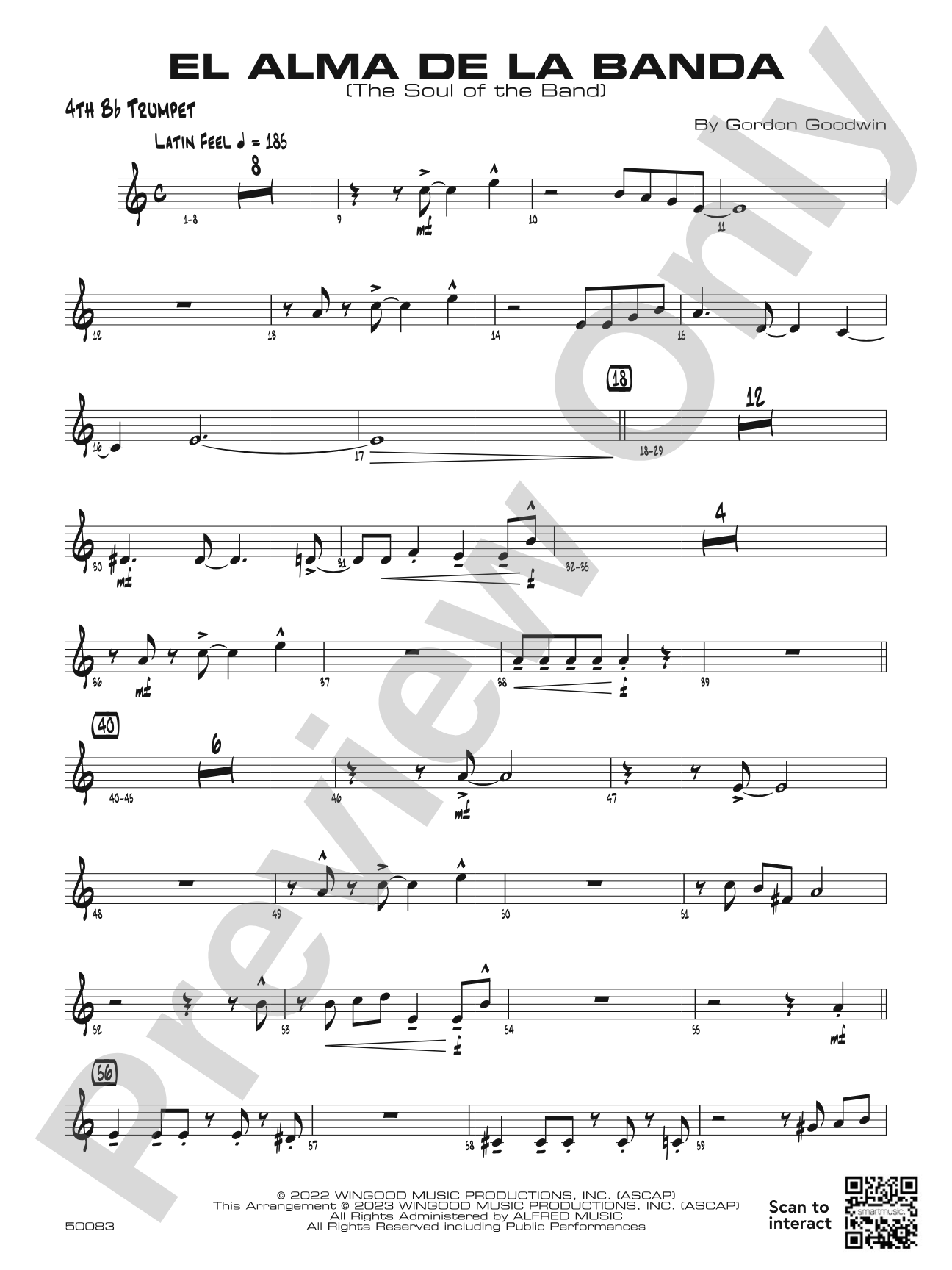

El Alma de la Banda: 4th B-flat Trumpet
(The Soul of the Band)
By Gordon Goodwin
Grade: 3.5
Item: 00-PC-0019045_T4
$3.00
Pickup currently not available
Description
It's soulful, Latin, and full of energy, yet very playable at 185 BPM. Lead trumpet range is to written high C above the staff, with solo space (suggested written solo) for alto, tenor, bari, trumpet 2, and trombones 1 and 2. Auxiliary percussion plus optional flute and vibes complete this gem. (3:30)


Don't just read it, hear it, play along with it, and watch your students grow with it. In MakeMusic Cloud, El Alma de la Banda: 4th B-flat Trumpet comes alive with professional accompaniment, adjustable tempo, and built-in practice tools that turn solo practice into real progress.
Open in the Player
Jump straight in and assign it today.
Start Your Free Trial
Open this title and explore the full library in minutes.
Sample Audio
1
Audio File
--:--
0:00
0:00
Sample Video
Additional Details
Series:
Jazz Band Series
Publisher:
Alfred Music
SKU:
00-PC-0019045_T4
More about this title
About the Composer: Gordon Goodwin

Gordon Goodwin began composing in earnest at age five, transcribing complete pieces directly from his imagination rather than fragments or single melodies. By thirteen, he had already written his first big band chart, Hang Loose, a feat that established him as a compositional prodigy and caught the attention of film and television producers.
Goodwin's work in film and television has earned him three Emmy Awards and multiple Grammy nominations, with orchestrations featured in Bad Boys II, Remember the Titans, Star Trek: Nemesis, and Armageddon, among others. He has written for and collaborated with artists including Christina Aguilera, Quincy Jones, Ray Charles, and Toni Braxton. As founder and leader of Gordon Goodwin's Big Phat Band (established in 2000), he continues to compose, arrange, and perform at the highest levels, cementing his status as one of contemporary jazz's most prolific and versatile voices.
Why we love this
Goodwin writes with a jazz educator's eye for playability. The soulful Latin groove and energetic big band voicings are immediately engaging, yet the 3.5 grade level keeps it accessible for developing ensembles. The distributed solo opportunities (alto, tenor, bari, both trumpets, and both trombones) mean your entire section gets meaningful solo time in a single three-and-a-half-minute chart.
What to expect
El Alma de la Banda pulses with the energy of a street-level Latin celebration filtered through big band sophistication. The writing balances lush harmonic textures with rhythmic precision, creating a piece that feels both rehearsed and spontaneous, intellectual yet unmistakably soulful.
Who it's for
Jazz ensembles at the 3.5 grade level seeking contemporary repertoire with genuine soulfulness and commercial appeal. Directors looking for charts that feature multiple soloists without sacrificing ensemble cohesion will find this particularly valuable.
How to get the most out of it
- Lock the cymbal crash and bass drum hits on the downbeats during the Latin grooves; these anchor the ensemble's forward motion at 185 BPM.
- Balance the lead trumpet's high passages by pulling back the saxes slightly during melody sections. The voicings are dense enough that clarity suffers if the top voice doesn't cut through.
- Give soloists advance notice of their suggested changes so they can personalize them. Goodwin's suggestions work beautifully, but ensemble confidence grows when musicians claim ownership of their improvisations.
- Use the auxiliary percussion thoughtfully. The timbres should enhance the Latin character without overwhelming the ensemble's blend during softer passages.
How to use it
This works equally well as a standalone feature on a jazz concert or nestled into a mixed-genre program where its Latin flavor provides contrast to bebop or swing standards. The three-and-a-half-minute length and high engagement factor make it ideal for spring concerts or jazz festival competition slots.
Skills your students will build
- Reading and performing Latin jazz rhythms at moderate tempos (185 BPM)
- Balancing ensemble voicing while featuring individual soloists
- Personalizing written solo suggestions through blues-based improvisation
- Executing syncopated big band sectional articulations (saxes and brass)
- Responding to dynamic and textural shifts in contemporary jazz writing