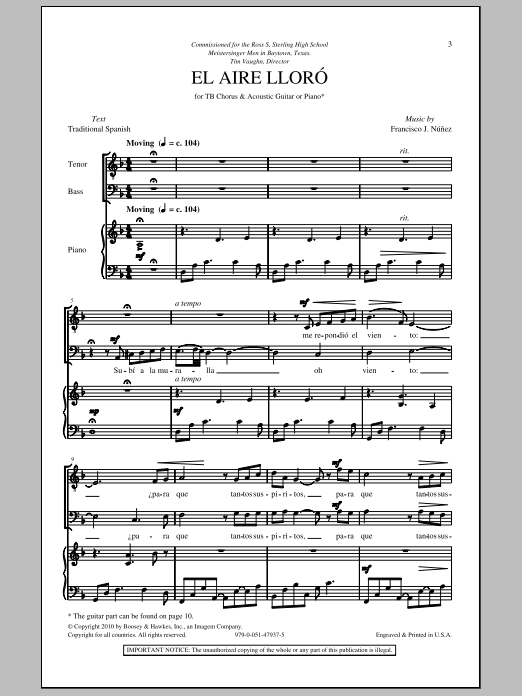
Francisco J. Nunez is a Puerto Rican composer whose choral works have become essential to contemporary music education. His compositions consistently blend Latin American musical traditions with sophisticated harmonic language, creating pieces that engage singers while expanding their cultural and technical horizons.
Why we love this
This piece gives your TB section a genuine concert work that doesn't talk down to limited voicing. Nunez writes with real harmonic color and textural sophistication, so singers feel they're interpreting something substantial rather than singing an exercise dressed up as art.
What to expect
The music unfolds with lyrical warmth and emotional directness. Spanish inflection shapes the melodic contours, and Nunez's harmonic palette creates intimate, sometimes wistful moments that linger after the final chord.
Who it's for
TB and flexible treble choirs seeking literature that respects their voices while introducing them to Spanish language concert repertoire. Directors programming diverse ensembles will find this accessible yet musically rewarding.
How to get the most out of it
Establish the Spanish language sounds early in rehearsal by isolating vowels and consonant clusters. Pure vowels and crisp articulation on final consonants make this music breathe authentically.
Balance the parts so no single voice dominates the melody. Nunez often passes thematic material between voices, and clarity here transforms the piece from competent to compelling.
Let the harmonic movement breathe. Resist the urge to rush through sustained chords; the color changes are often subtle and reward patient listening.
Record multiple run-throughs and listen back as an ensemble. Hearing your own blend and balance reveals intonation issues that feel invisible in the moment.
How to use it
This works beautifully in a multicultural concert program, paired with English and other world language selections to frame a thematic evening. It also serves well as a section feature that demonstrates your treble ensemble's musicality without requiring the resources of a larger chorus.
Skills your students will build
Spanish language diction and authentic vowel placement
Reading and performing in mixed voicing (TB/TTB/TBB/TTBB configurations)
Harmonic listening and balance within divided parts
Interpreting lyrical lines across multiple voice parts
Cultural context and stylistic awareness in Latin American choral music
You May Also Like
Scan to Complete Your Purchase
Use your phone's camera to scan the code below
You'll log in on your phone and the order will be added to your account