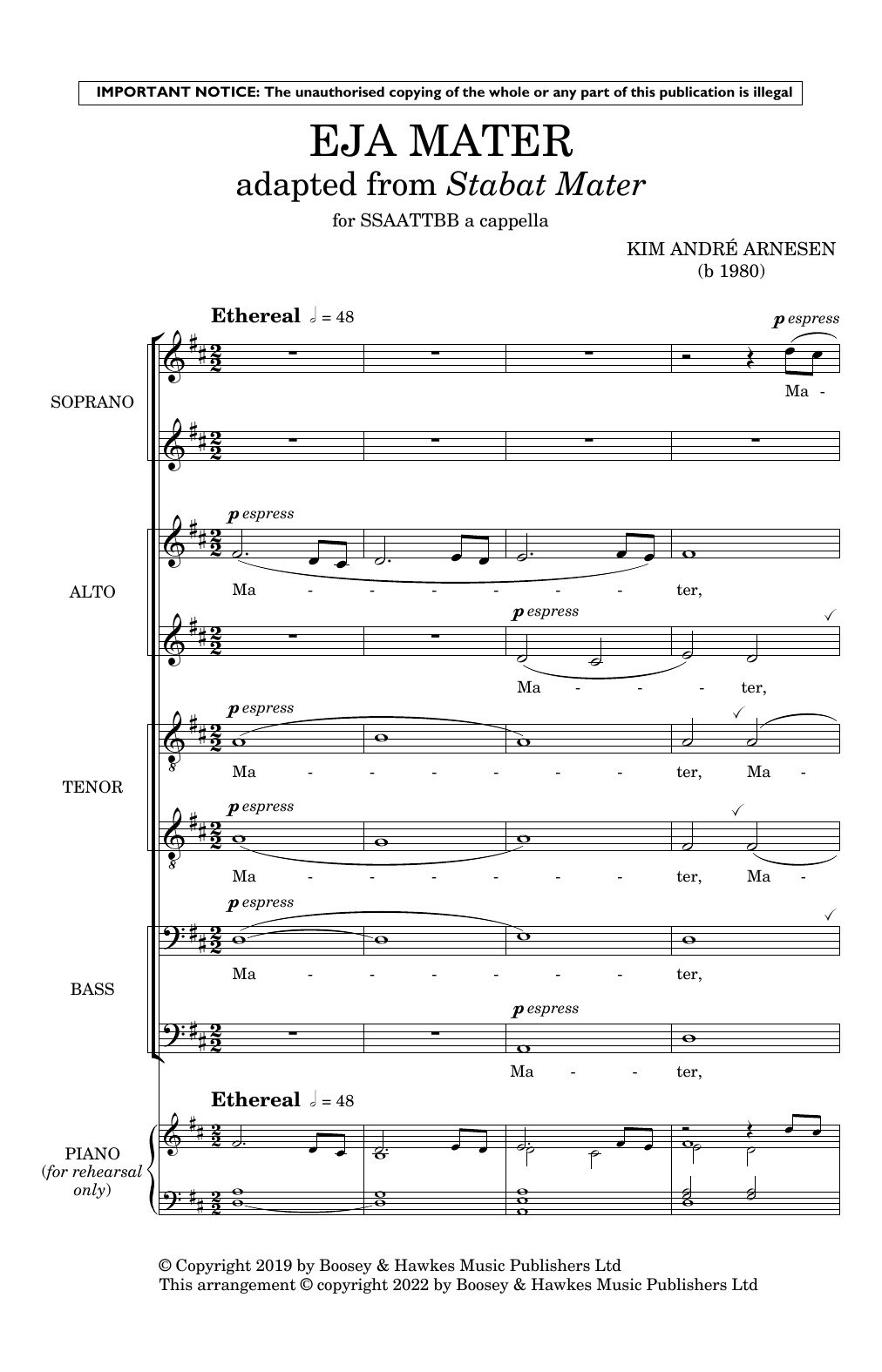
Eja Mater (Adapted from Stabat Mater) (a cappella version) Sheet Music Preview

Eja Mater (Adapted from Stabat Mater) (a cappella version): SSAATTBB Choral Octavo

By Kim André Arnesen

Item: 35-DS01614837

Digital Download
$3.25
Description

Eja Mater (Adapted from Stabat Mater) (a cappella version): SSAATTBB Choral Octavo isn't in MakeMusic Cloud just yet...but it could be. Let us know you'd like to see it, and you'll help shape what comes next. In the meantime, start a free trial and dive into thousands of interactive titles your students can play along with today.

Sample Audio
No sample audio found.
Sample Video
Additional Details
Publisher: Hal Leonard
Page Count: 19
SKU: 35-DS01614837

More about this title

About the Composer: Kim André Arnesen

Kim André Arnesen is a Norwegian composer whose work spans classical, liturgical, and contemporary sacred music. His compositions are known for their tonal clarity, emotional directness, and careful attention to text setting in both sacred and secular contexts.

Why we love this

Arnesen's adaptation distills the Stabat Mater tradition into something visceral and immediate without instrumental support. The eight-part writing creates rich harmonic color while remaining singable for choirs with solid fundamental skills, and the 19-page scope sits perfectly in that sweet spot where you can program a substantial work without dominating an entire concert.

What to expect

Contemplative and austere, with moments of genuine warmth. The unaccompanied voices create an intimate acoustic world that feels both sacred and profoundly human, inviting listeners into a space of quiet reflection.

Who it's for

Choirs with solid sight-reading skills and secure intonation in multi-part writing. The eight-part texture demands focused singers who can hold their lines independently, making this suitable for advanced high school choirs, college ensembles, and adult community choirs.

How to get the most out of it

  • Balance the inner voices carefully in the thicker passages; the altos and tenors especially need to sing with clarity so the harmonic movement remains audible rather than blurred.
  • Pay attention to breath placement as a group, especially in longer phrases; unified breathing strengthens the a cappella texture and prevents phrases from fragmenting.
  • Shape dynamics across full sections rather than measure to measure. This piece rewards broad interpretive gestures that let the harmony breathe.

How to use it

This works as a centerpiece for a concert devoted to sacred or meditative works, or as the anchor piece for a program exploring variations on Latin liturgical texts. Its length and emotional weight make it ideal for positioning after lighter fare, where the audience has settled into focused listening.

Skills your students will build

  • Sustaining independent vocal lines within thick eight-part harmony
  • Intonation stability in unaccompanied singing across multiple registers
  • Text-based interpretation and emotional communication without instrumental support
  • Blend and balance across soprano, alto, tenor, and bass sections

You May Also Like