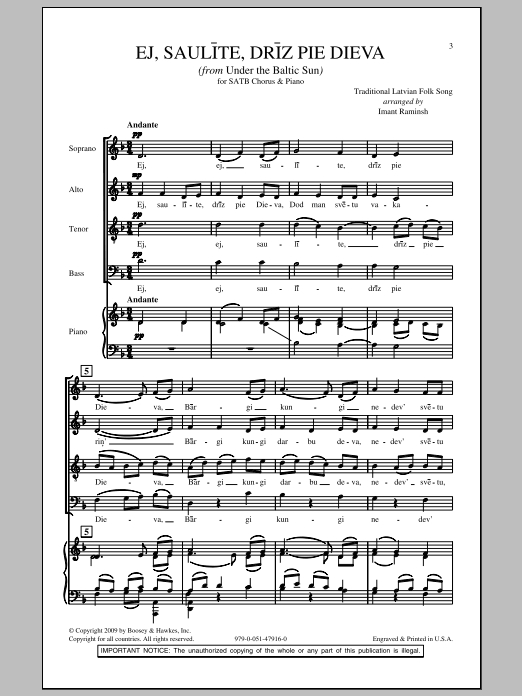
Ej, Saulite, Driz Pie Dieva Sheet Music Preview

Ej, Saulite, Driz Pie Dieva: SATB Choral Octavo

Arranged by Imant Raminsh

Item: 35-DS00137513

Digital Download
$2.99
Description

Ej, Saulite, Driz Pie Dieva: SATB Choral Octavo isn't in MakeMusic Cloud just yet...but it could be. Let us know you'd like to see it, and you'll help shape what comes next. In the meantime, start a free trial and dive into thousands of interactive titles your students can play along with today.

Sample Audio
No sample audio found.
Sample Video
Additional Details
Publisher: Hal Leonard
Page Count: 8
SKU: 35-DS00137513

More about this title

About the Arranger: Imant Raminsh

Imant Raminsh

Imant Raminsh holds degrees from the Royal Conservatory in Toronto, the University of Toronto, the Akademie Mozarteum in Salzburg, and the University of British Columbia. Born in Ventspils, Latvia in 1943, he emigrated to Canada as a child and has since established himself as a prolific composer across virtually every musical genre, from solo voice and chamber works to symphonic and operatic scores.

Raminsh's compositions have resonated with audiences worldwide, performed at prestigious venues including Carnegie Hall, Roy Thomson Hall, and concert halls across six continents. He has served as founding conductor for the Prince George Symphony, the Youth Symphony of the Okanagan, NOVA Children's Choir, and AURA Chamber Choir, and made his Carnegie Hall conducting debut in 2006. His contributions to Canadian choral music earned him the Outstanding Choral Composition Award from the Association of Canadian Choral Communities and the Distinguished Visiting Alumnus Award from the University of Toronto. In 2007, Latvia honored him with the Officer rank in the Order of the Three Stars of the Republic. A passionate advocate for environmental preservation through his work as a seasonal naturalist in British Columbia parks, Raminsh frequently draws inspiration from the natural world to inform his compositional voice.

Why we love this

Raminsh brings the sensibility of a seasoned conductor to this arrangement, crafting a piece that sits comfortably on the voice while maintaining the architectural integrity of the original. The writing balances accessibility with musical sophistication, offering festival and concert choirs an opportunity to explore folk material with contemporary compositional depth.

What to expect

The piece carries the earthy, reflective quality of Latvian folk tradition while filtered through Raminsh's sophisticated harmonic language. There is a quiet dignity in the writing, neither sentimental nor austere, that invites singers and listeners into a contemplative musical space.

Who it's for

This octavo suits advanced high school and college choirs, as well as community and professional ensembles comfortable navigating both text and music with cultural authenticity. Directors seeking to expand their choral library with non-Western European repertoire will find Raminsh's arrangement both musically rewarding and pedagogically valuable.

How to get the most out of it

  • Balance the outer voices carefully; the sopranos and basses establish harmonic edges that anchor the piece while the inner voices provide essential color and movement.
  • Attend to vowel consistency across the ensemble, particularly in the text setting, to ensure clarity of the Latvian language without sacrificing legit choral tone.
  • Shape phrases with attention to the natural arc of the melody rather than metronomic precision; allow the music to breathe as the text dictates.

How to use it

Consider programming this alongside other Northern European choral works to create a thematic concert exploring folk music through contemporary compositional lenses. The eight pages make it substantial enough for concert programming without dominating a set, and its cultural specificity pairs well with programming that celebrates global musical traditions.

Skills your students will build

  • Singing in Latvian with authentic pronunciation and cultural understanding
  • Navigating SATB voicing with independent melodic lines across all four parts
  • Interpreting folk material through a modern harmonic lens
  • Developing interpretive musicality in lyrical, non-metrical phrasing

You May Also Like