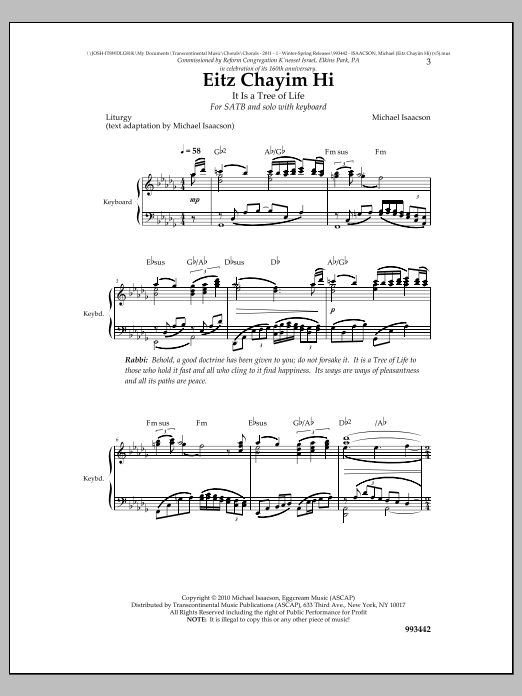
Michael Isaacson is a composer and arranger whose work bridges contemporary classical music with Jewish musical traditions. His arrangements have become staples in choral programs across North America, known for respecting the integrity of traditional material while crafting compelling, singable voicings that engage modern ensembles.
Why we love this
Isaacson's treatment of this traditional Hebrew text creates genuine warmth without sacrificing musical substance. The four-part writing sits comfortably for mixed voices while maintaining the spiritual weight that makes sacred choral music resonate with audiences.
What to expect
The piece carries quiet reverence without heaviness. There's a contemplative quality built into Isaacson's harmonic language that invites singers to connect personally with the text while maintaining the dignity appropriate to sacred music.
Who it's for
Choirs seeking accessible sacred repertoire that works for both liturgical and concert settings. This octavo suits intermediate to advanced ensembles comfortable with four-part writing and wanting to expand their knowledge of Jewish musical traditions.
How to get the most out of it
Balance the text clarity across all four voices; the meaning of Eitz Chayim Hi (Tree of Life) deepens when singers understand what they're singing and can project that intentionality.
Shape the harmonic progressions deliberately rather than treating them as neutral backdrop; Isaacson's voicings often contain subtle voice leading that rewards careful attention to dynamic shaping.
Consider the acoustic properties of your rehearsal space when setting initial tempos. A piece this length needs breathing room, and the right speed will feel different in a gymnasium than in a resonant sanctuary.
How to use it
Program this alongside other world sacred traditions to frame a concert theme around spiritual texts, or use it as an anchor piece in a liturgical service where your choir can sing reflectively. At nine pages, it's substantial enough to justify rehearsal time without dominating an entire concert's repertoire.
Skills your students will build
Singing sustained, lyrical lines in four-part harmony
Performing Hebrew text with accurate pronunciation and intention
Understanding voice leading in tonal, contemporary sacred music
Building confidence with non-English language repertoire
Developing sensitivity to harmonic color through varied voicing textures
You May Also Like
Scan to Complete Your Purchase
Use your phone's camera to scan the code below
You'll log in on your phone and the order will be added to your account