
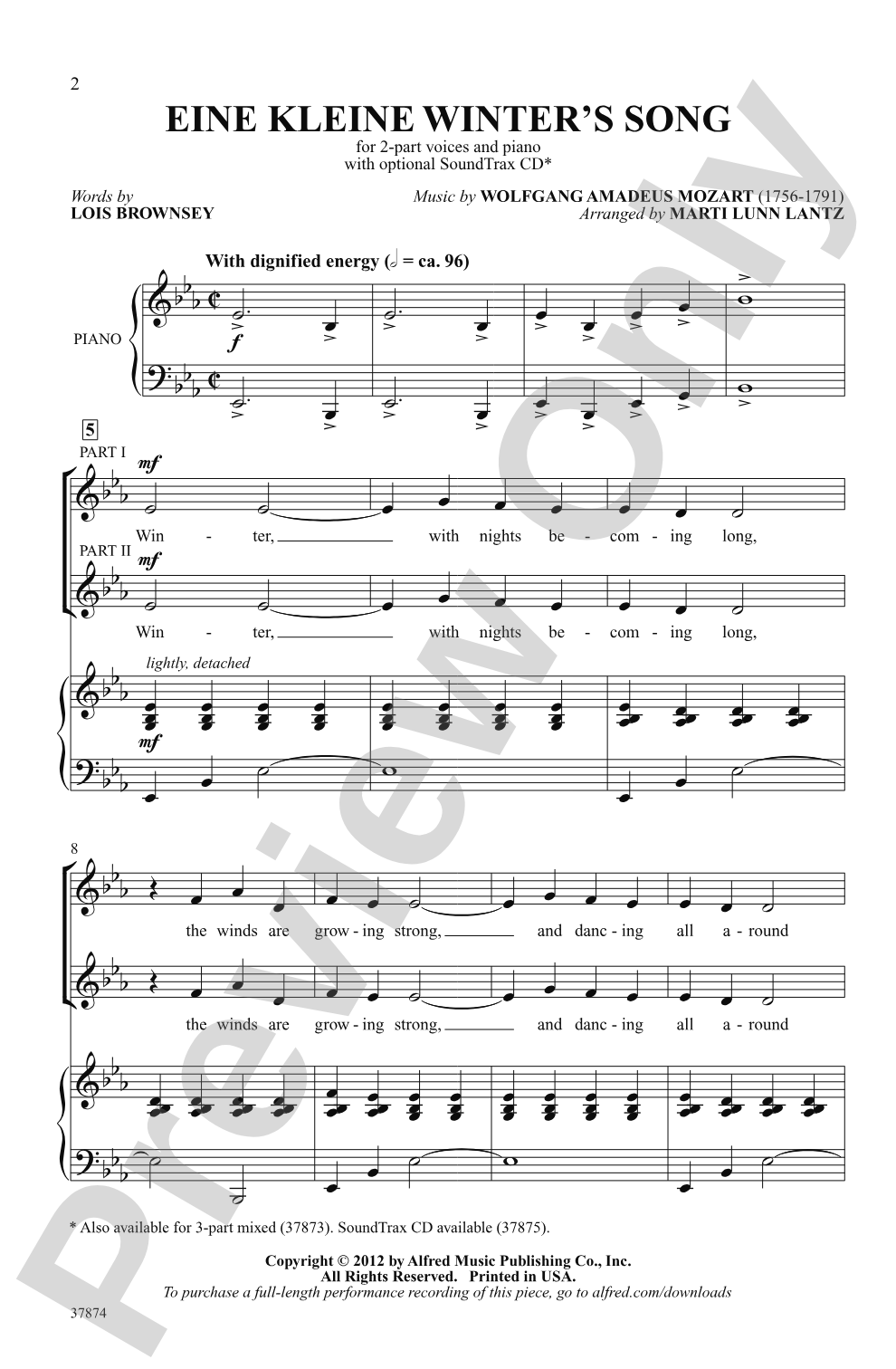
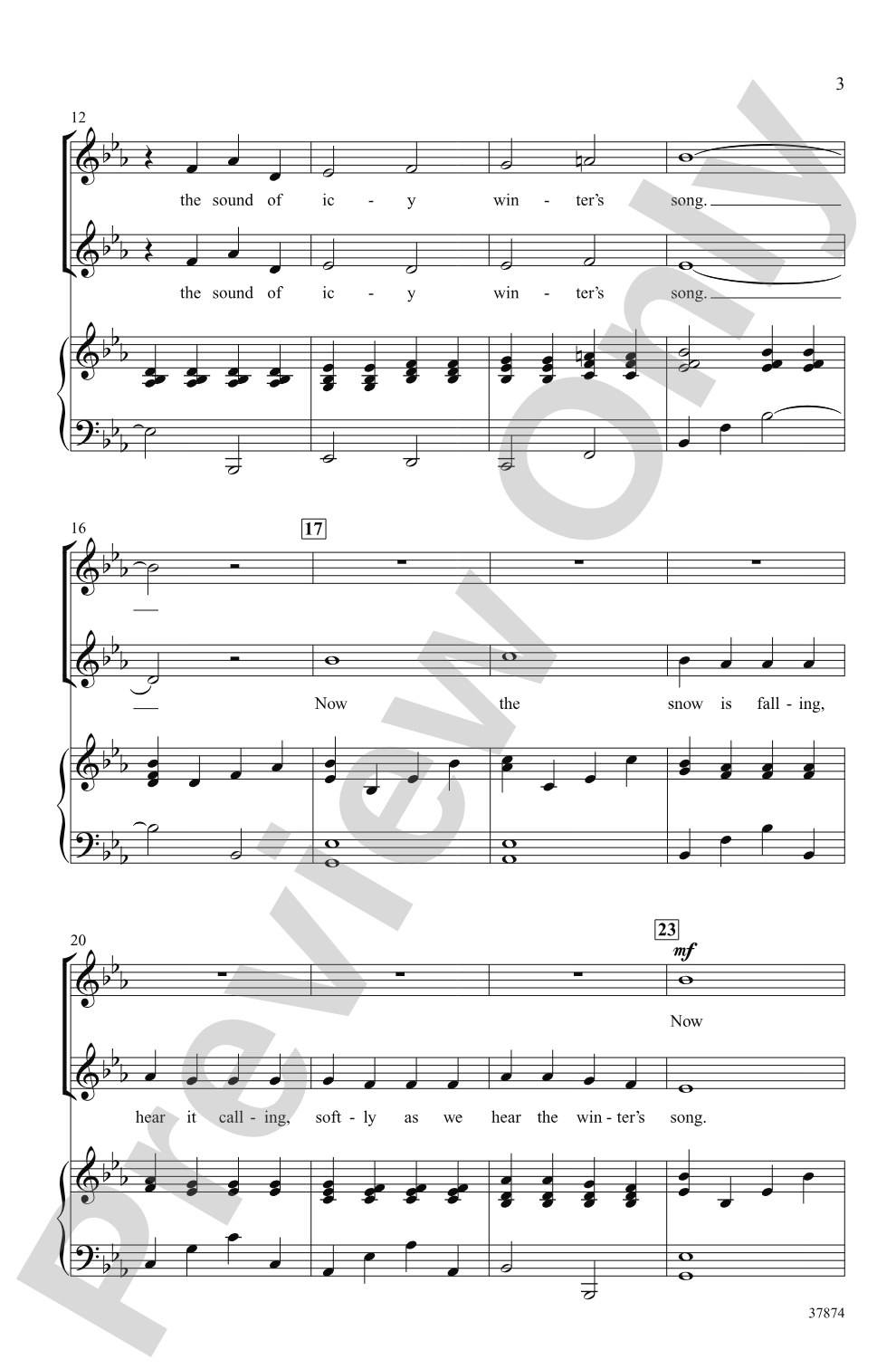

Eine Kleine Winter's Song: 2-Part Choral Octavo
Words by Lois Brownsey, music by Wolfgang Amadeus Mozart / arr. Marti Lunn Lantz
Item: 00-PO-0001240
$1.80
Minimum order quantity: 20 copies
Pickup currently not available
Related Items
Eine Kleine Winter's Song: SoundTrax Digital Audio Download |
$26.99
|
View | |
Eine Kleine Winter's Song: 3-Part Mixed Choral Octavo |
$1.80
|
View | |
Eine Kleine Winter's Song: 3-Part Mixed Choral Octavo |
$1.80
|
View | |
Eine Kleine Winter's Song: 2-Part Choral Octavo |
$1.80
|
View | |
Eine Kleine Winter's Song: Choral Octavo SoundTrax CD |
$26.99
|
View |
Description
Everyone recognizes this Mozart melody, presented here with a vivid winter text. Perfect for younger singers--to touch upon music history, to ignite their imaginations.


Eine Kleine Winter's Song: 2-Part Choral Octavo isn't in MakeMusic Cloud just yet...but it could be. Let us know you'd like to see it, and you'll help shape what comes next. In the meantime, start a free trial and dive into thousands of interactive titles your students can play along with today.
Request This Title
Tell us you want it.
Start Your Free Trial
Explore everything that's ready to play right now.
Sample Audio
1
Audio File
--:--
0:00
0:00
Sample Video
No sample videos found.
Additional Details
Series:
Alfred Choral Designs
Publisher:
Alfred Music
Page Count:
8
SKU:
00-PO-0001240
More about this title
About the Composer: Wolfgang Amadeus Mozart
Wolfgang Amadeus Mozart (1756–1791) composed across every major genre of his era, from symphonies and concertos to operas and chamber works. His melodies became the foundation of Western musical literacy, recognized instantly by listeners of all ages and abilities. For music educators, Mozart's output offers an unmatched resource: accessible yet sophisticated pieces that introduce students to Classical form, elegant phrasing, and the discipline of genuine composition.
Mozart's gift for melody makes his work especially valuable in choral settings with younger singers. His lines sit naturally in the voice, his harmonies support clear singing, and his cultural weight gives young performers a genuine connection to music history the moment they open the score.
Why we love this
Arranging a Mozart melody for young singers is a smart pedagogical move, and Marti Lunn Lantz has paired it with a fresh winter text that sparks imagination rather than feeling rote. The two-part voicing keeps the focus on the melody and phrasing without overwhelming singers who are still building confidence, yet the octavo format lets you perform with full ensemble textures. It's the kind of piece that makes students excited to learn about where music comes from.
What to expect
The piece captures that crystalline winter quality—bright, clear, and subtly wistful. Mozart's elegant contours become even more evocative when married to vivid seasonal imagery, creating a song that feels both timeless and immediate. Young singers will find the melody grateful to sing and the experience of performing actual Mozart genuinely musical.
Who it's for
This octavo works beautifully with middle school choirs and younger high school ensembles encountering Mozart's music for the first time. The two-part voicing and straightforward page count (8 pages) keep the learning curve manageable while introducing a melody every student recognizes, whether they know the composer's name or not.
How to get the most out of it
- Honor the phrase architecture of Mozart's original line. Even in a simplified arrangement, these melodies have clear breathing points and shapes; map them out with singers so each phrase feels intentional rather than breathless.
- Use the recorded accompaniment to establish stylistic clarity. Mozart's Classical period calls for crisp articulation and forward motion; the recording demonstrates the right energy and tempo.
- Blend the two parts by listening for harmonic support rather than soloistic independence. In music this spare, every singer contributes to the sonority; rehearse sections together to balance voice part thickness.
- Shape the text expressively to match the winter imagery. Even familiar melodies benefit from singers understanding and embodying what they're singing about.
How to use it
Include this in a winter concert or holiday program where you want to educate as well as entertain. It pairs well alongside contemporary seasonal repertoire and newer compositions; the juxtaposition highlights how Mozart's simplicity and craft have endured. At 8 pages with two parts, it's compact enough to polish alongside more demanding repertoire without derailing your rehearsal schedule.
Skills your students will build
- Recognizing and performing a major Classical melody
- Sustaining phrase lines across 4-8 bar arcs
- Blending two-part harmony with clear intonation
- Interpreting text as a guide to musical expression
- Identifying Mozart and connecting a familiar tune to its historical context