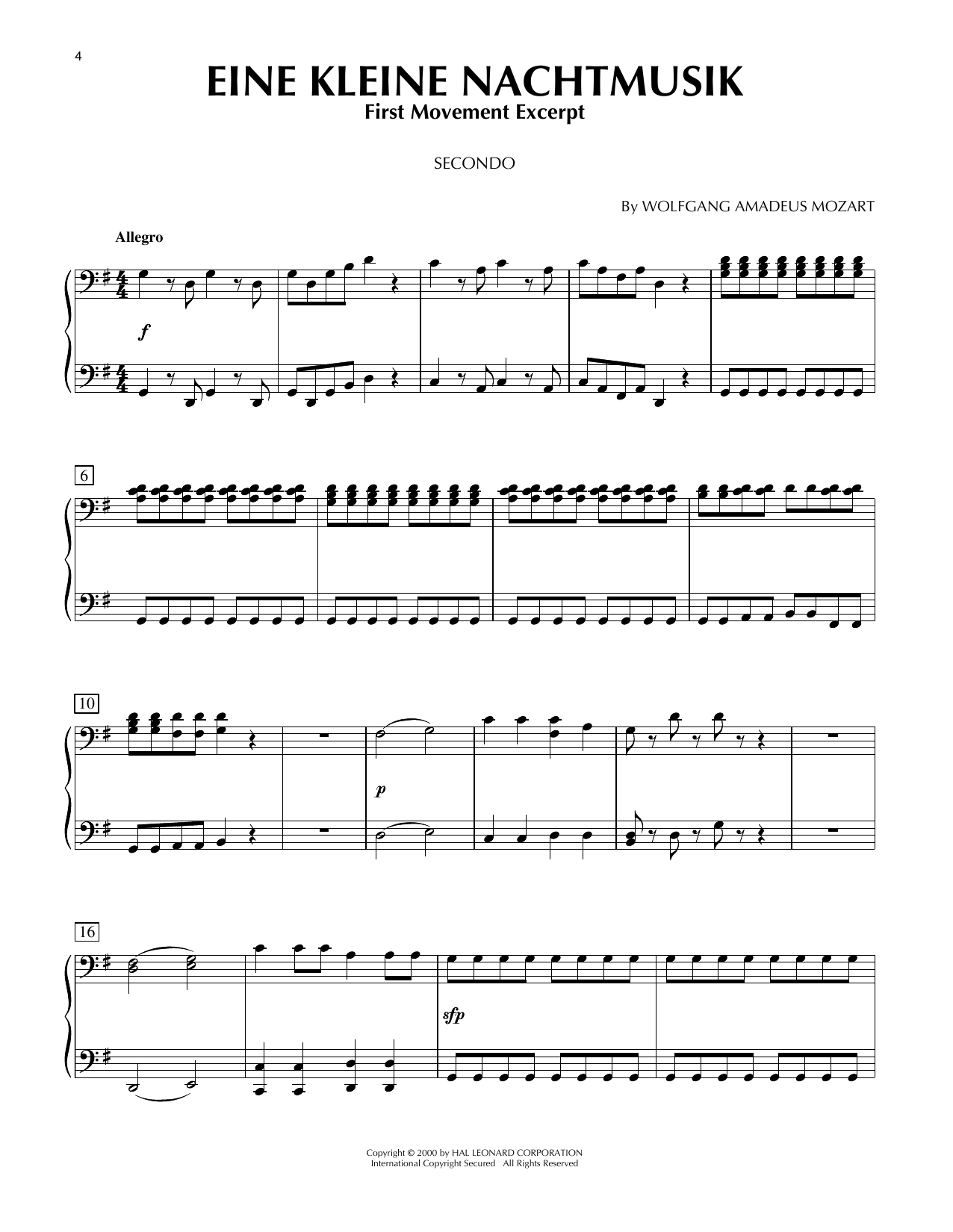
Eine Kleine Nachtmusik ("Serenade"), First Movement Excerpt Sheet Music Preview

Eine Kleine Nachtmusik ("Serenade"), First Movement Excerpt: Piano Duet

As performed by Wolfgang Amadeus Mozart

Item: 35-DS01818689

Digital Download
$5.99
Description

Discover MakeMusic Cloud: thousands of interactive titles your students can play along with today.

Sample Audio
No sample audio found.
Sample Video
Additional Details
Publisher: Hal Leonard
Page Count: 6
SKU: 35-DS01818689

More about this title

About the Artist: Wolfgang Amadeus Mozart

Wolfgang Amadeus Mozart (1756-1791) composed Eine kleine Nachtmusik in 1787, a work that exemplifies his gift for writing music of elegant simplicity and profound craft. Born in Salzburg and trained by his father Leopold from early childhood, Mozart became one of history's most prolific composers, working across every major genre with seemingly effortless mastery. His ability to write for young performers without sacrificing musical sophistication made him an ideal choice for music education, and this serenade remains a cornerstone of the classical repertoire.

Mozart's approach to orchestration and melodic writing in Eine kleine Nachtmusik reveals a composer deeply attuned to balance and proportion. The work's accessibility for developing musicians contrasts sharply with its structural integrity, offering students a genuine encounter with classical form rather than a watered-down approximation. His influence on how we teach music fundamentals, from phrase architecture to harmonic clarity, continues undiminished.

Why we love this

This opening excerpt captures what makes Eine kleine Nachtmusik enduringly teachable: it moves with purposeful grace while remaining genuinely playable for intermediate students. The writing sits comfortably on piano, avoiding the show-off figuration of Romantic showpieces while maintaining the kind of musical substance that keeps ensemble players engaged. You get authentic Mozart without the technical barriers of his concertos.

What to expect

Refined without pretension, the opening movement floats along with the lightness of evening entertainment for the Salzburg nobility. Each phrase unfolds with understated elegance; the harmonic language is transparent and speaking, never obscured by unnecessary complication. There's a courtesy in the phrasing, a sense of well-mannered conversation that feels distinctly 18th century.

Who it's for

Pianists at the intermediate level and early advanced stage will find this excerpt rewarding to learn, particularly students encountering classical period performance practices for the first time. Small ensembles or piano studios preparing students for competitions or recitals benefit from repertoire that combines musical legitimacy with reasonable technical demands. It also serves teachers seeking material to contextualize listening lessons in period history.

How to get the most out of it

  • Shape the opening theme with gentle emphasis on the downbeats; the courtly character depends on clear articulation without heaviness.
  • Allow the harmonic movement room to breathe by observing phrase boundaries carefully, resisting the urge to push through section endings.
  • Balance melody against accompaniment by thinking of the piano part as a continuation of the orchestral texture rather than background support.

How to use it

This excerpt works beautifully as a standalone recital piece or as part of a classical period survey where you want to demonstrate Mozart's gift for memorable melody. Program it alongside other short classical selections to create a thematic concert exploring chamber music traditions. It also pairs naturally with teaching units on classical form and the serenade genre itself.

Skills your students will build

  • Recognizing and executing eight-bar phrase structures
  • Performing with appropriate classical period articulation and pedaling
  • Maintaining proportional balance between melody and harmonic accompaniment
  • Understanding tonal harmony and functional progressions in a classical context
  • Sustaining lyrical legato lines across harmonic changes

You May Also Like