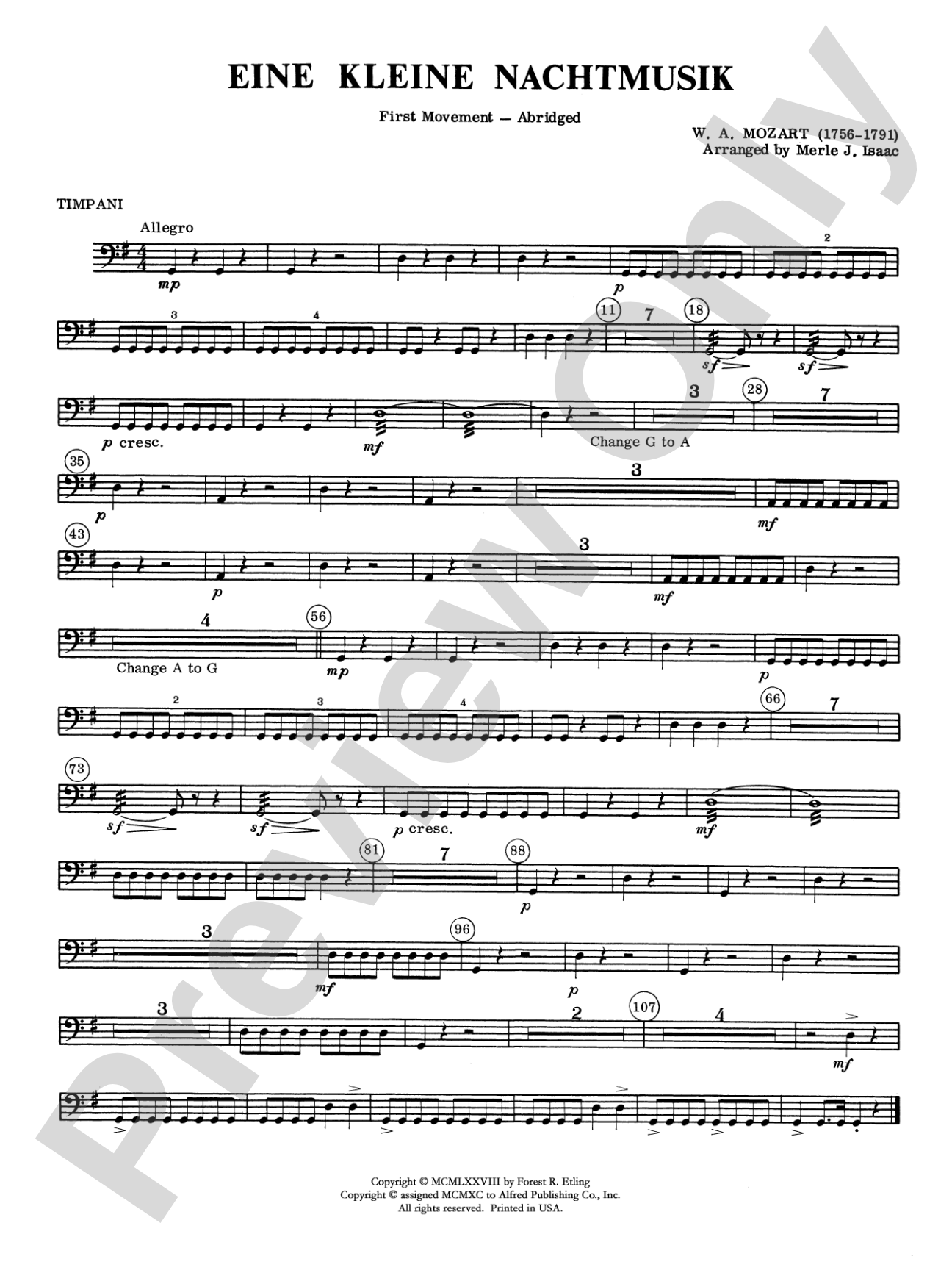
Eine Kleine Nachtmusik, 1st Movement: Timpani Sheet Music Preview

Eine Kleine Nachtmusik, 1st Movement: Timpani

(First Movement -- Abridged)

By Wolfgang Amadeus Mozart / arr. Merle J. Isaac

Grade: 3

Item: 00-PC-0000038_TMP

Digital Download
$3.00
Description

Don't just read it, hear it, play along with it, and watch your students grow with it. In MakeMusic Cloud, Eine Kleine Nachtmusik, 1st Movement: Timpani comes alive with professional accompaniment, adjustable tempo, and built-in practice tools that turn solo practice into real progress.

Sample Audio
No sample audio found.
Sample Video
Additional Details
Series: Highland/Etling Full Orchestra
Publisher: Alfred Music
Page Count: 238
SKU: 00-PC-0000038_TMP

More about this title

About the Composer: Wolfgang Amadeus Mozart

Wolfgang Amadeus Mozart (1756-1791) composed with a fluency and clarity that still defines what we mean by musical elegance. Born in Salzburg and trained by his father Leopold, Mozart absorbed the conventions of the Classical era and transformed them into works of seemingly effortless sophistication. His output spans every major genre—symphonies, concertos, operas, chamber music, sacred works—and his influence on the development of Western music is immeasurable.

For music educators, Mozart's works offer students a direct line to the heart of Classical style: balanced phrases, transparent orchestration, and melodic ideas that sing naturally across any instrument. His music teaches what good voice leading sounds like, how to build tension and release within clear harmonic structures, and why simplicity, when executed by a master, is never simple.

Why we love this

Eine kleine Nachtmusik is one of the most recognizable pieces in the orchestral repertoire, and this Grade 3 arrangement opens it to ensembles that would otherwise never perform it. Merle Isaac's adaptation preserves the elegant architecture of the original while making it genuinely playable for young orchestras, which means your students get to experience authentic Mozart rather than a watered-down approximation. The first movement's brilliant energy and clear formal structure make it ideal for teaching how a strong thematic idea can drive an entire work.

What to expect

Bright, elegant, and perfectly proportioned. The opening theme dances with courtly charm while maintaining an almost playful energy; the orchestration sparkles in a way that feels both transparent and full. You hear every line working together, and the movement's architecture unfolds with the inevitability of a perfect conversation.

Who it's for

Conductors programming a Grade 3 full orchestra will find a legitimate masterwork that challenges young musicians without overwhelming them. This arrangement works for orchestras aiming for contest or festival performance, and it suits ensembles that want to build confidence through repertoire of genuine musical substance rather than filler.

How to get the most out of it

  • Shape the opening theme with gentle dynamic contours rather than playing it at a single volume; the melody should speak like a conversation, not a proclamation.
  • Balance the viola and cello parts carefully in the accompaniment passages; they anchor the harmonic foundation and will muddy if they're mixed too loud.
  • Maintain a steady, dance-like pulse throughout. This music thrives on rhythmic clarity and forward motion, not rubato.
  • Mark your entrance cues clearly in rehearsal and insist on precise attacks. The piece's sparkle depends on crisp articulation from the whole ensemble.

How to use it

Program this as an elegant centerpiece for a young orchestra concert, perhaps pairing it with a contemporary piece or a shorter Baroque selection to create a mixed-era concert. It also stands alone as a complete musical experience and will appeal to audiences familiar with the original; programming it signals that your orchestra plays real music, not just simplified exercises.

Skills your students will build

  • Reading compound meter and maintaining rhythmic precision across phrase boundaries
  • Balancing melody and accompaniment in Classical-era textures
  • Understanding sonata form by following a single, memorable theme through development and recapitulation
  • Responding to conducting gestures for dynamic shape and phrasing
  • Coordinating multiple instrumental families (strings, winds, brass) in transparent orchestral scoring

You May Also Like