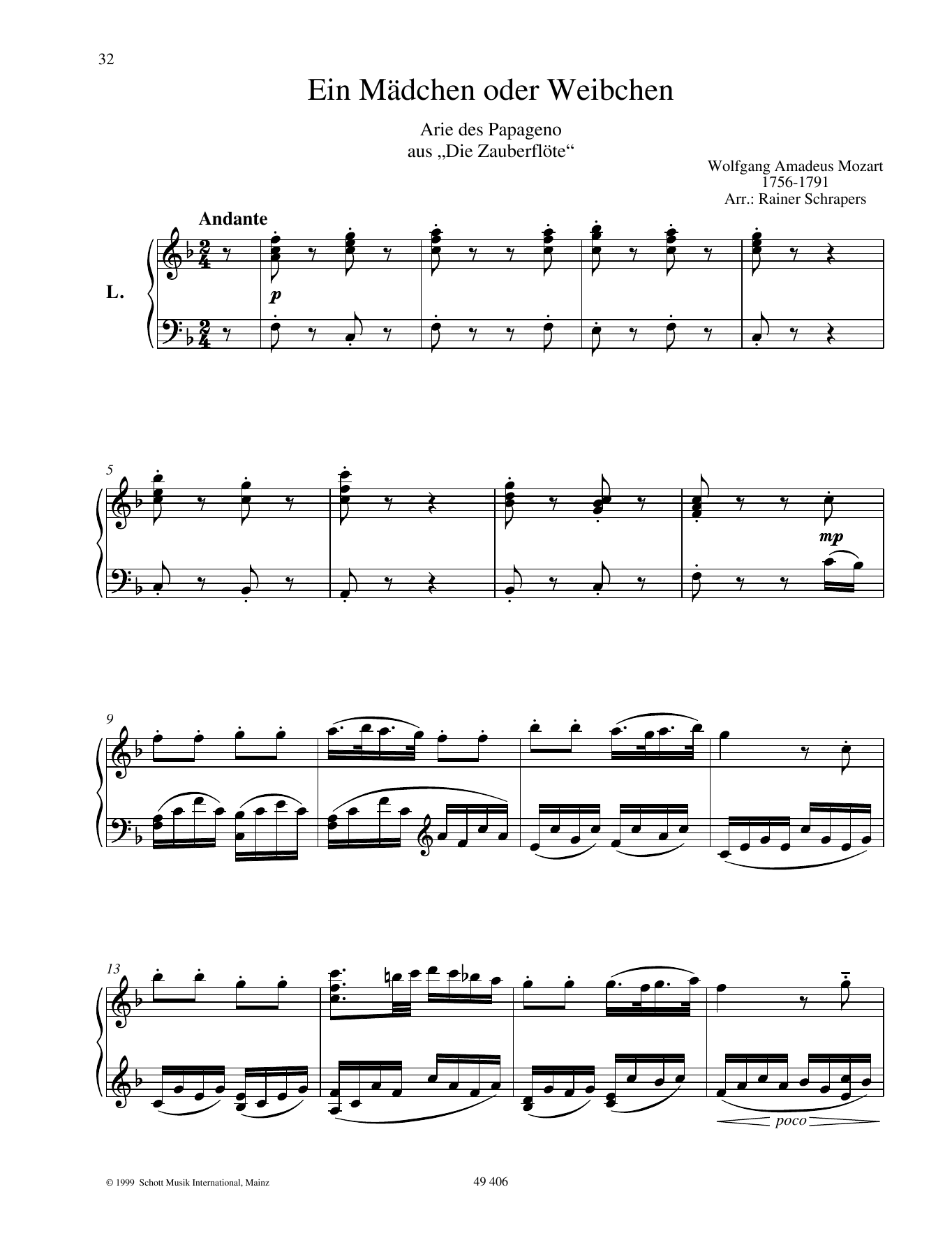
Ein Mädchen oder Weibchen Sheet Music Preview

Ein Mädchen oder Weibchen: Piano Duet

By Wolfgang Amadeus Mozart / Edited by Rainer Schrapers

Item: 35-DS00371901

Digital Download
$4.99
Description

Discover MakeMusic Cloud: thousands of interactive titles your students can play along with today.

Sample Audio
No sample audio found.
Sample Video
Additional Details
Publisher: Hal Leonard
Page Count: 4
SKU: 35-DS00371901

More about this title

About the Composer: Wolfgang Amadeus Mozart

Mozart composed Ein Mädchen oder Weibchen as part of Die Zauberflöte (The Magic Flute), one of his final and most enduring operas. Written in 1791, this aria showcases his gift for melody that feels both immediately accessible and remarkably sophisticated. The piece reveals Mozart's mastery of character development through music, capturing Papageno's yearning with economy and warmth.

For music educators, Mozart's output demonstrates the pedagogical value of clarity and structure. His works reward careful listening while remaining engaging for performers at multiple levels. Ein Mädchen oder Weibchen exemplifies how a seemingly simple melody can contain layers of harmonic interest and emotional depth.

Why we love this

This aria offers singers a chance to explore character portrayal without requiring dramatic intensity or technical fireworks. The melody sits naturally in the voice, allowing focus to shift toward phrasing and the gentle humor Mozart embedded in Papageno's confession of loneliness. It's a reliable choice when you need something that sounds elegant but doesn't demand extreme ranges or stamina.

What to expect

Wistful and intimate. Papageno's simple desire for companionship radiates through the melody, which unfolds with the warmth of a folk song dressed in classical attire. The piece carries a gentle melancholy that never tips into sentimentality, instead maintaining the wit and humanity that define The Magic Flute.

Who it's for

Soprano or tenor singers building a recital repertoire, voice students exploring Mozart's approach to lyrical writing, and vocalists comfortable with Italian diction and classical style conventions. It works equally well for performers new to Mozart or those revisiting his work with deeper interpretive aims.

How to get the most out of it

  • Shape the melody with understated elegance; Mozart's genius lies in simplicity, so resist the urge to over-interpret or add unnecessary rubato.
  • Balance the vocal line against the piano accompaniment so the orchestration (reimagined here for piano) supports without overwhelming.
  • Pay attention to the text declamation, particularly how the Italian or German words align with the melodic contour, to let the music and words reinforce each other.

How to use it

Position this in a recital exploring the human voice across eras, or pair it with other Mozart arias to highlight his range as a vocal composer. It also serves well in educational contexts when teaching classical style to singers, as the piece rewards close study of text setting, phrasing, and the relationship between melody and harmony.

Skills your students will build

  • Legit vocal technique in the classical style
  • Interpretation of Italian text underlay and diction
  • Phrasing of lyrical melody without modern vibrato excess
  • Character portrayal through musical simplicity rather than dramatic gesture

You May Also Like