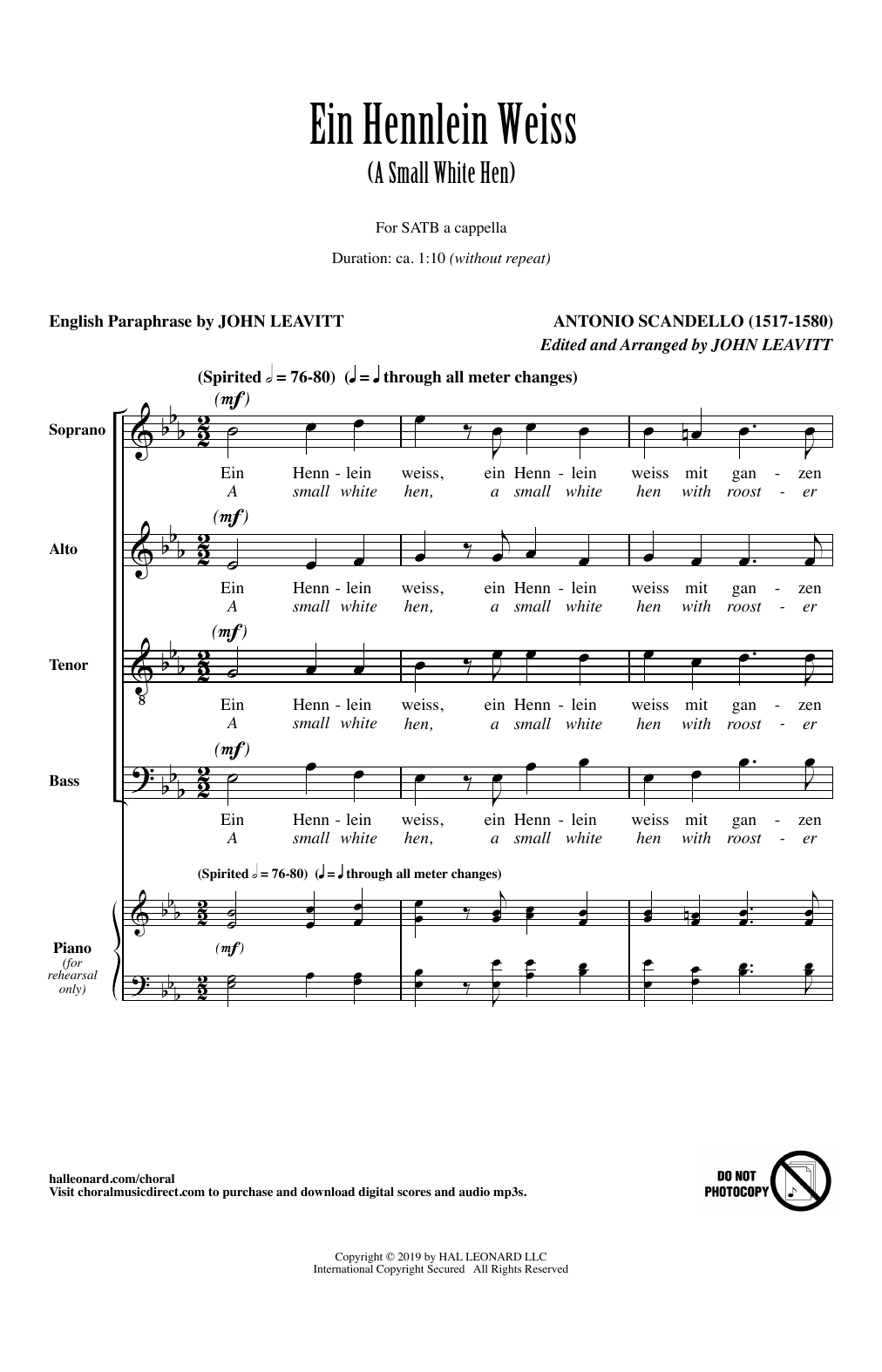
Ein Hennlein Weiss (arr. John Leavitt) Sheet Music Preview

Ein Hennlein Weiss (arr. John Leavitt): SATB Choral Octavo

Arranged by John Leavitt

Item: 35-DS00451100

Digital Download
$2.99
Description

Ein Hennlein Weiss (arr. John Leavitt): SATB Choral Octavo isn't in MakeMusic Cloud just yet...but it could be. Let us know you'd like to see it, and you'll help shape what comes next. In the meantime, start a free trial and dive into thousands of interactive titles your students can play along with today.

Sample Audio
No sample audio found.
Sample Video
Additional Details
Publisher: Hal Leonard
Page Count: 7
SKU: 35-DS00451100

More about this title

About the Arranger: John Leavitt

John Leavitt has established himself as one of the most prolific and respected choral arrangers in American music education. His arrangements span Renaissance madrigals to jazz standards, and they share a hallmark clarity of voicing paired with genuine musical substance. Leavitt's work appears regularly in festival programs and all-state competitions, trusted by directors who need both musical integrity and singable lines.

Why we love this

Leavitt's approach to this Renaissance gem balances authenticity with accessibility. The arrangement preserves the character of the original while giving each voice line enough independence to matter, making it equally rewarding for experienced ensembles and groups building their early Renaissance repertoire.

What to expect

Warm and intimate, with the gentle architecture of a traditional German melody. The four-part writing creates a sense of community and sung conversation, evoking the unforced elegance that makes Renaissance music feel both timeless and immediate.

Who it's for

Intermediate to advanced high school choirs and collegiate groups seeking accessible Renaissance repertoire with substance. This arrangement works for ensembles moving beyond pop or show choir into concert programming without requiring extensive madrigal experience.

How to get the most out of it

  • Bring out the text painting in the melodic contours; this melody carries the emotional arc, so soprano and alto lines deserve clarity even in supporting sections.
  • Shape the phrases by thinking in four-bar units rather than measure-by-measure. Renaissance music breathes in longer spans.
  • Balance the lower voices carefully so they support without muddying the harmonic texture; tenor and bass work best when they're crisp and well-defined.

How to use it

Include this as a bridge piece in a concert exploring Renaissance across cultures, or program it alongside other Leavitt arrangements to showcase how strong voicing choices honor both historical style and modern choir capabilities. It pairs naturally with other German songs or works by German Renaissance composers.

Skills your students will build

  • Singing Renaissance repertoire with appropriate diction and phrasing
  • Balancing four independent lines while maintaining ensemble unity
  • Understanding functional harmony within a modal or transitional harmonic context
  • Interpreting German text with musical sensitivity

You May Also Like