
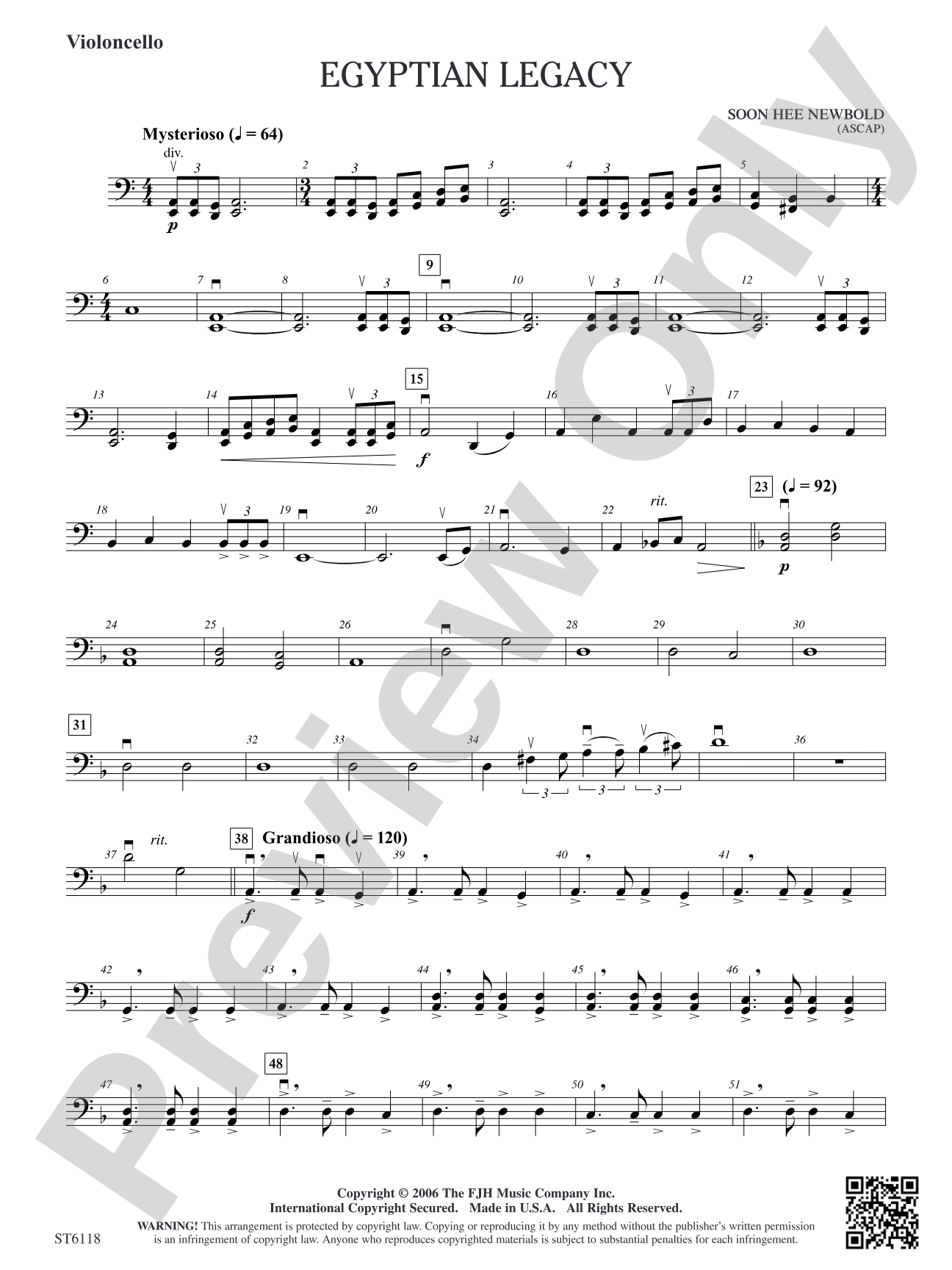

Egyptian Legacy: Violoncello
By Soon Hee Newbold
Grade: 4
Item: 98-PC-DST6118_VC1
$7.00
Pickup currently not available
Description
The sounds of Egypt come alive in this symphonic work that explores the great pyramids, the Sphinx, and the mysteries surrounding the pharaohs. Special effects include strummed pizzicato and col legno, both explained in the notes. Exploring a wide variety of styles, Egyptian Legacy is sure to be a stunning addition to any performance!


Don't just read it, hear it, play along with it, and watch your students grow with it. In MakeMusic Cloud, Egyptian Legacy: Violoncello comes alive with professional accompaniment, adjustable tempo, and built-in practice tools that turn solo practice into real progress.
Open in the Player
Jump straight in and assign it today.
Start Your Free Trial
Open this title and explore the full library in minutes.
Sample Audio
1
Audio File
--:--
0:00
0:00
Sample Video
No sample videos found.
Additional Details
Series:
FJH String Orchestra
Publisher:
The FJH Music Company, Inc.
SKU:
98-PC-DST6118_VC1
More about this title
About the Composer: Soon Hee Newbold

Soon Hee Newbold brings together a rare combination of performance experience, compositional sophistication, and global perspective. Trained as both a pianist and violinist from childhood, she spent years performing as a concert artist in professional ensembles across multiple continents before establishing herself as a composer whose works span all ensemble levels and performance settings, from Carnegie Hall to school auditoriums.
Newbold's music draws deeply from cultural traditions she has encountered through extensive travel and residence in countries including the Netherlands, Belgium, Australia, Indonesia, Singapore, and China. Her work as both a composer and filmmaker in Hollywood has further shaped her ability to craft programmatic narratives that engage audiences of all ages. She is frequently invited as a clinician and speaker, bringing her intercultural compositional philosophy directly to music educators and students.
Why we love this
Newbold writes for string orchestras with genuine understanding of what young ensembles can achieve musically. Egyptian Legacy balances accessible orchestration at Grade 4 with sophisticated special effects (strummed pizzicato and col legno) that feel innovative without overshadowing the melody, making students feel they're creating something substantial rather than simply playing through exercises. The programmatic arc of pharaohs and pyramids gives rehearsals a narrative spine that keeps engagement high while the diverse stylistic palette keeps the score fresh across multiple run-throughs.
What to expect
The sound evokes ancient desert landscapes and the grandeur of monumental architecture, moving between moments of contemplative mystery and driving energy. Pizzicato and col legno effects add texture and atmosphere without sacrificing melodic clarity, creating an orchestral palette that feels both exotic and warmly accessible.
Who it's for
String orchestra directors working with intermediate ensembles who want to program something that sounds ambitious and culturally engaging without requiring professional-level technique. Students at this level are ready to handle special effects and programmatic storytelling, making this an ideal vehicle for showing families and administrators what young orchestras can accomplish.
How to get the most out of it
- Introduce the special effects in isolated sections first. Have students practice the strummed pizzicato and col legno techniques during warmup on open strings before weaving them into full rehearsals, so the physical execution becomes automatic and doesn't compete with musicality.
- Shape the phrasing around the program content. When you're exploring the mystery of the Sphinx or walking through the pyramids, let the music breathe; resist the urge to drive forward rhythmically at every moment.
- Balance the texture carefully when multiple sections use effects simultaneously. The conductors notes will guide you, but listen for clarity; if the special effects muddies the harmonic foundation, dial back the dynamics slightly in those sections.
How to use it
Position this as a featured work on a spring concert celebrating world music, or use it as the centerpiece of a program exploring how composers find inspiration in historical and cultural subjects. It works equally well as a contest selection or as the climax of a general concert program, where its visual and sonic appeal commands immediate audience attention.
Skills your students will build
- Strummed pizzicato technique and col legno execution
- Balance and blend across multiple texture types
- Sustaining long melodic lines while maintaining rhythmic precision
- Responding to programmatic content through dynamic and expressive choices
- Reading and executing conductor direction through stylistic contrasts