Ego Sum Panis Vivus Sheet Music Preview

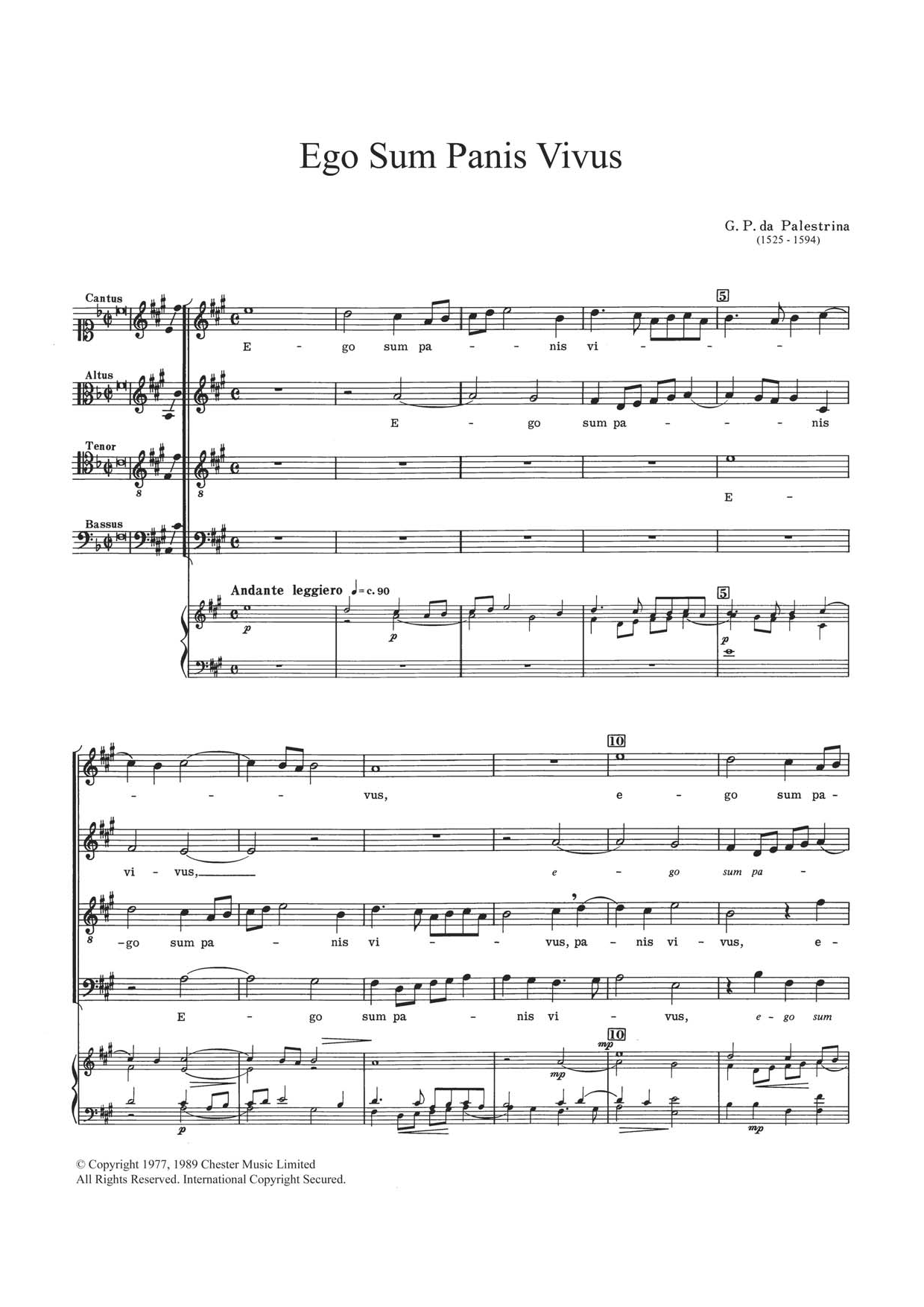
Ego Sum Panis Vivus: Choral Octavo

As performed by Giovanni Palestrina

Item: 35-DS00338096

Digital Download
$2.99
Description

Ego Sum Panis Vivus: Choral Octavo isn't in MakeMusic Cloud just yet...but it could be. Let us know you'd like to see it, and you'll help shape what comes next. In the meantime, start a free trial and dive into thousands of interactive titles your students can play along with today.

Sample Audio
No sample audio found.
Sample Video
Additional Details
Publisher: Hal Leonard
Page Count: 4
SKU: 35-DS00338096

More about this title

About the Artist: Giovanni Palestrina

Giovanni Palestrina (c. 1525–1594) stands as one of the Renaissance's most consequential composers, known for sacred works of crystalline clarity and spiritual depth. His mastery of polyphonic writing established a model for church music that influenced composers for centuries; his style became the benchmark against which all subsequent sacred choral writing was measured. Palestrina's ability to balance expressive text setting with rigorous counterpoint made him indispensable to music educators seeking exemplars of the craft.

Why we love this

Palestrina's gift for seamless voice leading creates a piece that sounds effortless despite its contrapuntal sophistication. Directors appreciate how cleanly the parts sit for singers while maintaining genuine harmonic interest; this is music that teaches voice independence without sounding academic. The text setting unfolds with such naturalness that ensemble singers grasp musical phrasing simply by following the Latin syllables.

What to expect

The music unfolds with quiet inevitability, each voice entering as if continuing a thought already in motion. There's a meditative quality here, neither solemn nor decorative, but deeply centered. Sing this and you feel the architecture of Renaissance polyphony, where every note belongs and nothing is wasted.

Who it's for

This octavo serves intermediate to advanced choral ensembles seeking a cornerstone repertoire work from the Renaissance. It works equally well for secular choirs building a strong classical foundation and church choirs exploring pre-Baroque sacred traditions. The four-page length makes it accessible without oversimplifying the musical substance.

How to get the most out of it

  • Shape each phrase as a continuous arc rather than stopping at bar lines; the linguistic rhythm of Latin carries the musical momentum forward.
  • Balance the parts carefully so the top line leads without drowning inner voices. Palestrina's contrapuntal texture collapses if any section disappears.
  • Allow the harmonic rhythm to breathe slightly at major cadences; this gives the choir a moment to reset and sharpens the arrival into the next section.
  • Approach the text with clarity and warmth. Underlay the Latin precisely so singers can hear the words supporting the melodic gestures.

How to use it

Pair this with other Renaissance sacred works to create a historically informed concert segment that demonstrates Palestrina's influence on his contemporaries and successors. It also serves as an excellent teaching piece midway through the season when singers have developed sufficient control to handle multiple independent lines. Consider programming it before or after a more complex contemporary work to highlight how modern composers still grapple with the voice-leading principles Palestrina perfected.

Skills your students will build

  • Independent voice leading and sustained attention to one's own line within a polyphonic texture
  • Latin text underlay and pronunciation in a liturgical context
  • Recognition of cadence types and harmonic function in Renaissance tonality
  • Phrasing and breathing in the absence of bar-line-driven momentum
  • Balance and blend across four or more simultaneous melodic lines

You May Also Like