
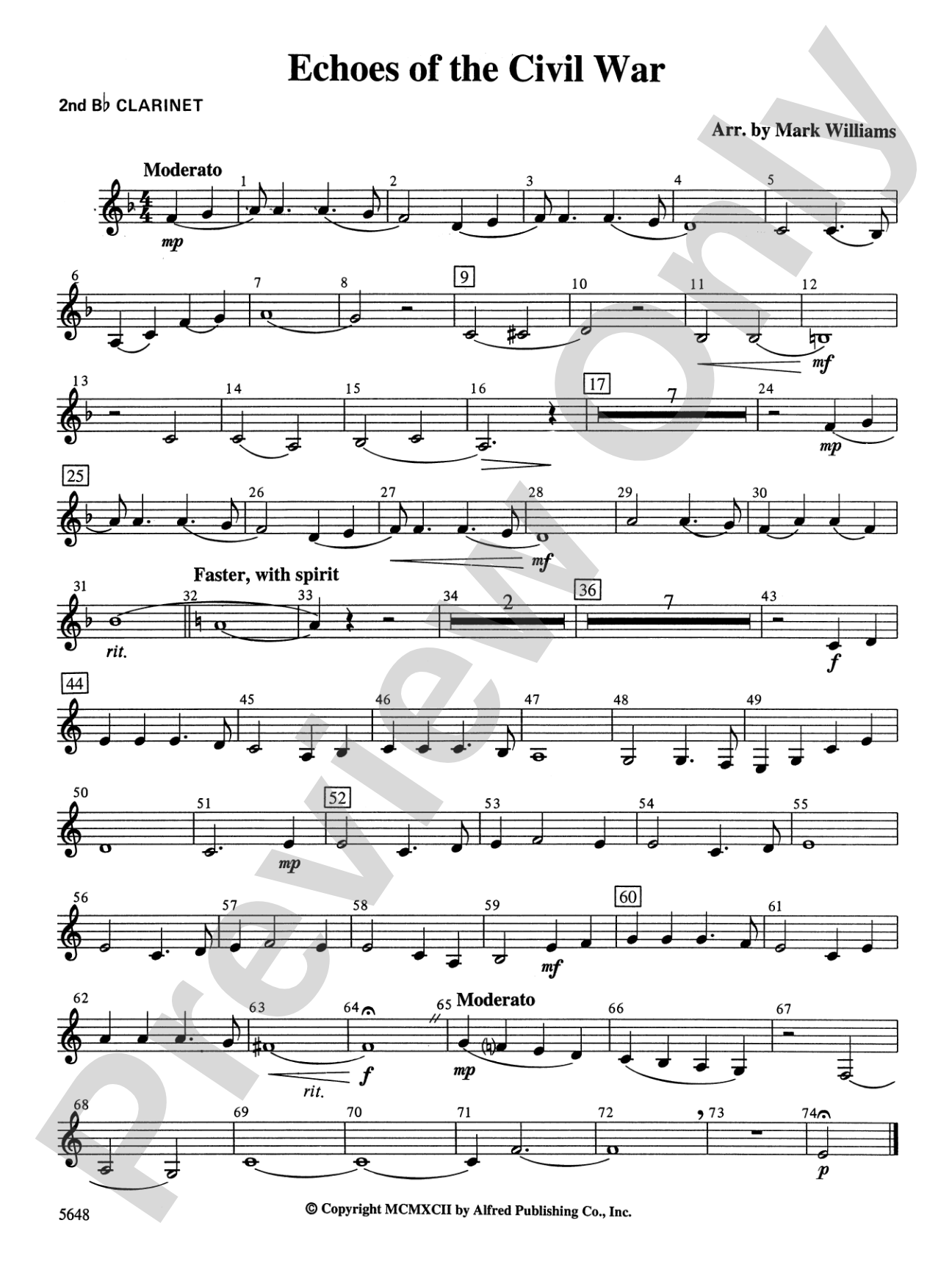

Echoes of the Civil War: 2nd B-flat Clarinet
By Mark Williams
Grade: 1.5 (Easy)
Item: 00-PC-0014637_C2
$3.00
Pickup currently not available
Description
This nostalgic arrangement of Civil War tunes begins with a peaceful woodwind statement of the 'Battle Cry of Freedom.' A trumpet and drum fanfare brings contrast and heralds the arrival of an upbeat section where 'Dixie,' played by the woodwinds, is superimposed over the opening tune in the brass. A stirring piece, filled with bittersweet pride and respect for an important period in American history. (Grade 1 1/2---Easy)


Don't just read it, hear it, play along with it, and watch your students grow with it. In MakeMusic Cloud, Echoes of the Civil War: 2nd B-flat Clarinet comes alive with professional accompaniment, adjustable tempo, and built-in practice tools that turn solo practice into real progress.
Open in the Player
Jump straight in and assign it today.
Start Your Free Trial
Open this title and explore the full library in minutes.
Sample Audio
1
Audio File
--:--
0:00
0:00
Sample Video
No sample videos found.
Additional Details
Series:
Challenger Band Series
Publisher:
Alfred Music
Page Count:
118
SKU:
00-PC-0014637_C2
More about this title
About the Composer: Mark Williams

Mark Williams built a prolific career as a composer and educator with deep roots in American band music. His output included more than 200 works for band, orchestra, and choir, and he co-authored the influential Accent on Achievement Band Method. Williams spent years teaching music in Washington State, focusing particularly on elementary band programs, while simultaneously serving as a clinician and guest conductor across 34 states, five Canadian provinces, and Australia.
Beyond the page, Williams was an active musician and leader. He performed professionally on bassoon and arranged music for the 560th Air Force Band, bringing his instrumental expertise directly into his compositional voice. His contributions to music education earned recognition from the Western International Band Clinic's Gralia Competition and multiple ASCAP Special Awards. He also served as Conductor and Artistic Director for the Spokane British Brass Band, grounding his compositional philosophy in the practical demands of community and school ensembles.
Why we love this
Williams captures authentic Civil War source material without sacrificing accessibility or musical sophistication. The layering of 'Battle Cry of Freedom' and 'Dixie' creates genuine dramatic texture at an easy level, giving young ensembles a real compositional concept to hear and execute rather than just playing familiar tunes in sequence. For a Grade 1.5 band, this piece offers contest appeal with genuine emotional weight.
What to expect
The piece breathes with genuine restraint at first, letting the woodwind melody settle like a memory. Then it opens up: the brass punctuates with purpose, woodwinds dance over the foundation, and the arrangement swells with honest sentiment. There's nostalgia here, but grounded nostalgia, shaped by respect for the period's complexity.
Who it's for
Young concert bands at the easy level who are ready to engage with American musical history and learn how composers layer melodies for effect. This works well for ensembles preparing for festivals or seeking repertoire that connects music to social studies curriculum.
How to get the most out of it
- Balance the opening woodwind statement of 'Battle Cry of Freedom' with restraint; this peace establishes the emotional baseline that makes the contrasting fanfare land harder.
- Shape the trumpet and drum fanfare as a distinct event, not an afterthought. Clear articulation and rhythmic precision here signal the structural turn.
- When the melodies overlap in the later section, ensure the 'Dixie' woodwind line projects clearly over the brass foundation without drowning the supporting material underneath.
How to use it
Program this alongside other American historical works for a concert centered on national identity and music, or place it in a patriotic or autumn concert where its bittersweet tone fits naturally. It also works as a strong festival entry that demonstrates ensemble control across multiple musical characters.
Skills your students will build
- Balancing multiple melodic lines in the same range
- Playing with dynamic restraint in lyrical passages before building to contrasting sections
- Hearing and executing layered textures (counterpoint at the Grade 1.5 level)
- Responding to structural landmarks: fanfare as dramatic pivot point
- Sustaining musical phrasing across period-appropriate melodies