
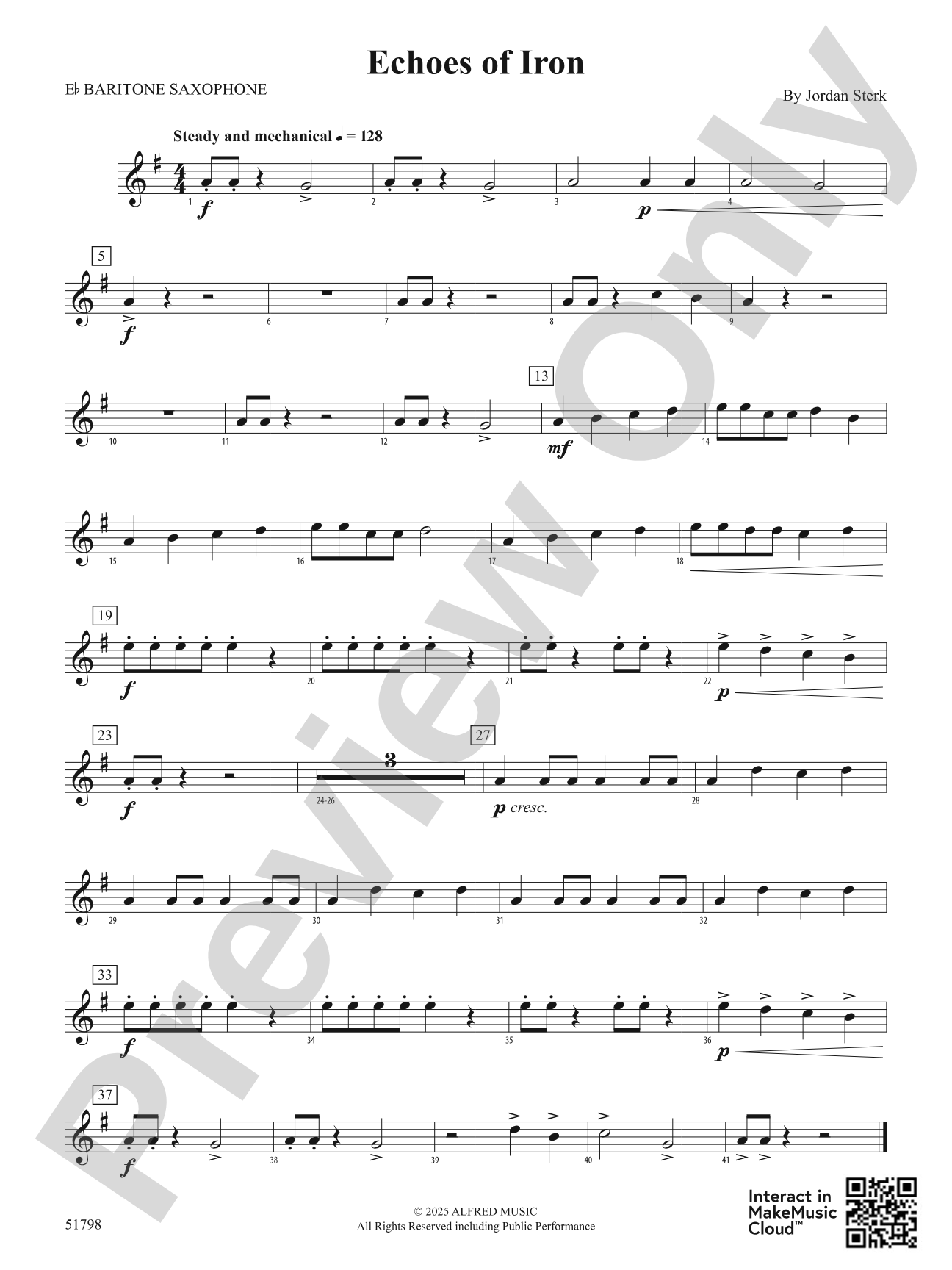

Echoes of Iron: E-flat Baritone Saxophone
By Jordan Sterk
Level:.5
Item: 00-PC-0019412_BTX
$3.00
Pickup currently not available
Description
Echoes of Iron, by Jordan Sterk, utilizes the first six notes of the B-flat concert scale for all instruments, plus a seventh note for the saxophones and French horn. Students will love the bold and powerful nature as well as the industrial sounds of the piece. Echoes of Iron is an excellent vehicle to teach and reinforce eighth-note rhythms, dynamics, and articulation. There are plentiful opportunities to create dynamic contrast, and each section of the band gets a chance to shine through with melody, including the percussion section with a brief soli. Perfect for one of your students' first concerts! (1:20)


Don't just read it, hear it, play along with it, and watch your students grow with it. In MakeMusic Cloud, Echoes of Iron: E-flat Baritone Saxophone comes alive with professional accompaniment, adjustable tempo, and built-in practice tools that turn solo practice into real progress.
Open in the Player
Jump straight in and assign it today.
Start Your Free Trial
Open this title and explore the full library in minutes.
Sample Audio
1
Audio File
--:--
0:00
0:00
Sample Video
Additional Details
Series:
Developing Band
Publisher:
Alfred Music
SKU:
00-PC-0019412_BTX
More about this title
About the Composer: Jordan Sterk

Jordan Sterk earned his Bachelor of Music Education from Michigan State University, where he studied tuba and euphonium with Philip Sinder and composition with John T. Madden. His training in both performance and composition informs his approach to writing accessible music for developing musicians.
Sterk teaches band at all levels in Owosso, Michigan, and channels his classroom experience directly into his compositional work. Beyond composing, he arranges music and writes drill, bringing a practical understanding of what works in the rehearsal room.
Why we love this
Sterk designed this piece with an unflinching understanding of what beginning band students need: limited note vocabulary, but maximum impact. The industrial character gives students permission to play with power and attitude, and the orchestration ensures every section gets a moment of melodic ownership. You'll spend rehearsal time on musicianship, not on decoding new notes.
What to expect
Echoes of Iron sounds like the musical equivalent of a well-oiled machine. Bold unison statements anchor the piece, while industrial textures and sparse orchestration create an energetic, modern character that feels contemporary without being precious. The brief percussion feature adds a sense of spectacle and gives the back of the band their moment on stage.
Who it's for
This work is ideal for beginning and early intermediate concert bands encountering their first public performance. The limited pitch set removes technical barriers, allowing students to focus on rhythmic accuracy, dynamic control, and articulation as primary learning objectives.
How to get the most out of it
- Emphasize the contrast between thick, resonant unison passages and lighter sectional scoring. The piece gains its industrial sound partly from sudden drops in texture, so make those moments deliberate.
- Shape eighth-note passages with clear articulation. Since the piece relies on rhythm as a primary voice-leading tool, consistent tonguing across sections creates clarity and forward motion.
- Balance dynamics with section awareness. The brief percussion soli needs to cut through without overwhelming, so adjust woodwind and brass levels during those moments in rehearsal.
- Use the bold opening as a teaching moment for ensemble sound and synchronization. Unison or near-unison writing demands attention to breath placement and attack that benefits your whole band.
How to use it
This works beautifully as an opening or closing piece on an early-season concert, signaling to audiences that even beginning musicians can make a powerful musical statement. Its 1:20 runtime fits naturally into mixed programs alongside longer or more lyrical works, providing welcome rhythmic and textural variety.
Skills your students will build
- Eighth-note rhythms in 4/4 meter
- Dynamic contrast and controlled expression
- Clear articulation across wind and percussion sections
- Unison playing and rhythmic synchronization
- Sectional balance and listening within ensemble