Echoes of Egypt Sheet Music Preview

Echoes of Egypt: Piano

By Kevin Olson

Item: 98-DW9324

Digital Download
$2.50
Description
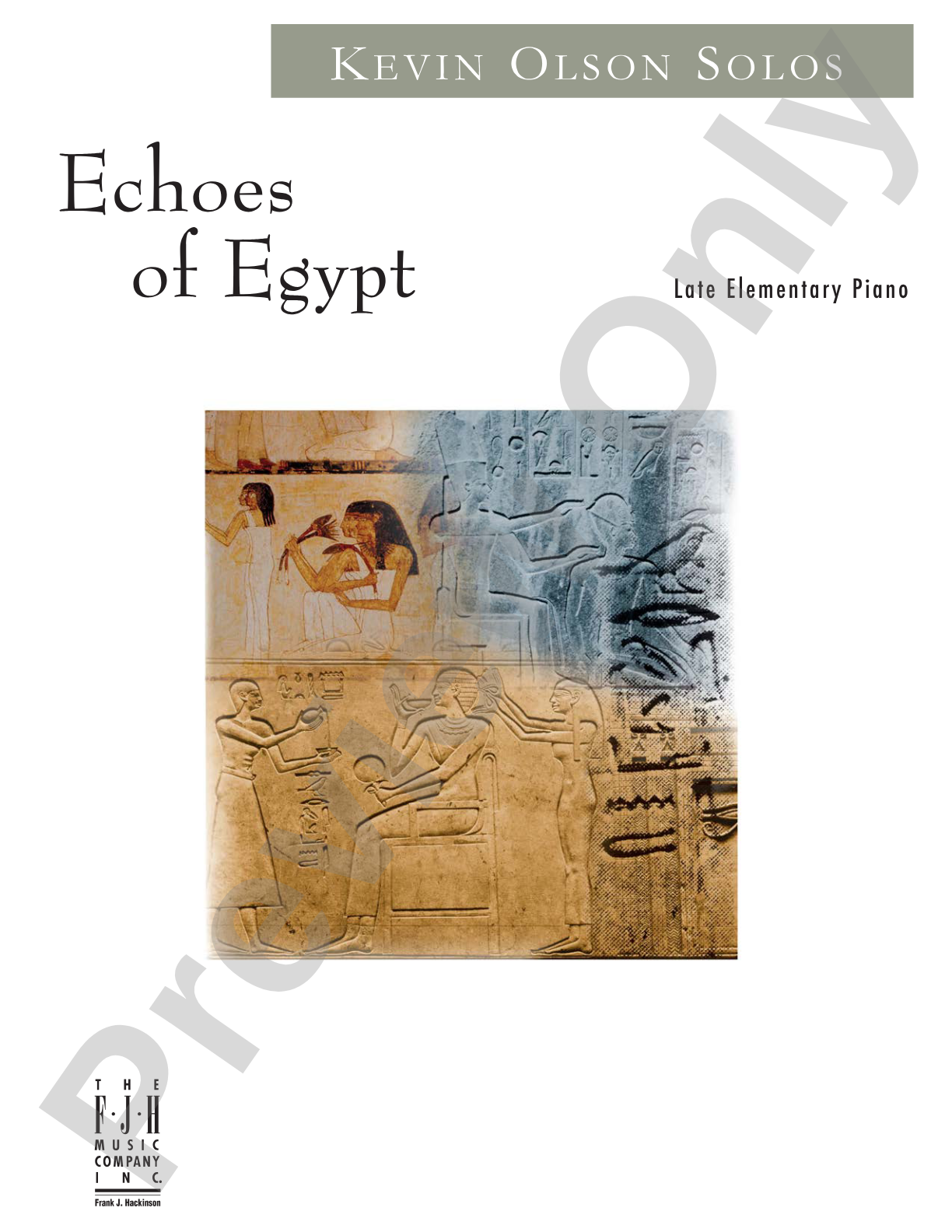
This mysterious Egyptian-sounding piece is written for the late elementary level student. The A section contains a haunting single note melody while the B section has an interesting change in mood using a LH melody with RH triads moving downward step wise in a rhythmic fashion. The A section then returns to end the piece.

Echoes of Egypt: Piano isn't in MakeMusic Cloud just yet...but it could be. Let us know you'd like to see it, and you'll help shape what comes next. In the meantime, start a free trial and dive into thousands of interactive titles your students can play along with today.

Sample Audio
No sample audio found.
Sample Video
Additional Details
Series: Written For You
Publisher: The FJH Music Company, Inc.
SKU: 98-DW9324

More about this title

Why we love this

Olson crafts a piece that genuinely captures the appeal of world music exploration without requiring students to stretch beyond their technical reach. The shift from sparse, haunting melody to rhythmic textural interplay gives late elementary pianists a real compositional idea to study and perform, making this more than just a novelty piece.

What to expect

Sparse and hypnotic in the A section, this piece evokes the isolation of desert landscapes through its single-note melody floating above silence. The B section awakens with rhythmic energy and harmonic color, creating genuine musical contrast that rewards careful listening.

Who it's for

Late elementary pianists ready to explore mood and texture beyond simple melodic lines will connect with this piece. It works well for students who respond to character and storytelling in music and want to develop independence between their hands without navigating complex rhythmic figures.

How to get the most out of it

  • Shape the A section's single-note melody with dynamic nuance and rubato rather than playing it straight. A touch of freedom in phrasing will deepen the mysterious quality.
  • Balance the left hand melody in the B section carefully against the right hand triads so both lines remain audible. The harmonic interest depends on hearing both parts clearly.
  • Practice the stepwise descending triads in the right hand as a unit. Pay attention to consistent rhythm and even voice leading rather than treating them as separate notes.
  • Use the mood shift between sections as a structural anchor. Mark the transition clearly so the return to the A section feels like a genuine return home.

How to use it

Feature this during a recital program exploring world music influences or cultural discovery. It pairs naturally with other pieces that use non-Western scales or compositional ideas, giving students and audiences a window into how composers draw inspiration from different musical traditions.

Skills your students will build

  • Contrasting two distinct musical textures and moods within a single piece
  • Coordinating independent melodic lines between left and right hands
  • Maintaining rhythmic precision in stepwise-moving chord progressions
  • Shaping a sparse melody with expression and phrasing
  • Understanding ABA form through listening and performance

You May Also Like