

Echo: 2-Part Choral Octavo
Words and music by Sally K. Albrecht
Item: 00-PO-0005560
$2.05
Minimum order quantity: 20 copies
Pickup currently not available
Description
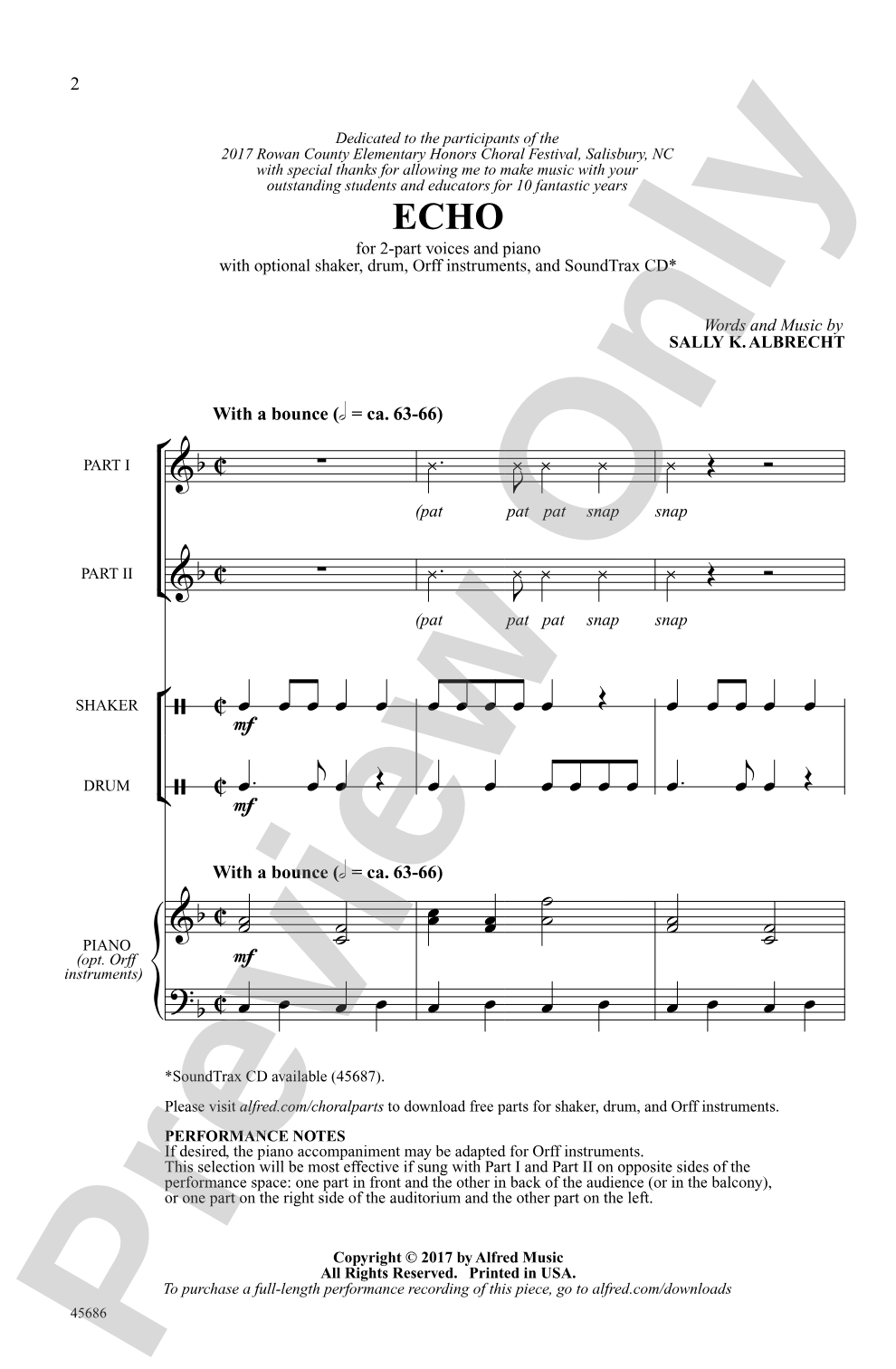
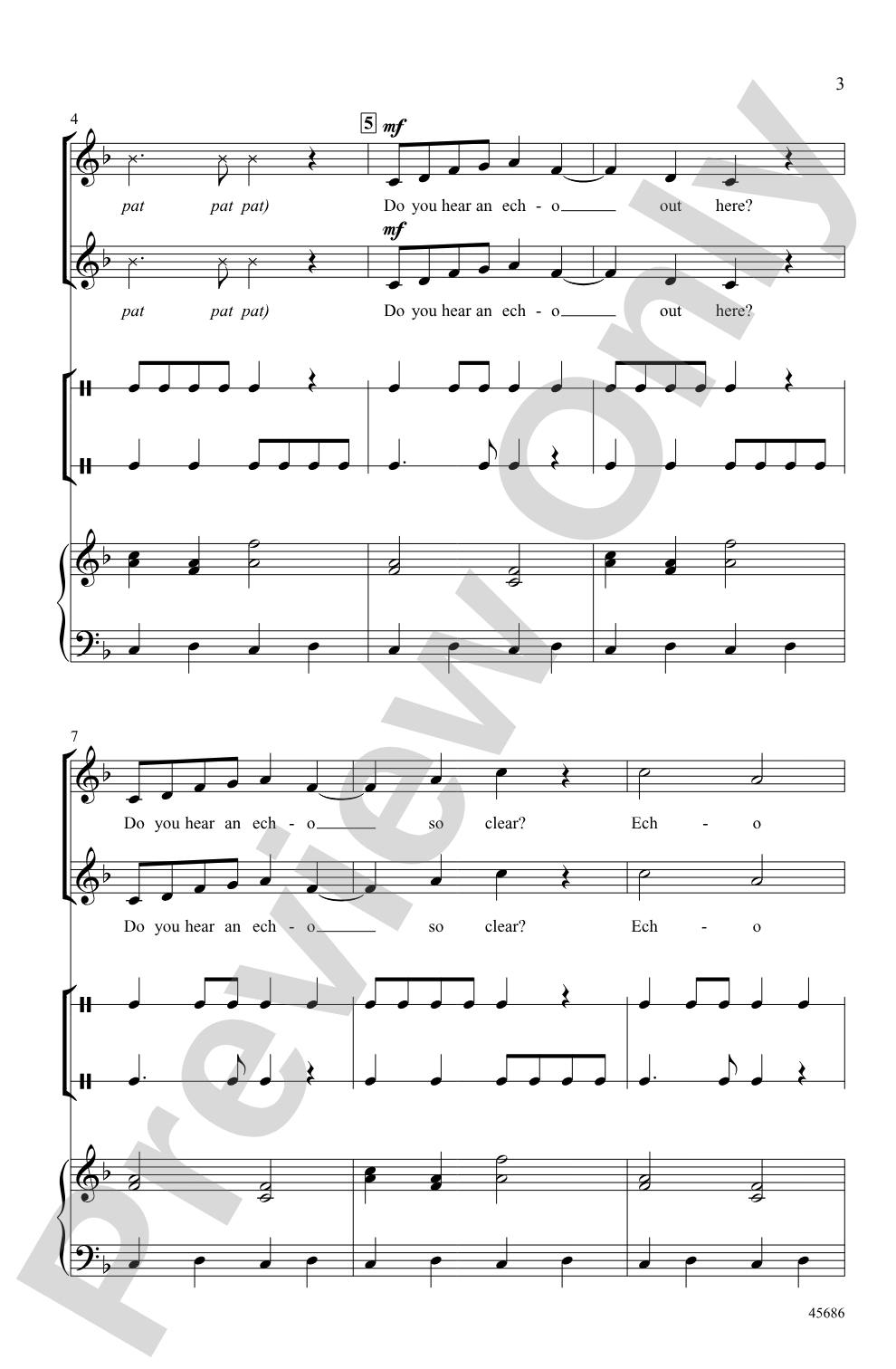
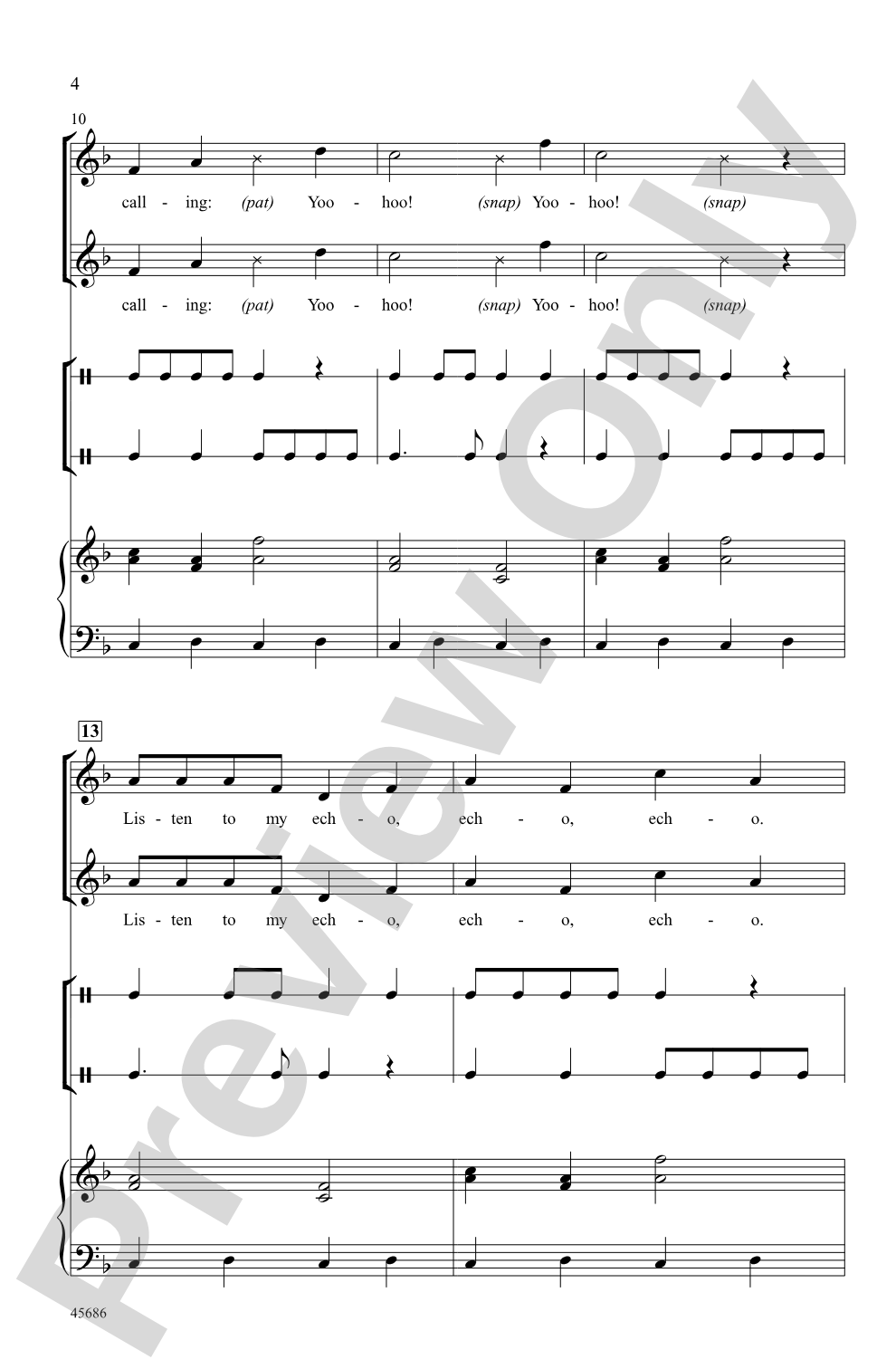
Attention Orff educators! A pentatonic melody is sung in unison then echoed from part to part. Simple body percussion further engages students and ensures a kinesthetic rhythm experience. The ostinato accompaniment can be played on a piano or easily adapted for barred instruments. Optional shaker and drum add even more layers.


Echo: 2-Part Choral Octavo isn't in MakeMusic Cloud just yet...but it could be. Let us know you'd like to see it, and you'll help shape what comes next. In the meantime, start a free trial and dive into thousands of interactive titles your students can play along with today.
Request This Title
Tell us you want it.
Start Your Free Trial
Explore everything that's ready to play right now.
Sample Audio
1
Audio File
--:--
0:00
0:00
Sample Video
Additional Details
Series:
Alfred Choral Designs
Publisher:
Alfred Music
Page Count:
12
SKU:
00-PO-0005560
More about this title
About the Composer: Sally K. Albrecht

Sally K. Albrecht has shaped American choral music for over three decades as a composer, conductor, and clinician with particular expertise in movement-integrated choral work. A consistent ASCAP award recipient since 1987, she has published more than 600 choral works and 75 full-length musicals and songbooks. She has led honor choirs at prestigious venues including Lincoln Center, Carnegie Hall, and The Kennedy Center, and served as Director of School Choral, Vocal, and Elementary Publications at major educational publishers, most recently Alfred Music.
Albrecht holds degrees from Rollins College (B.A. in Music and Theater, 1976), the University of Miami (M.A. in Drama, 1977; M.M. in Accompanying, 1979), and has taught at Oakland University, Jersey City State College, and Meredith College. She is a Distinguished Alumna of both the University of Miami Frost School of Music and Rollins College, where she serves on the Board of Trustees. A recipient of the Omicron Delta Kappa National Leadership Honor Society's "Pillar of Leadership" award, she lives in Wake Forest, North Carolina with composer and arranger Jay Althouse.
Why we love this
Albrecht delivers what middle school and upper elementary choirs actually need: a piece that teaches call-and-response singing while keeping every student physically and musically engaged. The pentatonic framework removes harmonic complexity, the body percussion creates immediate success, and the optional instrumental layers let you scale the piece up or down depending on your ensemble's resources and experience level.
What to expect
Fresh and interactive. The pentatonic melody floats naturally over a steady ostinato, creating a meditative quality that deepens when the two parts echo back and forth. Body percussion transforms the piece from something you listen to into something you inhabit, making the rhythm physical and memorable.
Who it's for
This piece belongs in upper elementary and middle school choirs seeking an accessible, kinesthetically engaging introduction to part singing. It works equally well in general music classes where movement and rhythm instruments are central to learning, and it requires no prior experience with harmony or complex meters.
How to get the most out of it
- Establish the body percussion patterns before adding the melody so singers have a kinesthetic anchor for the pulse.
- Keep the echo responses clean by having Part 1 hold silence during Part 2's entrance; this prevents muddying and lets the call-and-response dialogue shine.
- Use the recorded accompaniment to lock in your tempo and ostinato consistency during early rehearsals, then transition to live piano or barred instruments once the piece is secure.
- Layer the optional shaker and drum parts gradually during later rehearsals to maintain focus on vocal accuracy in the 2-part writing.
How to use it
Program this as a gateway piece into 2-part singing at a winter or spring concert, or as a centerpiece for an assembly that celebrates kinesthetic learning. It also serves as excellent material for a general music unit on call-and-response traditions across cultures, where the accompaniment options let you explore different instrumental timbres.
Skills your students will build
- Singing pentatonic melodies with secure intonation
- Responding to call-and-response patterns with accuracy and ensemble awareness
- Maintaining body percussion patterns while singing
- Reading 2-part choral notation
- Understanding ostinato accompaniment and how accompaniment supports melody
- Adapting instrumental parts between piano and barred instruments