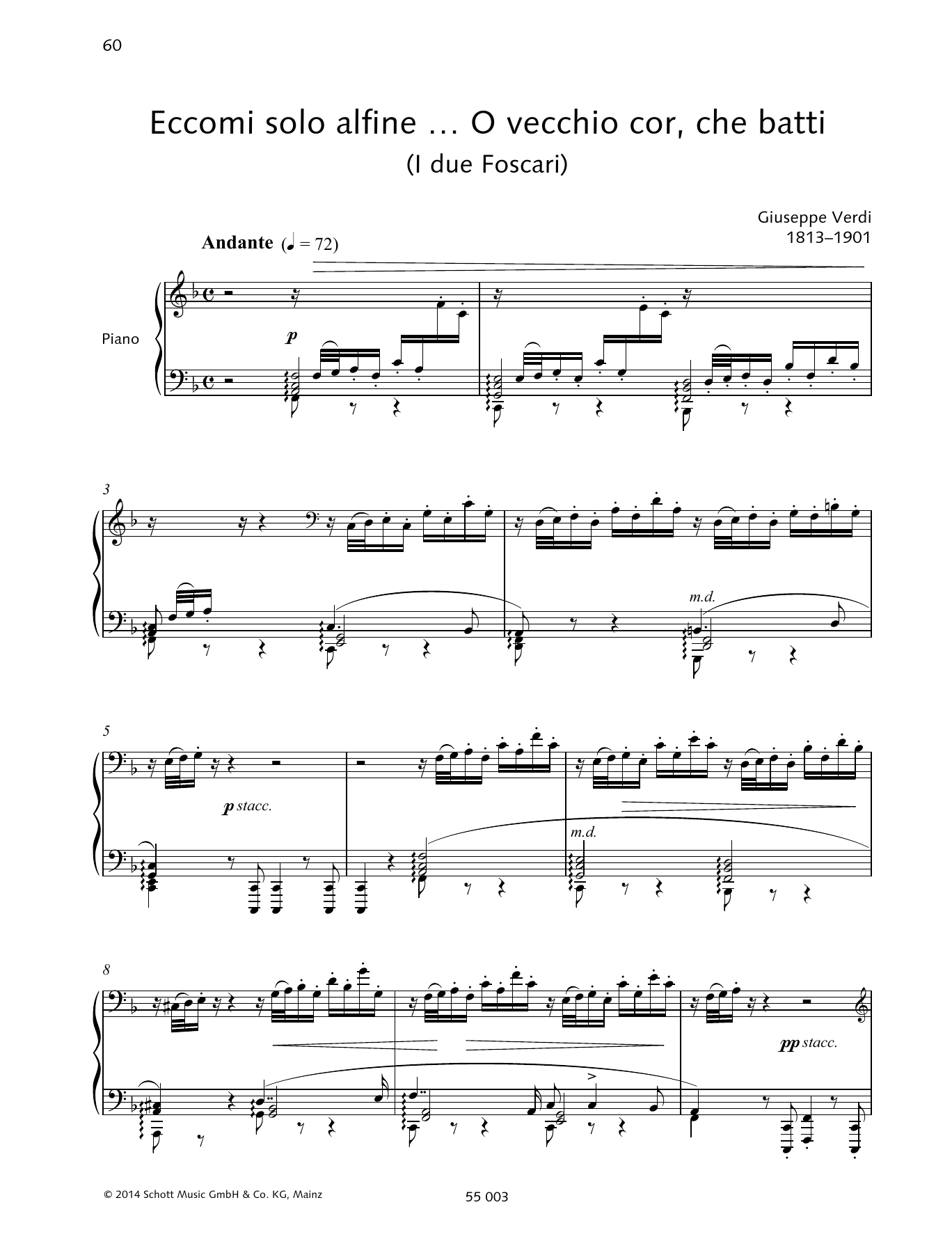
Eccomi solo alfine ... O vecchio cor, che batti Sheet Music Preview

Eccomi solo alfine... O vecchio cor, che batti: Piano Vocal

By Giuseppe Verdi / Arranged by Francesca Licciarda

Item: 35-DS00369839

Digital Download
$4.99
Description

Eccomi solo alfine... O vecchio cor, che batti: Piano Vocal isn't in MakeMusic Cloud just yet...but it could be. Let us know you'd like to see it, and you'll help shape what comes next. In the meantime, start a free trial and dive into thousands of interactive titles your students can play along with today.

Sample Audio
No sample audio found.
Sample Video
Additional Details
Publisher: Hal Leonard
Page Count: 5
SKU: 35-DS00369839

More about this title

About the Composer: Giuseppe Verdi

Giuseppe Verdi (1813-1901) fundamentally transformed Italian opera by deepening the emotional and psychological dimensions of his characters. Working across more than five decades, he refined his craft from the explosive early successes of Rigoletto and La traviata toward the nuanced storytelling of Otello and Falstaff, earning him recognition as one of the most influential composers in the Western canon.

For music educators, Verdi's output offers an unmatched resource for teaching dramatic character development through song. His vocal writing balances accessibility with sophistication; singers at various levels can find repertoire suited to their range and experience, while the harmonic language and orchestral textures reward detailed study. Understanding Verdi's approach to text-setting and emotional architecture remains essential to any comprehensive vocal pedagogy.

Why we love this

This recitative-aria pairing captures Verdi at his most introspective, offering singers a moment of genuine psychological complexity rather than surface virtuosity. The journey from hesitation to resolve reads beautifully on stage, and Licciarda's piano reduction preserves the vocal line's integrity while keeping accompaniment manageable for rehearsal and performance settings.

What to expect

A moment of private reckoning. The recitative strips away artifice to reveal a character confronting their own aging and isolation, then the aria finds unexpected dignity in that solitude. Verdi's harmonic language here is lean and direct, asking the singer to do emotional work without melodic excess.

Who it's for

Advanced vocalists working on Verdi operatic repertoire, whether for competition, audition, or concert performance. This excerpt suits singers with solid legit voices and the interpretive maturity to navigate its introspective character.

How to get the most out of it

  • Shape the recitative's rhythmic flexibility carefully; resist the urge to rush through the parlando sections, as each phrase builds toward the aria's emotional core
  • Let the orchestra color guide your dynamic choices in the aria proper. The accompaniment pattern in the piano part reveals where Verdi wants harmonic tension to peak
  • Consider where the character has arrived emotionally by the final cadence. Verdi's ending is understated; honor that restraint rather than pushing toward artificial grandeur

How to use it

Feature this in a recital exploring Verdi beyond the famous arias, pairing it with other character-driven excerpts from his mature operas. It works particularly well in programs devoted to aging, mortality, or introspection in art song and opera.

Skills your students will build

  • Stylistically informed recitative delivery with proper phrase breathing and dramatic pacing
  • Legit soprano singing with controlled passaggio transitions
  • Interpreting Verdi's harmonic language and its relationship to text expression
  • Character development across contrasting sections (recitative to lyric aria)
  • Coordinate vocal line with accompanimental patterns in reductive scores

You May Also Like