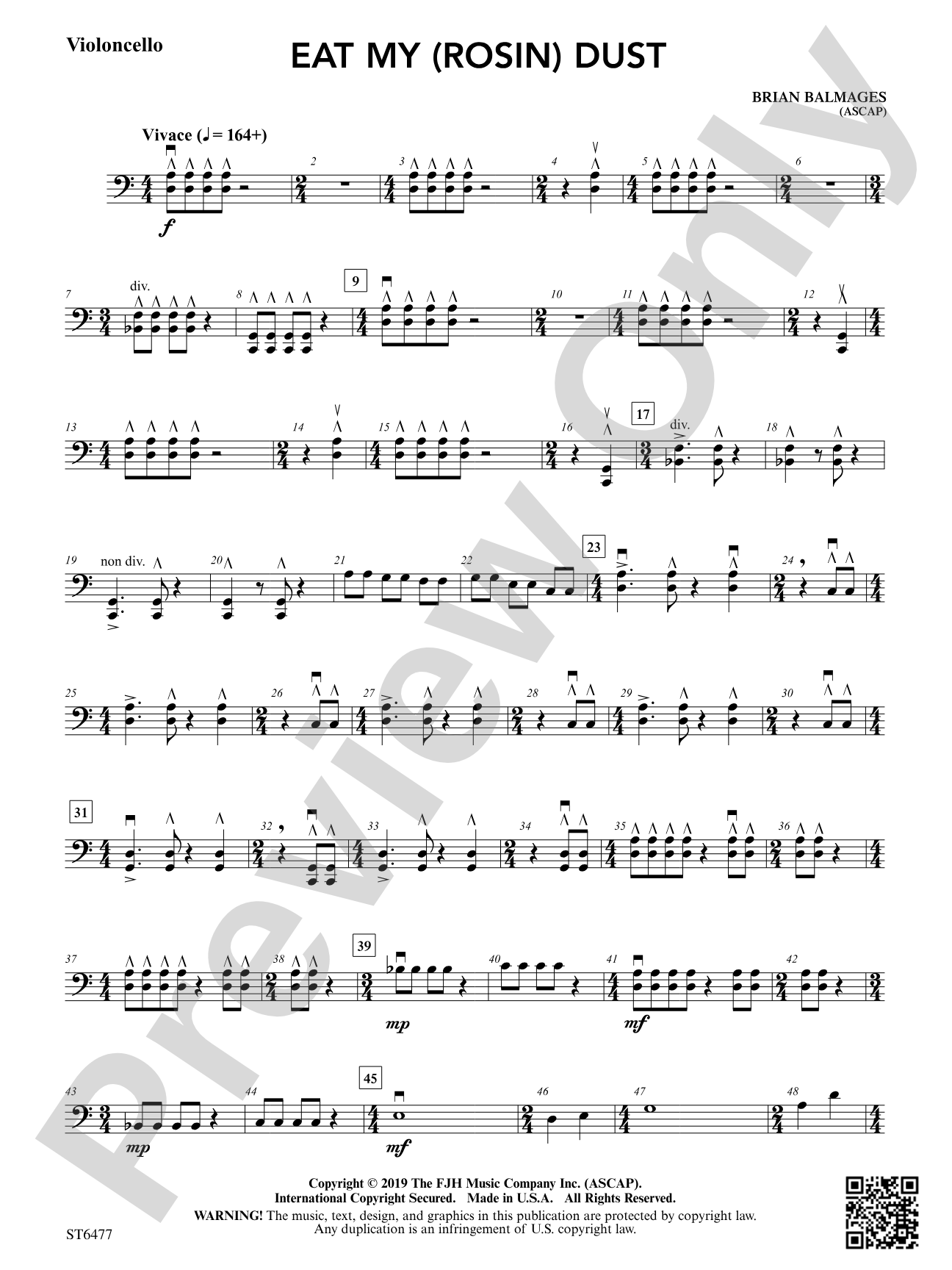
East My (Rosin) Dust: Violoncello Sheet Music Preview

East My (Rosin) Dust: Violoncello

By Brian Balmages

Grade: 2.5;3

Item: 98-PC-DST6477_VC1

Digital Download
$7.00
Description
This spirited, high energy work encompasses all the attitude expressed in its title! The orchestra's true personality shines as it moves between technical off-the-string passages and soaring melodies. Combine that with syncopated rhythmic ideas and one can see why the title is so fitting. As playful as the title is, this certainly is not a novelty piece - it is a technical, yet extremely playable showcase for your orchestra.

East My (Rosin) Dust: Violoncello isn't in MakeMusic Cloud just yet...but it could be. Let us know you'd like to see it, and you'll help shape what comes next. In the meantime, start a free trial and dive into thousands of interactive titles your students can play along with today.

Sample Audio
0:00
0:00
Sample Video
Additional Details
Series: FJH Developing Strings
Publisher: The FJH Music Company, Inc.
SKU: 98-PC-DST6477_VC1

More about this title

About the Composer: Brian Balmages

Brian Balmages

Brian Balmages has built a career as both composer and conductor across orchestral, band, and chamber music genres. His works have been commissioned and performed globally—from Carnegie Hall and the Kennedy Center to the Sydney Opera House—by ensembles ranging from professional orchestras to school groups. He holds the A. Austin Harding Award from the American School Band Directors Association, won the 2020 NBA William D. Revelli Composition Contest, and was elected to the American Bandmasters Association.

Balmages currently serves as Director of MakeMusic Publications and Digital Education for Alfred and MakeMusic. His guest conducting has taken him to the Midwest Clinic, Western International Band Clinic, College Band Directors Conference, and numerous international venues. He holds degrees from James Madison University (where he received the inaugural Distinguished Alumni Award from the School of Visual and Performing Arts) and the University of Miami, which commissioned him to compose for the presidential inauguration.

Why we love this

Balmages nails the balance between entertainment and legitimate technique here. Your students get to feel the swagger and attitude that comes from mastery—the syncopated rhythms and off-the-string passages demand real skill, but the piece stays joyful and accessible at Grade 2.5/3, making it rewarding for both conductor and ensemble.

What to expect

Buoyant and cocky in the best way. The orchestra swaggers through technical off-the-string passages, then opens up into soaring lines that prove there's real musicianship behind all that swagger. It's playful throughout, but never lightweight.

Who it's for

String orchestra directors seeking a Grade 2.5/3 piece that combines technical growth with genuine musicality and fun. This works for groups that have solid fundamentals and are ready for syncopation, varied articulations, and textural variety without stepping into advanced territory.

How to get the most out of it

  • Isolate the syncopated figures in separate sectionals early. The rhythmic character drives the energy, so lock those in before full-orchestra rehearsals.
  • Shape the contrast between the technical off-the-string passages and the soaring melodies; this dynamic range is what gives the piece its personality. Don't let the fast passages overshadow the lyrical moments.
  • Take the tempo with confidence. The spirited character demands conviction from the podium; hesitation will flatten the playfulness.

How to use it

Program this as a cornerstone of a winter or spring concert where you want to showcase your orchestra's technical range and personality. It pairs well before or after something more lyrical, using the contrast to highlight both the ensemble's versatility and Balmages's gift for character.

Skills your students will build

  • Syncopated rhythm reading and execution
  • Off-the-string articulation and control
  • Contrast between technical passages and sustained, soaring lines
  • Sectional independence within orchestral texture
  • Ensemble unity across varied rhythmic and dynamic shapes

You May Also Like