
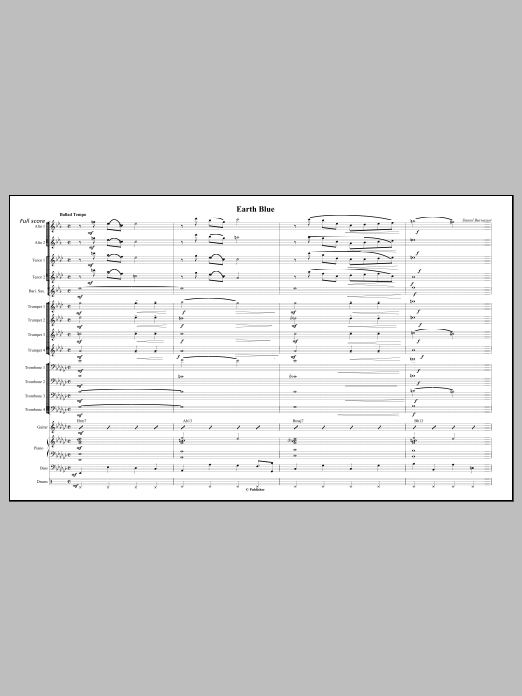

Earth Blue: Jazz Ensemble Conductor Score & Parts
By Daniel Burwasser
Item: 35-PK00288700
$10.40
Pickup currently not available
Buy Extra Parts (Digital PDF Download)
| Product | Price | Quantity |
|---|---|---|
| Earth Blue - Full Score | $3.00 | |
| Earth Blue - Alto Saxophone | $0.30 | |
| Earth Blue - Alto Saxophone | $0.30 | |
| Earth Blue - Tenor Saxophone | $0.30 | |
| Earth Blue - Tenor Saxophone | $0.30 | |
| Earth Blue - Baritone Saxophone | $0.30 | |
| Earth Blue - Trumpet | $0.30 | |
| Earth Blue - Trumpet | $0.30 | |
| Earth Blue - Trumpet | $0.30 | |
| Earth Blue - Trumpet | $0.30 | |
| Earth Blue - Trombone | $0.30 | |
| Earth Blue - Trombone | $0.30 | |
| Earth Blue - Trombone | $0.30 | |
| Earth Blue - Trombone | $0.30 | |
| Earth Blue - Electric Guitar | $0.30 | |
| Earth Blue - Piano | $0.45 | |
| Earth Blue - Contrabass | $0.45 | |
| Earth Blue - Drum Set | $0.30 |
Parts Added to Cart!
Description
Jazz ballad with moderate tempo swing section in the middle for improvised solos. Duration: 06:00


Earth Blue: Jazz Ensemble Conductor Score & Parts isn't in MakeMusic Cloud just yet...but it could be. Let us know you'd like to see it, and you'll help shape what comes next. In the meantime, start a free trial and dive into thousands of interactive titles your students can play along with today.
Request This Title
Tell us you want it.
Start Your Free Trial
Explore everything that's ready to play right now.
Sample Audio
No sample audio found.
Sample Video
No sample videos found.
Additional Details
Publisher:
Hal Leonard
SKU:
35-PK00288700
More about this title
Why we love this
Earth Blue gives you a ballad with real substance and a middle section that invites genuine improvisation. Rather than feeling like a vehicle tacked onto a melody, the swing section grows naturally from the arrangement, and soloists have room to breathe without losing the emotional arc of the piece.
What to expect
Earth Blue opens with the introspection of a late-night standard, then shifts into a medium-tempo swing that feels contemporary and conversational. The whole arc sits somewhere between bittersweet reflection and a moment of easy groove.
Who it's for
Jazz ensembles at the intermediate level and above will find a piece that respects both their developing ears and their desire to play with freedom. Conductors looking for something that teaches arrangement craft alongside solo etiquette will appreciate how cleanly this works.
How to get the most out of it
- Shape the ballad section with dynamic restraint; let the ensemble listen to the soloist rather than filling every space with chord stabs
- Establish the swing groove in rehearsal before the soloists enter; a solid rhythm section makes the difference between comfortable and sloppy
- Prepare written solos or chord changes in advance if your ensemble isn't ready for open improvisation, then gradually release the reins as confidence grows
- Return to the ballad material with intention; make the final section feel like a landing, not an afterthought
How to use it
This works beautifully in a jazz concert or mixed program as a contrasting piece after something uptempo, or as an opener that sets a contemplative tone. It's also sized perfectly as a centerpiece for a shorter concert where you want feature soloists without overwhelming your program.
Skills your students will build
- Leading and accompanying improvisation over jazz changes
- Balancing melodic phrasing in a ballad context
- Reading and executing swing articulation
- Listening and responding as an ensemble to solo voices
- Managing tempo and dynamics across different sections of a single piece