Early Will I Seek Thee Sheet Music Preview

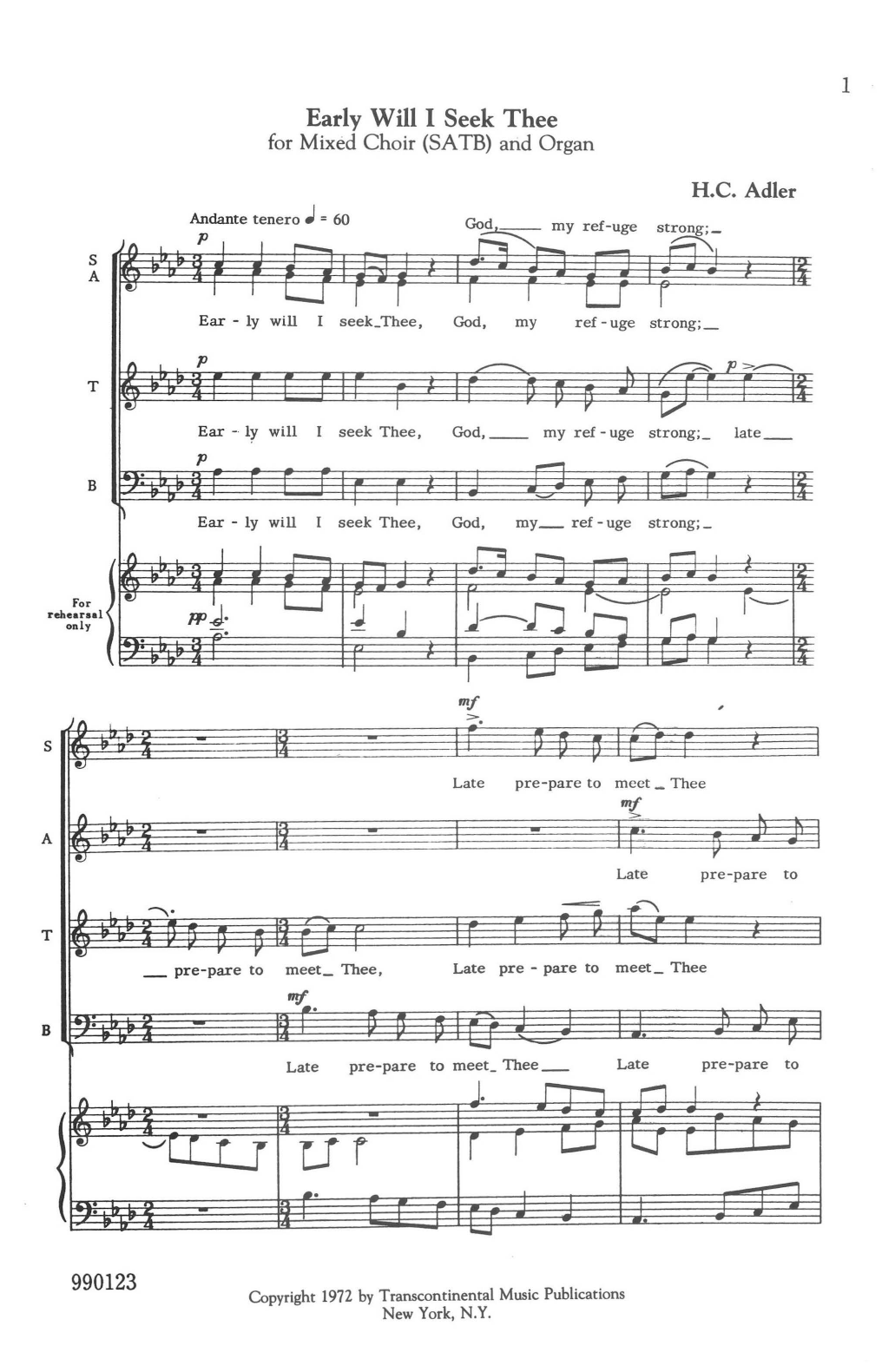
Early Will I Seek Thee: SATB Choral Octavo

By Hugo Adler

Item: 35-DS01478854

Digital Download
$2.99
Description

Early Will I Seek Thee: SATB Choral Octavo isn't in MakeMusic Cloud just yet...but it could be. Let us know you'd like to see it, and you'll help shape what comes next. In the meantime, start a free trial and dive into thousands of interactive titles your students can play along with today.

Sample Audio
No sample audio found.
Sample Video
Additional Details
Publisher: Hal Leonard
Page Count: 7
SKU: 35-DS01478854

More about this title

About the Composer: Hugo Adler

Hugo Adler (1894-1955) was a composer and conductor whose work spanned Jewish liturgical music, art songs, and choral compositions. Born in Austria, he built a career exploring the intersection of traditional Hebrew texts and contemporary compositional techniques, bringing classical sophistication to sacred music.

Adler's output demonstrates a deep commitment to making theological texts sing with both spiritual weight and musical substance. His choral writing balances accessibility for church and synagogue choirs with genuine artistic ambition, making him a valued resource for directors seeking repertoire with both integrity and practical viability.

Why we love this

Adler's setting draws from Jewish liturgical tradition while remaining utterly accessible to secular choirs encountering this text for the first time. The seven-page score unfolds without bombast, allowing the earnest, intimate quality of the words to shape the musical narrative. It's the kind of piece that lands differently every time you sing it.

What to expect

Quiet searching. The piece mirrors the emotional trajectory of its text: beginning in uncertainty and building toward affirmation without ever losing its introspective core. Harmonies warm gradually, and the voices often move as an ensemble rather than individuals, creating a sense of shared purpose.

Who it's for

Any SATB choir looking for liturgical or contemplative repertoire that works in both sacred and secular contexts. This sits comfortably alongside other classical choral works in a mixed concert program and requires standard vocal ranges and reasonable musicianship without virtuosic demands.

How to get the most out of it

  • Treat the opening phrase as a genuine musical question, not a declaration. Keep vowels open and the dynamic restrained to create space for the piece to breathe.
  • Shape phrases across the bar line rather than landing hard on downbeats. The text underlay will guide you if you let it dictate the arc instead of the meter.
  • Balance inner voices with care during moments where multiple lines move simultaneously. Soprano and alto often carry the primary melodic interest, but tenor and bass lines deserve audibility to support the harmonic foundation.
  • Locate the climactic moment in your rehearsal time and build toward it gradually across the full performance. Resist the urge to reach full intensity too early.

How to use it

Pair this with other contemplative works in a concert built around themes of faith, seeking, or spiritual reflection. Its modest length makes it ideal for building a coherent thematic set without requiring a full evening of programming. Consider placing it early enough in a concert that the audience arrives in the right headspace to receive it.

Skills your students will build

  • Singing sustained lines with consistent tone and minimal vibrato
  • Balancing ensemble blend while maintaining individual line clarity
  • Responding to text prosody over strict metrical placement
  • Building long-term dynamic arcs across entire phrases
  • Ensemble breathing and entry precision in a slower tempo context

You May Also Like