Earl of Oxford's March: Baritone B.C. Sheet Music Preview

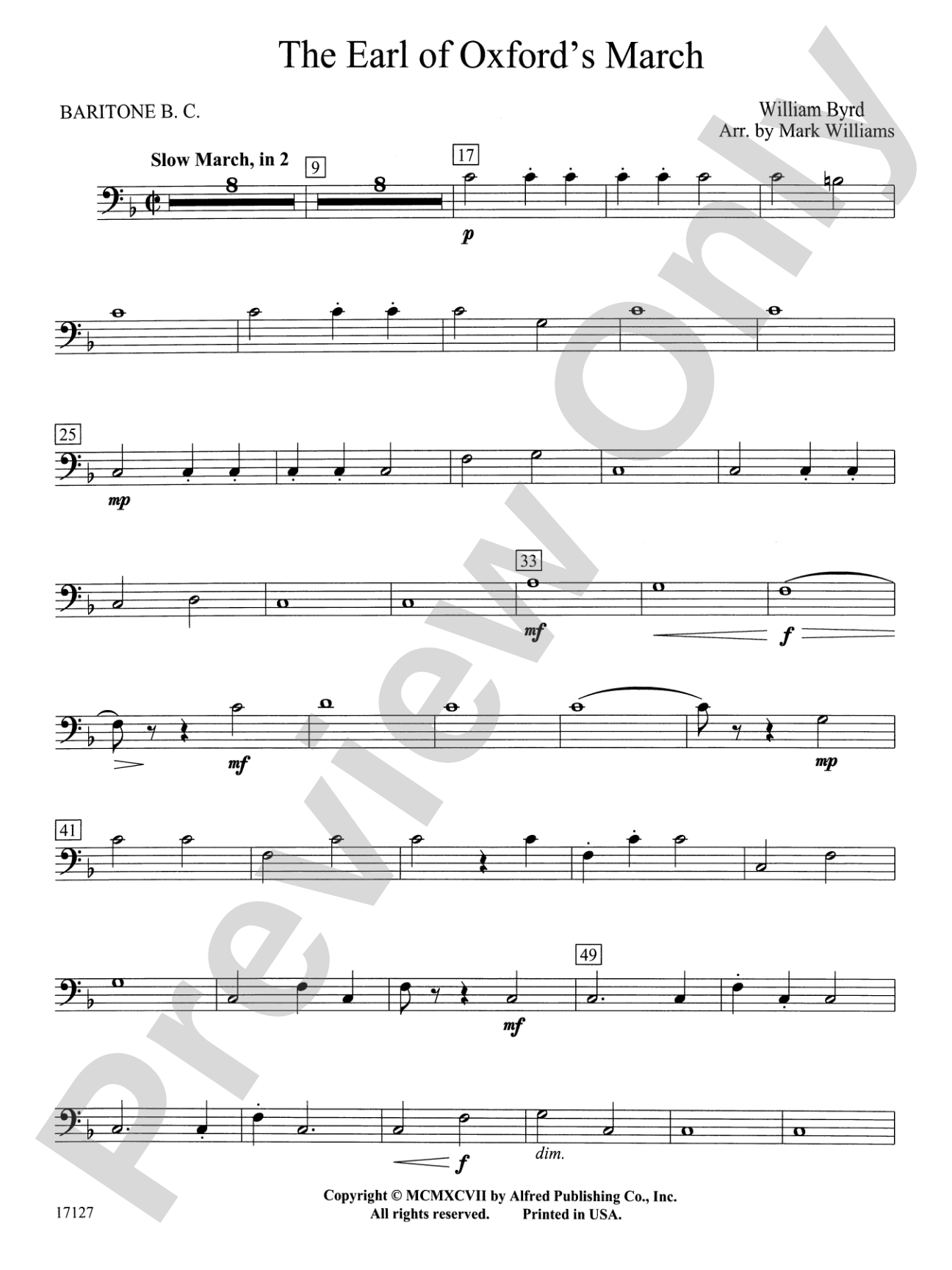
Earl of Oxford's March: Baritone B.C.

By William Byrd / arr. Mark Williams

Grade: 2 (Medium Easy)

Item: 00-PC-0000210_BBC1

Digital Download
$3.00
Description
This selection from the Fitzwilliam Virginal Book has become well-known to band audiences through its inclusion in Gordon Jacob's William Byrd Suite. Going back to the original manuscript, Mark Williams has crafted an outstanding version of this work for younger bands.

Don't just read it, hear it, play along with it, and watch your students grow with it. In MakeMusic Cloud, Earl of Oxford's March: Baritone B.C. comes alive with professional accompaniment, adjustable tempo, and built-in practice tools that turn solo practice into real progress.

Sample Audio
0:00
0:00
Sample Video
Additional Details
Series: Young Symphonic
Publisher: Alfred Music
Page Count: 260
SKU: 00-PC-0000210_BBC1

More about this title

About the Arranger: Mark Williams

Mark Williams

Mark Williams built a prolific career as a composer and arranger for school ensembles, contributing over 200 works across band, orchestra, and choral literature. He co-authored the Accent on Achievement Band Method and spent decades teaching elementary band in Washington state while maintaining active roles as a clinician, guest conductor, and woodwind performer. His expertise earned him invitations to 34 states, multiple Canadian provinces, and Australia, along with recognition through the Western International Band Clinic's Gralia Competition and several ASCAP Special Awards.

Beyond the concert stage, Williams served as woodwind performer and arranger for the 560th Air Force Band and as Conductor and Artistic Director for the Spokane British Brass Band. A bassoonist himself, he held degrees from Eastern Washington University and understood the needs of developing musicians from firsthand experience in the classroom.

Why we love this

Williams returns to the original Fitzwilliam Virginal Book source rather than relying on the Gordon Jacob arrangement that most band directors know, giving your ensemble access to fresh interpretive possibilities. The Grade 2 treatment respects the piece's Renaissance character while remaining accessible to younger players, and its contest/festival designation makes it both a solid concert selection and a competitive option.

What to expect

A stately processional with courtly elegance, rooted in Renaissance counterpoint but arranged to sit comfortably in the modern band sound. The familiar melodic material has dignity without pretension, inviting your ensemble to play with purpose and clarity.

Who it's for

Band directors working with developing ensembles who want substantive repertoire beyond simple march arrangements. This piece suits groups preparing for contests, festivals, or concert programs that benefit from a historically grounded yet accessible selection.

How to get the most out of it

  • Balance the melody across your trumpet and clarinet sections to project the tune without overwhelming the inner voices that provide harmonic support.
  • Shape the phrasing with slight tempo adjustments rather than dramatic ritardandos; Renaissance dances benefit from subtle breathing rather than heavy interpretive gestures.
  • Attend to articulation consistency among like instruments, especially in scalar passages, to maintain the character of a historical march.

How to use it

Program this alongside other early music arrangements or as a concert opener that sets a refined tone before moving to more contemporary works. It works equally well as a festival or contest entry where judges appreciate both historical authenticity and transparent scoring at an intermediate level.

Skills your students will build

  • Sustaining melodic lines with consistent tone across phrase boundaries
  • Balancing harmonic voices in Renaissance-style counterpoint
  • Interpreting phrasing and articulation from historical context
  • Reading from a conductor score while tracking individual part clarity

You May Also Like